Last updated:
Omphalotus olearius
"Jack-o'-lantern mushroom, False chanterelle"
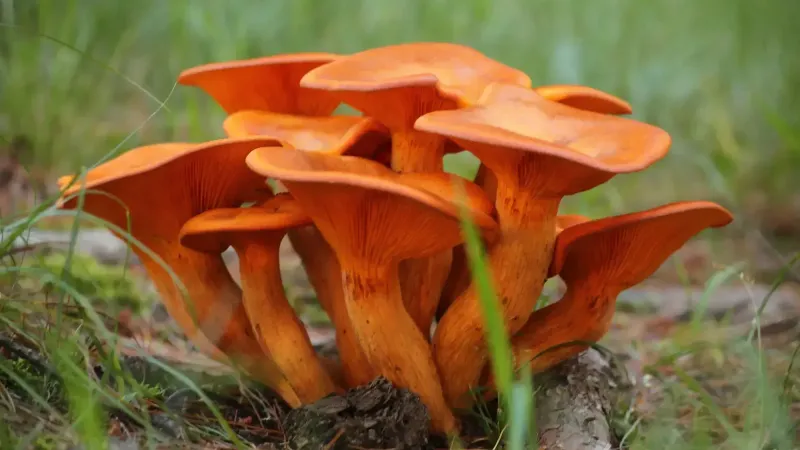
Omphalotus olearius fruiting bodies
Scientific Classification
Kingdom:Fungi
Division:Basidiomycota
Class:Agaricomycetes
Order:Agaricales
Family:Omphalotaceae
Genus:Omphalotus
Frequently Asked Questions
- What is Jack-o'-lantern mushroom?
- Jack-o'-lantern mushroom (Omphalotus olearius) is a mushroom species, belonging to the Omphalotaceae family. It is studied for its biological characteristics and is documented in the ShroomSpy mycology database.
- Is Jack-o'-lantern mushroom edible?
- Poisonous — do not eat. The jack-o'-lantern is not deadly, but it is a violent gastrointestinal irritant. Ingestion causes severe nausea, vomiting, abdominal cramping, diarrhea, and sweating, typically beginning within 15 minutes to a few hours and lasting up to about 24 hours; severe cases may require supportive hospital care. It is one of the most common causes of mushroom poisoning because it is mistaken for edible chanterelles — unlike chanterelles (which grow singly with blunt, forked, ridge-like false gills), the jack-o'-lantern grows in dense clusters on or near wood and has true thin, sharp, decurrent gills.
- What is the scientific classification of Jack-o'-lantern mushroom?
- Jack-o'-lantern mushroom belongs to the kingdom Fungi, division Basidiomycota, class Agaricomycetes, order Agaricales, family Omphalotaceae, genus Omphalotus. Its scientific name is Omphalotus olearius.
About
Omphalotus olearius, the jack-o'-lantern mushroom, is a striking bright orange to yellow-orange wood-rotting fungus that fruits in dense clusters on or above buried hardwood. It is best known for two things: its bioluminescence — fresh fruiting bodies emit a faint green glow, brightest from the gills — and its toxicity. It is a poisonous gastrointestinal irritant and one of the most frequent causes of mushroom poisoning, largely because foragers mistake it for edible chanterelles.
History
The species name olearius and the synonym illudens ("deceiving") both point to the mushroom's long association with olive groves and with fooling foragers. Its eerie nighttime glow — a form of natural luminescence also called foxfire — has been noted since antiquity; Pliny the Elder remarked on a luminous agaric growing on trees that could be found by its own light at night. Across cultures the glow gave rise to folklore, and the autumn brightness of the gills lends the mushroom its Halloween-evoking common name. Despite its beauty it has been documented repeatedly as a poisoning agent, including mass poisonings of foragers who took it for chanterelles.
Overview
Ecologically, Omphalotus olearius is a white-rot decomposer that breaks down lignin and cellulose in dead and buried hardwood, and its bioluminescence is thought to be a byproduct of this wood-decay metabolism. It is common in North America in late summer and early fall and also occurs in southern Europe and the Middle East, often around olive trees. While the mushroom is poisonous, its sesquiterpene compounds — chiefly illudin S and illudin M — have drawn pharmacological interest: illudin S inspired the semi-synthetic anticancer agent irofulven, which has been studied in clinical oncology trials. Key identifying features are the clustered growth on wood, uniform bright orange coloration, true sharp decurrent gills, white spore print, and the green glow of fresh specimens.
Physical Characteristics
Caps:
The cap is typically funnel-shaped, measuring 5-15 cm in diameter, with a smooth, orange to yellow-orange surface that may become slightly wavy at the edges.
Gills:
The gills are closely spaced, decurrent, and have a similar orange color to the cap, often with a slightly lighter edge.
Pharmacology
Helps With
Cancer
Illudin S and illudin M from O. olearius have been investigated as antitumor alkylating agents; a synthetic derivative (irofulven) entered oncology clinical trials.
Possible Side Effects
Nausea
O. olearius causes severe nausea, vomiting, and abdominal cramps within 30 minutes to 3 hours due to illudin sesquiterpenes — a well-documented cause of mushroom poisoning.
Dizzy
Dizziness and diaphoresis frequently accompany the GI symptoms; hospitalization is sometimes required for supportive care.
Chemical Constituents
Medicinal Chemistry
Mushroom Ratings
0.0
Based on 0 Reviews
5
★4
★3
★2
★1
★Share your thoughts
If you've consumed this mushroom, share your thoughts with our community