Last updated:
Panaeolus foenisecii
"Mower's Mushroom, Haymaker's Mushroom"
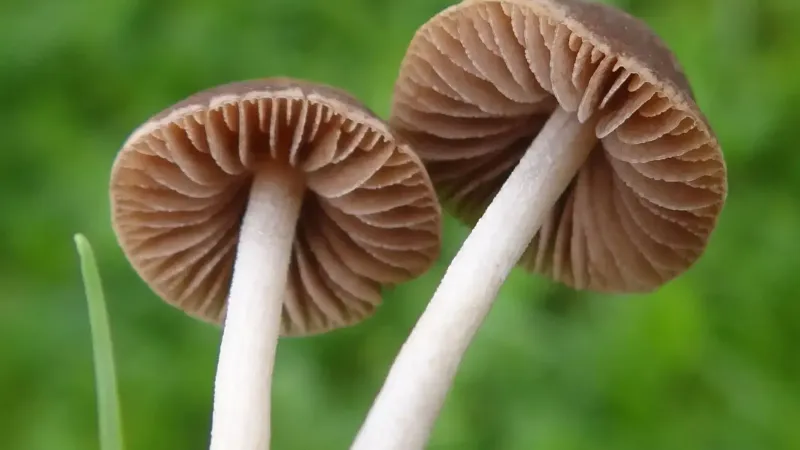
Panaeolus foenisecii fruiting bodies
Scientific Classification
Kingdom:Fungi
Division:Basidiomycota
Class:Agaricomycetes
Order:Agaricales
Family:Panaeolaceae
Genus:Panaeolus
Frequently Asked Questions
- What is Mower's Mushroom?
- Mower's Mushroom (Panaeolus foenisecii) is a mushroom species, belonging to the Panaeolaceae family. It is studied for its biological characteristics and is documented in the ShroomSpy mycology database.
- Is Mower's Mushroom edible?
- Not edible. Panaeolus foenisecii is a common lawn and pasture mushroom that is not considered edible: small amounts eaten raw have been reported to be poisonous to young children, and ingestion can cause gastrointestinal upset. It is also documented to cause GI distress, ataxia and other reactions in dogs. Despite a long-standing popular reputation as a 'magic mushroom', repeated chemical analyses of specimens from across North America, Europe and Australia have consistently failed to find psilocybin or psilocin; the species reliably contains only serotonin and 5-hydroxytryptophan, which are inactive when taken orally. It should be regarded as inedible and is easily confused with genuinely toxic or psilocybin-containing lawn mushrooms, so foraging it for any purpose is strongly discouraged.
- What is the scientific classification of Mower's Mushroom?
- Mower's Mushroom belongs to the kingdom Fungi, division Basidiomycota, class Agaricomycetes, order Agaricales, family Panaeolaceae, genus Panaeolus. Its scientific name is Panaeolus foenisecii.
About
Panaeolus foenisecii, commonly called the mower's or haymaker's mushroom, is a small, fragile saprotrophic fungus that fruits scattered to gregariously in lawns, pastures and other grassy places throughout the temperate world, especially after hay harvest. It has a 1-3 cm campanulate to convex cap that is smoky to dull chestnut brown and strongly hygrophanous, fading to tan or grayish as it dries, often with a darker ring-like band along the margin. Its gills become mottled dull brown as the rough, purplish-brown spores ripen unevenly, and the slender brittle stem is pallid and slightly twisted toward the apex. It is not edible and is best regarded as a toxic lawn mushroom rather than a recreational one.
History
The species was first described by Persoon and sanctioned by Elias Magnus Fries, later transferred by Kuhner; the epithet foenisecii is Latin for 'of the haymaker', reflecting its habit of appearing in mown grass after the hay harvest. Because it does not grow on dung, fruits after haying and produces roughened purplish-brown rather than black spores, it has often been segregated into the genus Panaeolina. Its taxonomic history is tangled: it has at various times been placed in Psilocybe, Psathyrella, Panaeolus and Panaeolina, and recent DNA work has placed the genus near the Galeropsidaceae. For much of the 20th century it carried a reputation as a hallucinogenic 'magic mushroom', largely on the basis of Ola'h's mid-century reports describing it as a 'latent' psilocybin producer.
Overview
Modern chemistry has not supported that reputation. Surveys of specimens from eight countries across three continents, and analyses of more than a hundred German collections, repeatedly failed to detect psilocybin, psilocin or baeocystin; respected authors including Stamets and Gartz conclude the species is not active. What it does reliably contain are 5-substituted indoles, namely serotonin and its precursor 5-hydroxytryptophan, both of which are inactive by mouth and can be mistaken for psilocin in older thin-layer tests. The real hazard is gastrointestinal: small amounts eaten raw have been reported poisonous to young children, and the mushroom has poisoned dogs. Ecologically it is a harmless decomposer of grassland litter, but it grows alongside genuinely psilocybin-bearing relatives such as Panaeolus subbalteatus and Panaeolus cinctulus, so it is an easy and potentially dangerous source of misidentification.
Physical Characteristics
Caps:
Convex to bell-shaped, 1-5 cm in diameter, light brown to grayish-brown, smooth texture with a slightly striate margin.
Gills:
Free, close to crowded, white to grayish, turning black with age.
Mushroom Ratings
0.0
Based on 0 Reviews
5
★4
★3
★2
★1
★Share your thoughts
If you've consumed this mushroom, share your thoughts with our community