Last updated:
Phallus indusiatus
"Veiled Lady, Bamboo Fungus, Long Net Stinkhorn"
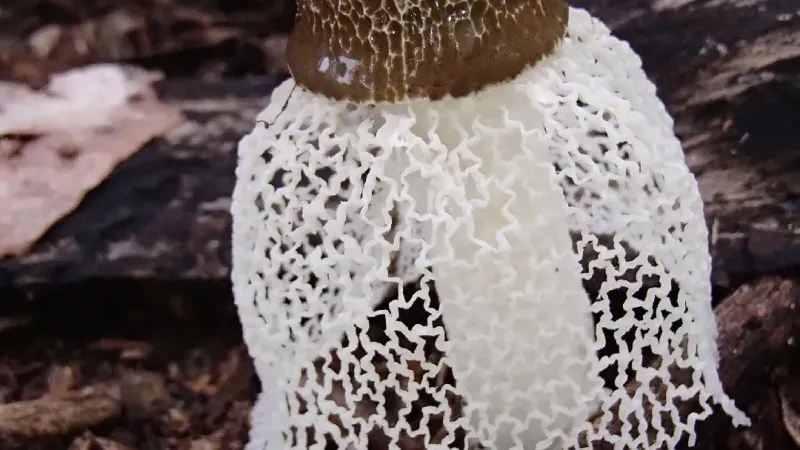
Phallus indusiatus fruiting bodies
Scientific Classification
Kingdom:Fungi
Division:Basidiomycota
Class:Agaricomycetes
Order:Agaricales
Family:Phallaceae
Genus:Phallus
Frequently Asked Questions
- What is Veiled Lady?
- Veiled Lady (Phallus indusiatus) is a mushroom species, belonging to the Phallaceae family. It is studied for its biological characteristics and is documented in the ShroomSpy mycology database.
- Is Veiled Lady edible?
- Edible and prized. Known as bamboo fungus (zhusheng) in Chinese cuisine, where the rinsed, dried fruiting body is a valued culinary delicacy. The foul-smelling olive spore slime (gleba) on the cap must be washed away before eating; once cleaned, the species is non-toxic and considered a choice edible.
- What effects does Veiled Lady produce?
- Veiled Lady is associated with the following effects: Energy. Individual experiences vary based on dose, set, and setting.
- What is the scientific classification of Veiled Lady?
- Veiled Lady belongs to the kingdom Fungi, division Basidiomycota, class Agaricomycetes, order Agaricales, family Phallaceae, genus Phallus. Its scientific name is Phallus indusiatus.
About
Phallus indusiatus (synonym Dictyophora indusiata), commonly called the veiled lady or bamboo fungus, is a striking stinkhorn of the family Phallaceae. It is best known for the delicate, lace-like net (the indusium) that drapes from beneath its bell-shaped cap down over the upper stalk, giving the fruiting body the appearance of a veiled figure. The mushroom emerges from a gelatinous "egg" and is found in tropical and subtropical regions, typically among bamboo litter and decaying woody debris. It is both a celebrated culinary mushroom and the subject of growing pharmacological interest.
History
Phallus indusiatus has been used for centuries in Chinese cuisine and traditional medicine, where the cleaned, dried fruiting body is known as bamboo fungus (zhusheng) and prized as a delicacy in soups and banquet dishes. The genus name Phallus refers to the shape of the fruiting body, while the epithet indusiatus refers to the indusium, the skirt-like veil that distinguishes this species. The species has also been studied under its synonym Dictyophora indusiata, and modern research has increasingly focused on its bioactive compounds.
Overview
As a saprotroph, Phallus indusiatus contributes to the decomposition of organic matter and nutrient cycling in its tropical habitats. The fresh cap is coated in a dark, fetid spore slime (the gleba) that lures insects to disperse the spores; this slime is rinsed away before the mushroom is eaten. Beyond its culinary value, the species is noted for bioactive metabolites: small molecules with documented anti-inflammatory activity, the nerve-growth-factor-stimulating dictyophorines, and soluble polysaccharides studied for antioxidant and immune-related effects. Its distinctive netted veil makes it one of the most easily recognized members of the Phallaceae.
Physical Characteristics
Caps:
A thimble-like, bell-shaped cap (the head) about 1.5-4 cm tall, covered when fresh with a dark olive-green, foul-smelling spore slime (gleba) that attracts insects; once the slime is removed the cap surface is pale and pitted/reticulate.
Gills:
None
Cognitive Effects
Energy
P. indusiatus is high in protein and zinc, nutrients central to physical energy and immune function when consumed as bamboo fungus.
Pharmacology
Helps With
Immune System
Phallus indusiatus polysaccharides (PI-1, PI-2) have demonstrated dose-dependent immunostimulatory effects including enhanced splenic lymphocyte proliferation in murine models.
Cancer
PI polysaccharides from P. indusiatus showed significant inhibition rates against sarcoma S180 and hepatoma H22 in mouse tumor models.
Inflammation
Polysaccharide fractions from P. indusiatus inhibit COX-2 expression and reduce prostaglandin production in LPS-stimulated macrophages.
Chemical Constituents
Medicinal Chemistry
Nutrition Facts
Serving Size100
Amount Per Serving
Calories270
% Daily Value*
Total Fat 2 g3%
Saturated Fat 0 g0%
Trans Fat 0 g
Cholesterol 0 mg0%
Sodium 10 mg0%
Total Carbohydrate 55 g20%
Dietary Fiber 20 g71%
Total Sugars 0 g
Protein 18 g36%
Vitamin A 0 µg 0%•Thiamin B1 0 mg 0%
Riboflavin B2 0 mg 0%•Niacin B3 0 mg 0%
Vitamin B6 0 mg 0%•Folate B9 0 µg 0%
Vitamin B12 0 mg 0%•Vitamin C 0 mg 0%
Vitamin D 0 µg 0%•Vitamin E 0 mg 0%
Vitamin K 0 µg 0%•Calcium 0 mg 0%
Copper 0 mg 0%•Iron 0 mg 0%
Magnesium 0 mg 0%•Manganese 0 mg 0%
Phosphorus 280 mg 22%•Potassium 1200 mg 26%
Selenium 0 µg 0%•Zinc 5 mg 45%
Vit A 0 µg 0%•B1 0 mg 0%
B2 0 mg 0%•B3 0 mg 0%
B6 0 mg 0%•B9 0 µg 0%
B12 0 mg 0%•Vit C 0 mg 0%
Vit D 0 µg 0%•Vit E 0 mg 0%
Vit K 0 µg 0%•Calcium 0 mg 0%
Copper 0 mg 0%•Iron 0 mg 0%
Mg 0 mg 0%•Mn 0 mg 0%
Phosph. 280 mg 22%•Pot. 1200 mg 26%
Selenium 0 µg 0%•Zinc 5 mg 45%
* Percent Daily Values are based on a 2,000 calorie diet.
Mushroom Ratings
0.0
Based on 0 Reviews
5
★4
★3
★2
★1
★Share your thoughts
If you've consumed this mushroom, share your thoughts with our community