Last updated:
Phellinus ribis
"Black Knot Fungus, Phellinus Knot"
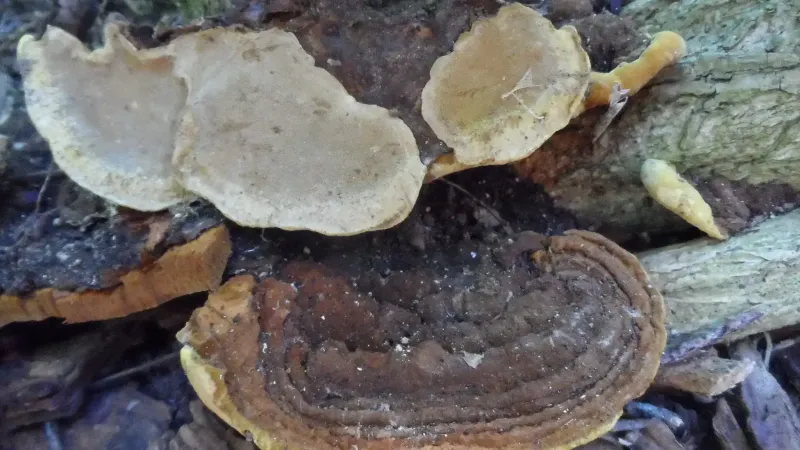
Phellinus ribis fruiting bodies
Scientific Classification
Kingdom:Fungi
Division:Basidiomycota
Class:Agaricomycetes
Order:Hymenochaetales
Family:Hymenochaetaceae
Genus:Phellinus
Frequently Asked Questions
- What is Black Knot Fungus?
- Black Knot Fungus (Phellinus ribis) is a mushroom species, belonging to the Hymenochaetaceae family. It is studied for its biological characteristics and is documented in the ShroomSpy mycology database.
- Is Black Knot Fungus edible?
- Non-edible. Phellinus ribis is a hard, woody bracket fungus with no culinary use. As with other Phellinus conks, it is studied only as a medicinal decoction or extract, never eaten as food.
- What effects does Black Knot Fungus produce?
- Black Knot Fungus is associated with the following effects: Energy. Individual experiences vary based on dose, set, and setting.
- What is the scientific classification of Black Knot Fungus?
- Black Knot Fungus belongs to the kingdom Fungi, division Basidiomycota, class Agaricomycetes, order Hymenochaetales, family Hymenochaetaceae, genus Phellinus. Its scientific name is Phellinus ribis.
About
Phellinus ribis is a woody, perennial bracket fungus (conk) in the family Hymenochaetaceae. Rather than a fleshy mushroom, it forms hard, cushion-shaped to bracket-like fruiting bodies on the wood of currant (Ribes) and related shrubs and small trees, where it acts as a wood-decay fungus. It is inedible but, like several members of the genus Phellinus, has drawn interest as a medicinal fungus prepared as a decoction or extract.
History
Phellinus ribis takes its species name from Ribes, the currant genus on which it is characteristically found. It belongs to a genus of tough, bracket-forming polypores that have a long record of use in traditional medicine, where the dried conk is boiled into a decoction. Documented laboratory work on P. ribis dates to the mid-20th century: Robbins and colleagues (1945) reported antibacterial activity against Staphylococcus aureus in P. ribis alongside several related Phellinus species.
Overview
Like other Phellinus conks, P. ribis is a wood-decay fungus that contributes to the breakdown of dead and living woody tissue. It is gathered from the wild rather than cultivated. Research interest centers on the genus's polysaccharides and styrylpyrone compounds, which across Phellinus species have been associated with antioxidant, anti-inflammatory, antibacterial, and antitumor activity in laboratory studies. Much of this evidence is at the genus level or drawn from closely related species, so claims specific to P. ribis should be treated cautiously.
Physical Characteristics
Caps:
Forms hard, woody, perennial bracket-like fruiting bodies (conks) rather than a fleshy cap. They are small to medium, cushion-shaped to effused-reflexed, with a rusty-brown to dark brown or blackish, cracked upper surface.
Gills:
None. The underside is a pore surface (poroid hymenophore), brown in color, typical of bracket polypores.
Cognitive Effects
Energy
Polysaccharides from Phellinus ribis may support cellular energy metabolism by enhancing mitochondrial enzyme activity in preclinical models.
Pharmacology
Helps With
Immune System
Phellinus ribis polysaccharides, similar to those in related Phellinus species, may activate macrophages and NK cells, supporting innate immune defense.
Cancer
Crude polysaccharide extracts from P. ribis have shown in vitro anti-proliferative activity against hepatocellular carcinoma cell lines.
Inflammation
Hispidin-type styrylpyrone compounds present in Phellinus spp. may reduce TNF-α and IL-6 production in lipopolysaccharide-stimulated macrophages.
Chemical Constituents
Medicinal Chemistry
Mushroom Ratings
0.0
Based on 0 Reviews
5
★4
★3
★2
★1
★Share your thoughts
If you've consumed this mushroom, share your thoughts with our community