Last updated:
Phlebia radiata
"radiate polypore"
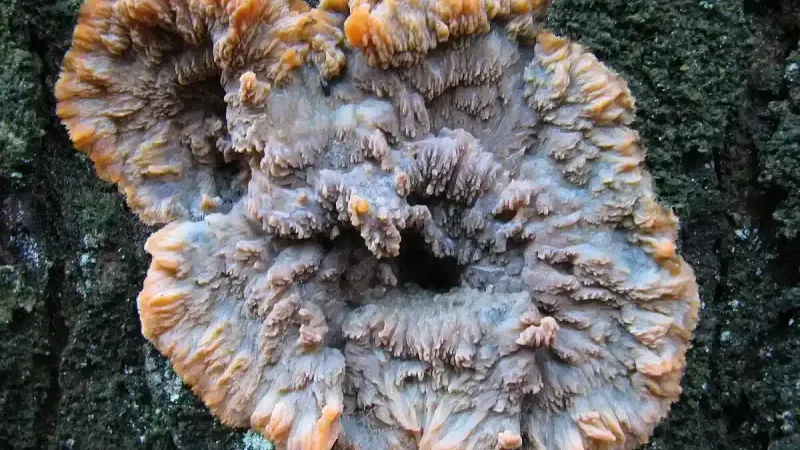
Phlebia radiata fruiting bodies
Scientific Classification
Kingdom:Fungi
Division:Basidiomycota
Class:Agaricomycetes
Order:Polyporales
Family:Meruliaceae
Genus:Phlebia
Frequently Asked Questions
- What is radiate polypore?
- radiate polypore (Phlebia radiata) is a mushroom species, belonging to the Meruliaceae family. It is studied for its biological characteristics and is documented in the ShroomSpy mycology database.
- Is radiate polypore edible?
- Non-edible. Phlebia radiata is a tough, thin, crust-like wood-rotting fungus with no culinary value; it is not gathered or eaten. It is not known to be poisonous, but it is not a food species.
- What is the scientific classification of radiate polypore?
- radiate polypore belongs to the kingdom Fungi, division Basidiomycota, class Agaricomycetes, order Polyporales, family Meruliaceae, genus Phlebia. Its scientific name is Phlebia radiata.
About
Phlebia radiata is a resupinate, crust-forming white-rot fungus that grows flat against dead wood rather than producing a stalked or shelf-like fruiting body. It is widely distributed on decaying wood in temperate forests of North America and Europe, where it plays an important ecological role in wood decomposition. P. radiata is best known scientifically as a powerful degrader of lignin, the rigid polymer that gives wood its strength.
History
Phlebia radiata was described by the mycologist Elias Magnus Fries in the early nineteenth century. The genus name Phlebia derives from the Greek for vein, a reference to the wrinkled, vein-like texture of the fruiting surface. The species has never been used as food or in traditional medicine; instead, its scientific significance grew through research into how wood-rotting fungi break down lignin and cellulose.
In modern mycology and biotechnology, P. radiata became a model organism for studying ligninolytic enzymes. Researchers have characterized its production of lignin peroxidase (LiP), manganese peroxidase (MnP), and laccase, and it has been studied for its ability to transform persistent environmental pollutants such as TNT.
Overview
Phlebia radiata is a corticioid (crust) fungus, not a polypore, and forms thin, wrinkled, waxy sheets that adhere closely to the surface of dead wood. As a white-rot fungus, it degrades lignin and cellulose, contributing to nutrient cycling and the recycling of dead wood in forest ecosystems.
Its ecological and biochemical importance lies in its enzyme system. Together with Phanerochaete chrysosporium, P. radiata is classified in the lignin–manganese peroxidase group of white-rot fungi, secreting extracellular peroxidases and laccase that oxidize and break apart lignin. This same enzymatic machinery has made the species a subject of interest for mycoremediation and industrial biotechnology.
Physical Characteristics
Caps:
Phlebia radiata is a resupinate fungus, meaning it grows flat against the wood rather than forming a true cap. Its fruiting body is a thin, crust-like sheet with a wrinkled or radially veined, waxy surface that lies tightly against the substrate.
Gills:
None. As a corticioid (crust) fungus, it has no gills; the spore-bearing surface is the smooth-to-wrinkled face of the resupinate fruiting body.
Mushroom Ratings
0.0
Based on 0 Reviews
5
★4
★3
★2
★1
★Share your thoughts
If you've consumed this mushroom, share your thoughts with our community