Last updated:
Pholiota squarrosa
"Shaggy Pholiota, Scaly Pholiota, Scaly Cap"
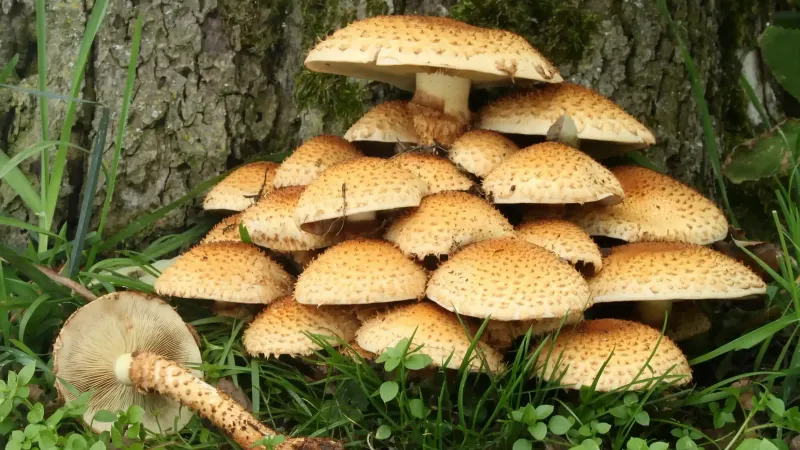
Pholiota squarrosa fruiting bodies
Scientific Classification
Kingdom:Fungi
Division:Basidiomycota
Class:Agaricomycetes
Order:Agaricales
Family:Strophariaceae
Genus:Pholiota
Frequently Asked Questions
- What is Shaggy Pholiota?
- Shaggy Pholiota (Pholiota squarrosa) is a mushroom species, belonging to the Strophariaceae family. It is studied for its biological characteristics and is documented in the ShroomSpy mycology database.
- Is Shaggy Pholiota edible?
- Not edible / poisonous. Pholiota squarrosa causes gastrointestinal distress (nausea, vomiting, diarrhea, cramps) in many people, and reactions are notably worse when eaten with alcohol. Documented poisonings are well recorded. Do not consume.
- What is the scientific classification of Shaggy Pholiota?
- Shaggy Pholiota belongs to the kingdom Fungi, division Basidiomycota, class Agaricomycetes, order Agaricales, family Strophariaceae, genus Pholiota. Its scientific name is Pholiota squarrosa.
About
Pholiota squarrosa is a distinctive wood-rotting mushroom recognised by its dry, shaggy cap densely covered in dark brown recurved scales over an ochre-yellow to rust-brown ground colour. It fruits in dense clusters at the base of broad-leaved trees and is widely distributed across Europe and North America. It is not edible: it causes gastrointestinal upset in many people, and reactions are notably worse when consumed with alcohol.
History
Pholiota squarrosa was first described by the Danish naturalist Otto Friedrich Müller and later placed in the genus Pholiota by Paul Kummer, giving the accepted authority Pholiota squarrosa (Müll.) Kummer. The genus name Pholiota derives from the Greek pholis, meaning scale, and the epithet squarrosa is Latin for scaly or scurfy, both reflecting the conspicuous recurved scales that cover the cap and stem. Field guides have long flagged it as a species to avoid: although it is common, easily recognised, and aesthetically striking, multiple authors note difficult digestion and recorded cases of poisoning.
Overview
Ecologically, P. squarrosa is a saprotroph and weak parasite that decomposes wood, often entering living trees through wounds and decayed areas; it is a frequent coloniser of mountain ash (rowan) and other broad-leaved trees, fruiting in characteristic tufted clusters at the trunk base in summer and autumn. Key field characters are the dry scaly cap and stem (distinguishing it from the sticky-capped look-alikes Pholiota aurivella and Pholiota adiposa), the broadly adnate rust-brown gills, the rust-brown spore print, and the strong garlic-radish smell. It has no culinary or commercial value and should not be eaten.
Physical Characteristics
Caps:
The cap is 5-12 cm across, convex then expanding and flattening with a slight central umbo, ochre-yellow to yellowish rust-brown, and densely covered with dark brown recurved (upturned) scales, particularly toward the centre. The cap surface is dry, not sticky.
Gills:
The gills are broadly adnate with a short decurrent tooth (attached to the stem, not free), crowded, yellowish at first and turning rust-brown as the spores mature. The spore print is rich rust-brown.
Mushroom Ratings
0.0
Based on 0 Reviews
5
★4
★3
★2
★1
★Share your thoughts
If you've consumed this mushroom, share your thoughts with our community