Published:
Pleurocordyceps cornusynnemata
"Horned Synnemata Cordyceps, Cornu Synnemata Fungus"
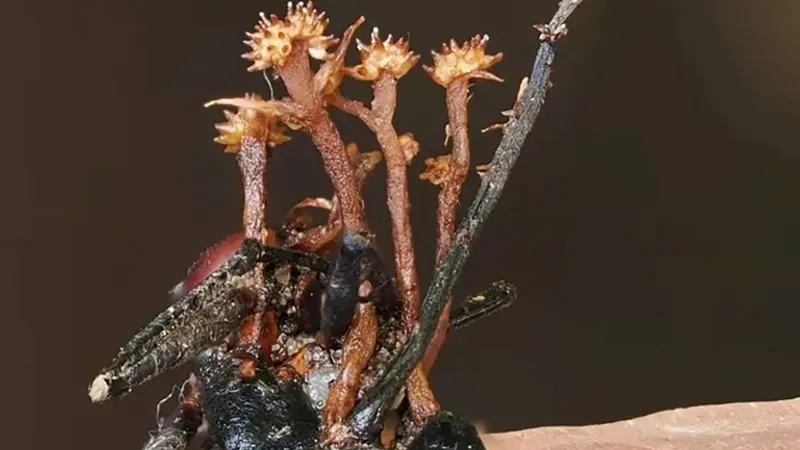
Pleurocordyceps cornusynnemata fruiting bodies
Scientific Classification
Kingdom:Fungi
Division:Ascomycota
Class:Sordariomycetes
Order:Hypocreales
Family:Polycordycipitaceae
Genus:Pleurocordyceps
Frequently Asked Questions
- What is Horned Synnemata Cordyceps?
- Horned Synnemata Cordyceps (Pleurocordyceps cornusynnemata) is a mushroom species, belonging to the Polycordycipitaceae family. It is studied for its biological characteristics and is documented in the ShroomSpy mycology database.
- Is Horned Synnemata Cordyceps edible?
- Not edible — an entomopathogenic fungus of taxonomic/research interest, not used culinarily.
- What is the scientific classification of Horned Synnemata Cordyceps?
- Horned Synnemata Cordyceps belongs to the kingdom Fungi, division Ascomycota, class Sordariomycetes, order Hypocreales, family Polycordycipitaceae, genus Pleurocordyceps. Its scientific name is Pleurocordyceps cornusynnemata.
About
Pleurocordyceps cornusynnemata is an entomopathogenic fungus in the family Polycordycipitaceae, one of several genera segregated from the broad, historically confusing concept of "Cordyceps sensu lato." Like its relatives, it is an insect-associated ascomycete that reproduces through synnemata — erect, bundled clusters of spore-bearing filaments — rather than a fleshy cap-and-stem body. It is known primarily from Asian collections and is of scientific rather than culinary or medicinal interest.
History
The genus Pleurocordyceps was established in 2020 on the basis of molecular phylogenetic analysis, part of a wider effort to disentangle the many unrelated fungi that had accumulated under the name Cordyceps. Multi-locus DNA sequencing separated these insect- and fungus-dwelling species into natural groups, of which Pleurocordyceps is one. The species epithet derives from the Latin cornu ("horn"), referencing the horn-shaped synnemata that distinguish this fungus.
Overview
As an entomopathogen, Pleurocordyceps cornusynnemata participates in the natural regulation of insect populations, and members of its wider clade are studied for their roles in forest ecosystems and their potential in biological pest control. It is not eaten and has no documented medicinal use; its significance lies in taxonomy and in the study of how the Cordyceps-like fungi diversified. Reliable field data on its distribution, host range, and life cycle remain limited, reflecting how recently the species and its genus were described.
Physical Characteristics
Caps:
No true cap. The fungus produces erect, horn- or antler-shaped synnemata — compact, bundled columns of spore-bearing conidiophores — arising from the substrate or host, typically pale to cream-colored with a powdery, spore-laden apex.
Gills:
None. As an ascomycete, it bears no gills; asexual spores (conidia) are produced along the synnemata and sexual spores form in flask-shaped perithecia rather than on lamellae.
Mushroom Ratings
0.0
Based on 0 Reviews
5
★4
★3
★2
★1
★Share your thoughts
If you've consumed this mushroom, share your thoughts with our community