Last updated:
Pleurocybella porrigens
"Angel's Wings, Pleurocybella"
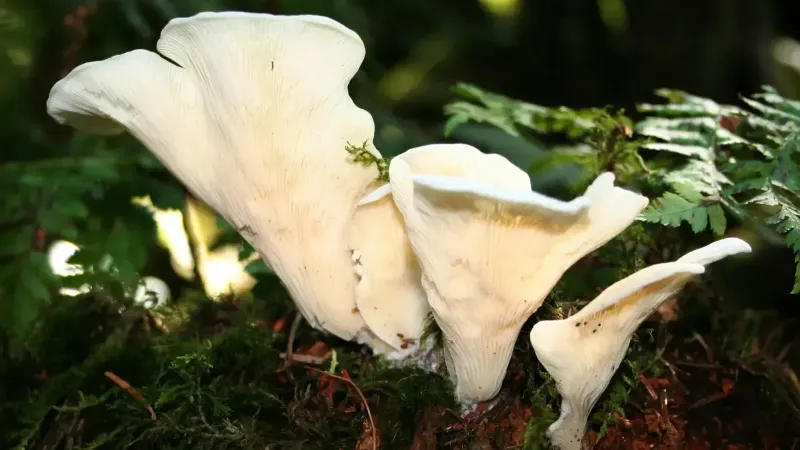
Pleurocybella porrigens fruiting bodies
Scientific Classification
Kingdom:Fungi
Division:Basidiomycota
Class:Agaricomycetes
Order:Agaricales
Family:Pleurocybellaceae
Genus:Pleurocybella
Frequently Asked Questions
- What is Angel's Wings?
- Angel's Wings (Pleurocybella porrigens) is a mushroom species, belonging to the Pleurocybellaceae family. It is studied for its biological characteristics and is documented in the ShroomSpy mycology database.
- Is Angel's Wings edible?
- POISONOUS — do not eat. Pleurocybella porrigens (Angel's Wings) was long considered edible but is now known to cause delayed, sometimes fatal acute encephalopathy (brain damage). In 2004 at least 17 people in Japan died after eating it; every fatality had pre-existing kidney disease. It contains one or more toxins that remain chemically unidentified, and no amount of cooking is known to make it safe. People with impaired renal function are at greatest risk. It is easily confused with edible oyster mushrooms (Pleurotus ostreatus); a key distinction is that Angel's Wings grows on conifer wood while oysters grow on hardwoods. Avoid consumption entirely.
- What is the scientific classification of Angel's Wings?
- Angel's Wings belongs to the kingdom Fungi, division Basidiomycota, class Agaricomycetes, order Agaricales, family Pleurocybellaceae, genus Pleurocybella. Its scientific name is Pleurocybella porrigens.
About
Pleurocybella porrigens, commonly known as Angel's Wings, is a delicate, thin-fleshed, fan-shaped white mushroom that fruits in overlapping clusters on decaying conifer wood across temperate forests of North America, Europe, and Asia. Despite its attractive appearance and a long history of being eaten, it is now regarded as a poisonous species that should never be consumed. It has been linked to delayed, sometimes fatal acute encephalopathy, and it is easily mistaken for edible oyster mushrooms (Pleurotus ostreatus).
History
For generations Pleurocybella porrigens — known in Japan as sugihiratake — was foraged and eaten as an edible mushroom. That reputation changed sharply in the autumn of 2004, when an outbreak of acute brain damage in Japan killed at least 17 people who had eaten it. Every person who died had serious pre-existing kidney disease. Subsequent research in mice confirmed that the fungus contains one or more toxins, but their chemical identity has not been determined. The episode reclassified P. porrigens from a traditional edible to a mushroom that should be avoided.
Overview
Pleurocybella porrigens is a saprotrophic fungus that breaks down dead conifer wood, contributing to forest nutrient cycling. It is not edible and is not cultivated for food. Its thin, almost translucent white caps and effectively stemless, laterally attached fruiting bodies grow on coniferous wood, which is the single most useful trait for separating it from the edible oyster mushroom (Pleurotus ostreatus), which grows on hardwoods and has a fruity smell. Because the responsible toxin is unidentified and cannot be neutralised by cooking, and because the risk is especially severe for anyone with reduced kidney function, the only safe practice is to avoid eating this mushroom altogether.
Physical Characteristics
Caps:
The cap is shell- to fan-shaped, 2-10 cm across, thin-fleshed with an often inrolled margin and a smooth, moist surface that is white to pale cream, ageing yellowish-buff.
Gills:
Gills are crowded, narrow and white to cream, radiating from the point of attachment.
Mushroom Ratings
0.0
Based on 0 Reviews
5
★4
★3
★2
★1
★Share your thoughts
If you've consumed this mushroom, share your thoughts with our community