Last updated:
Pleurotus Citrinopileatus
"Golden Oyster"
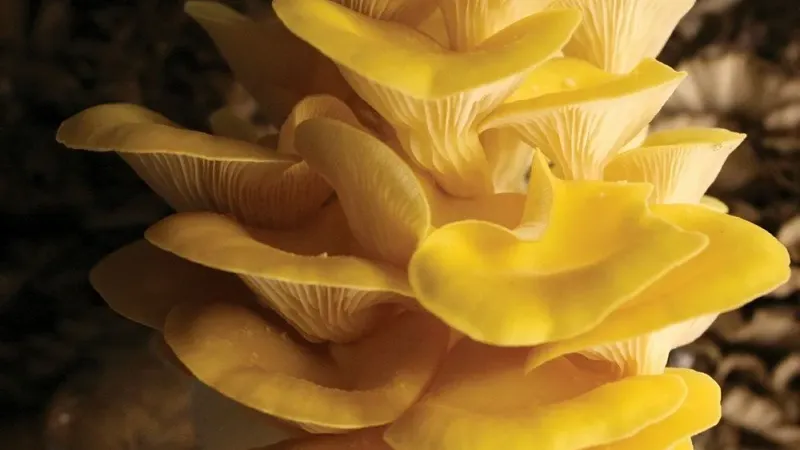
Pleurotus Citrinopileatus fruiting bodies
Scientific Classification
Kingdom:Fungi
Division:Basidiomycota
Class:Agaricomycetes
Order:Agaricales
Family:Pleurotaceae
Genus:Pleurotus
Frequently Asked Questions
- What is Golden Oyster?
- Golden Oyster (Pleurotus Citrinopileatus) is a mushroom species, belonging to the Pleurotaceae family. It is studied for its biological characteristics and is documented in the ShroomSpy mycology database.
- Is Golden Oyster edible?
- Edible and highly valued in cuisine.
- What effects does Golden Oyster produce?
- Golden Oyster is associated with the following effects: Memory. Individual experiences vary based on dose, set, and setting.
- What is the scientific classification of Golden Oyster?
- Golden Oyster belongs to the kingdom Fungi, division Basidiomycota, class Agaricomycetes, order Agaricales, family Pleurotaceae, genus Pleurotus. Its scientific name is Pleurotus Citrinopileatus.
About
Pleurotus citrinopileatus, commonly known as the Golden Oyster mushroom, is a vibrant yellow gourmet mushroom admired for its striking appearance, delicate texture, and mild, nutty flavor. It is not only prized for culinary uses but also for its ecological role in decomposing wood and potential medicinal properties, including antioxidant and cholesterol-lowering effects.
History
Native to eastern Asia, particularly China and Japan, Golden Oyster mushrooms have long been used in traditional cuisine and natural medicine. Their popularity in the West surged with the rise of urban and small-scale mushroom farming, due to their fast growth, aesthetic appeal, and culinary versatility. They're often grown on straw, sawdust, or agricultural waste, making them a sustainable crop.
Golden Oysters have also been studied for their antimicrobial compounds, statin-like substances (lovastatin), and immunomodulating polysaccharides, contributing to their value in functional foods and nutraceuticals.
Overview
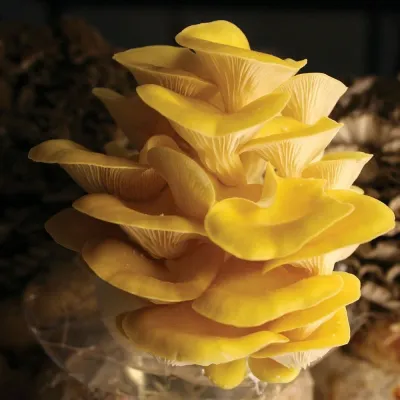
These mushrooms grow in dense clusters, with bright lemon-yellow caps, thin stems, and a delicate structure. They grow rapidly, often maturing in under a week in the right conditions, but are fragile and highly perishable, best consumed fresh or lightly cooked.
Flavor-wise, they offer a light, nutty, almost cashew-like profile, and pair well with stir-fries, light sautés, or soups. Medicinally, they are valued for lowering cholesterol, supporting immune health, and their role in mycoremediation.
Physical Characteristics
Caps:
Bright yellow to golden, convex to flat as it matures.
Gills:
Decurrent, closely spaced, white to pale yellow.
Cognitive Effects
Memory
Reported to improve mood and mental well-being when consumed.
Pharmacology
Helps With
Cholesterol
Contains compounds that may help lower cholesterol levels.
Cardiovascular Support
Boosts immune system function due to its high antioxidant content.
Possible Side Effects
Allergies
May cause allergic reactions in sensitive individuals.
Golden Oyster Products
Explore Golden Oyster products from independent vendors
Chemical Constituents
Medicinal Chemistry
Similar Species
Species: Pleurotus ostreatus
(Oyster Mushroom)
Edibility: edible - widely consumed and considered safe when properly cooked
Key Differences: Has a more grayish to brownish cap color compared to the bright yellow of P. citrinopileatus.
Species: Pleurotus ostreatus
(Oyster Mushroom)
Edibility: edible - widely consumed and considered safe when properly cooked
Key Differences: Has a more grayish to brownish cap color compared to the bright yellow of P. citrinopileatus.
Nutrition Facts
Serving Size100
Amount Per Serving
Calories33
% Daily Value*
Total Fat 0.41 g1%
Saturated Fat 0 g0%
Trans Fat 0 g
Cholesterol 0 mg0%
Sodium 18 mg1%
Total Carbohydrate 6.09 g2%
Dietary Fiber 2.3 g8%
Total Sugars 0 g
Protein 3.31 g7%
Vitamin A 0 µg 0%•Thiamin B1 0 mg 0%
Riboflavin B2 0 mg 0%•Niacin B3 0 mg 0%
Vitamin B6 0.11 mg 6%•Folate B9 38 µg 10%
Vitamin B12 0 mg 0%•Vitamin C 0 mg 0%
Vitamin D 0 µg 0%•Vitamin E 0 mg 0%
Vitamin K 0 µg 0%•Calcium 3 mg 0%
Copper 0.344 mg 38%•Iron 1.33 mg 7%
Magnesium 18 mg 4%•Manganese 0.113 mg 5%
Phosphorus 120 mg 10%•Potassium 420 mg 9%
Selenium 2.3 µg 4%•Zinc 0.77 mg 7%
Vit A 0 µg 0%•B1 0 mg 0%
B2 0 mg 0%•B3 0 mg 0%
B6 0.11 mg 6%•B9 38 µg 10%
B12 0 mg 0%•Vit C 0 mg 0%
Vit D 0 µg 0%•Vit E 0 mg 0%
Vit K 0 µg 0%•Calcium 3 mg 0%
Copper 0.344 mg 38%•Iron 1.33 mg 7%
Mg 18 mg 4%•Mn 0.113 mg 5%
Phosph. 120 mg 10%•Pot. 420 mg 9%
Selenium 2.3 µg 4%•Zinc 0.77 mg 7%
* Percent Daily Values are based on a 2,000 calorie diet.
Mushroom Ratings
0.0
Based on 0 Reviews
5
★4
★3
★2
★1
★Share your thoughts
If you've consumed this mushroom, share your thoughts with our community