Last updated:
Podostroma cornu-damae
"poison fire coral, fire coral fungus"
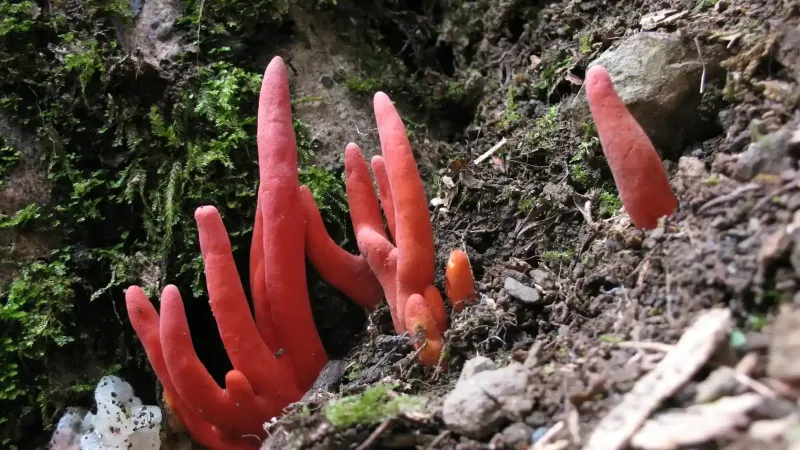
Podostroma cornu-damae fruiting bodies
Scientific Classification
Kingdom:Fungi
Division:Ascomycota
Class:Sordariomycetes
Order:Hypocreales
Family:Hypocreaceae
Genus:Podostroma
Frequently Asked Questions
- What is poison fire coral?
- poison fire coral (Podostroma cornu-damae) is a mushroom species, belonging to the Hypocreaceae family. It is studied for its biological characteristics and is documented in the ShroomSpy mycology database.
- Is poison fire coral edible?
- DEADLY POISONOUS - do not touch or consume. Podostroma cornu-damae (also classified as Trichoderma cornu-damae) is one of the few mushrooms whose toxins can be fatal even through skin contact. It contains potent trichothecene mycotoxins (including satratoxins, roridins, and verrucarins). Ingestion causes vomiting and diarrhea within hours, followed by multi-organ failure: bone marrow suppression, peeling skin, hair loss, liver and kidney damage, and neurological injury. Multiple deaths have been documented in Japan and Korea. There is no culinary or safe use.
- What is the scientific classification of poison fire coral?
- poison fire coral belongs to the kingdom Fungi, division Ascomycota, class Sordariomycetes, order Hypocreales, family Hypocreaceae, genus Podostroma. Its scientific name is Podostroma cornu-damae.
About
Podostroma cornu-damae (also placed in the genus Trichoderma) is one of the most dangerous fungi in the world, sometimes called the poison fire coral. It is instantly recognizable by its bright red, finger-like or branched fruiting bodies that rise from the forest floor, resembling a piece of coral or a clutch of red antlers rather than a typical capped mushroom. Native to East Asia, it is responsible for documented human fatalities and is notable because its toxins can be harmful even through handling.
History
The species was first described from Japan and has long been known in Japanese as kaentake, meaning "fire flame fungus," a reference to its vivid red color. Its scientific epithet cornu-damae derives from Latin for "deer horn," describing the antler-like branching of the fruiting body. It has been recorded across Japan, Korea, and parts of China, and more recently reported in other temperate and subtropical regions. Several poisoning cases, including deaths, have been documented in the medical literature, which established it as one of the few mushrooms capable of causing fatal trichothecene mycotoxicosis.
Overview
Podostroma cornu-damae is a saprobic ascomycete that grows from buried wood and woody debris in forest soil, fruiting as erect red clavarioid structures. Its danger lies in a group of trichothecene mycotoxins, including satratoxins, roridins, and verrucarins. Poisoning typically begins with gastrointestinal symptoms within hours of ingestion, progressing to bone marrow suppression, peeling skin, hair loss, low blood pressure, and damage to the liver, kidneys, and nervous system. Because it superficially resembles harmless coral or club fungi, and even some edible species when young, accurate identification and complete avoidance are essential. It has no culinary or medicinal use and must never be touched or eaten.
Physical Characteristics
Caps:
No true cap. The fruiting body is a clavarioid (coral- or finger-like) structure, usually bright red to orange-red, 3-15 cm tall, sometimes branched or antler-like, with a roughly cylindrical or club shape arising from the ground or buried wood.
Gills:
None. This fungus is an ascomycete and produces no gills; spores form on the surface of the fleshy red stroma.
Mushroom Ratings
0.0
Based on 0 Reviews
5
★4
★3
★2
★1
★Share your thoughts
If you've consumed this mushroom, share your thoughts with our community