Last updated:
Polyporus squamosus
"Dryad's saddle, Pheasant's back"
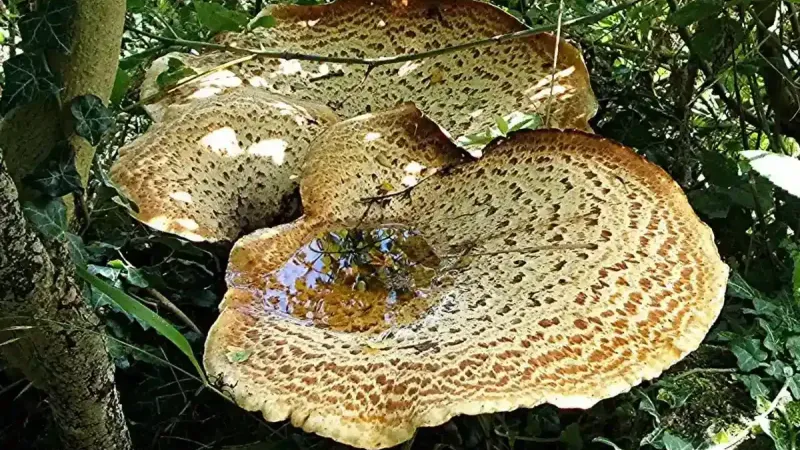
Polyporus squamosus fruiting bodies
Scientific Classification
Kingdom:Fungi
Division:Basidiomycota
Class:Agaricomycetes
Order:Polyporales
Family:Polyporaceae
Genus:Polyporus
Frequently Asked Questions
- What is Dryad's saddle?
- Dryad's saddle (Polyporus squamosus) is a mushroom species, belonging to the Polyporaceae family. It is studied for its biological characteristics and is documented in the ShroomSpy mycology database.
- Is Dryad's saddle edible?
- Edible when young and tender, with a distinctive watermelon-like fragrance. Only the soft outer margins of young specimens are eaten; the flesh toughens and becomes inedible with age, so older brackets are not worth collecting. It is not a stand-alone edible but works thinly sliced and sauteed into soups, frittatas, and other dishes.
- What is the scientific classification of Dryad's saddle?
- Dryad's saddle belongs to the kingdom Fungi, division Basidiomycota, class Agaricomycetes, order Polyporales, family Polyporaceae, genus Polyporus. Its scientific name is Polyporus squamosus.
About
Polyporus squamosus, commonly known as the dryad's saddle or pheasant's back, is a distinctive bracket fungus characterized by its fan-shaped, semicircular fruiting bodies with an ochre-yellow to straw-colored surface marked by concentric zones of dark brown, flattened scales. The underside bears large, angular whitish pores rather than gills, and a torn fresh specimen releases an unmistakable watermelon-like fragrance. It grows on the stumps and trunks of hardwoods such as sycamore and elm, acting as both a saprobe and a parasite, and is widely distributed across Europe, Asia, and eastern North America. The fungus is edible when young and tender and plays an important ecological role as a wood-decay organism.
History
Polyporus squamosus was first validly named by William Hudson and later sanctioned by Elias Magnus Fries, giving the authority citation (Huds.) Fr. The species epithet derives from the Latin squama, meaning "scale," a reference to the conspicuous brown scales feathered across the cap. Long valued by foragers as a spring substitute when morels are scarce, it has also featured in Traditional Chinese Medicine as a warming remedy said to address sore tendons and ligaments. Its abundance and easy identification have made it a familiar fixture of foraging communities across the temperate Northern Hemisphere.
Overview
Ecologically, Polyporus squamosus is an important white-rot decomposer that breaks down lignin and cellulose in dead and living hardwood, contributing to forest nutrient cycling. It fruits chiefly in spring and summer but can appear year-round, often forming tiered clusters on the same host over successive seasons. Phytochemical screening has identified trehalose as its main free sugar and p-hydroxybenzoic acid as its principal phenolic compound, alongside notable levels of beta-tocopherol and polyunsaturated fatty acids; extracts show antioxidant, antifungal, and antibacterial activity. Its scaly cap and large white pore surface readily distinguish it from tougher, hoof-shaped polypores.
Flavors
Mild
Young P. squamosus has a mild, mushroomy flavor that works best incorporated into cooked dishes; older specimens turn bitter and leathery.
Textures
Firm
Young specimens have firm, tender flesh near the margins; the bracket toughens rapidly and becomes inedible as it ages and expands.
Fragrances
Floral
A torn fresh specimen releases a distinctive watermelon-like (cucumber-melon) fragrance that aids identification.
Physical Characteristics
Caps:
The cap is fan-shaped to saddle-shaped, measuring 5-30 cm across, with a wavy margin. It is typically brown to yellow-brown with a scaly texture.
Gills:
None; the underside features a series of small pores instead of gills, which are white to cream-colored.
Pharmacology
Helps With
Bacterial Suppression
Extracts of Polyporus squamosus show antibacterial activity against E. coli, Staphylococcus aureus, Bacillus subtilis, and Salmonella typhimurium in laboratory studies.
Inflammation
As a low-calorie, high-fiber food relatively rich in polyunsaturated fatty acids, P. squamosus has been studied as a potentially valuable food for combating inflammation and heart disease.
Possible Side Effects
Nausea
Older P. squamosus brackets become tough, fibrous, and indigestible; only young, tender outer margins should be eaten to avoid gastrointestinal upset.
Chemical Constituents
Medicinal Chemistry
Nutrition Facts
Serving Size100
Amount Per Serving
Calories280
% Daily Value*
Total Fat 2.5 g3%
Saturated Fat 0 g0%
Trans Fat 0 g
Cholesterol 0 mg0%
Sodium 18 mg1%
Total Carbohydrate 50 g18%
Dietary Fiber 19 g68%
Total Sugars 0 g
Protein 20 g40%
Vitamin A 0 µg 0%•Thiamin B1 0 mg 0%
Riboflavin B2 0 mg 0%•Niacin B3 11 mg 69%
Vitamin B6 0 mg 0%•Folate B9 0 µg 0%
Vitamin B12 0 mg 0%•Vitamin C 0 mg 0%
Vitamin D 0 µg 0%•Vitamin E 0 mg 0%
Vitamin K 0 µg 0%•Calcium 0 mg 0%
Copper 0 mg 0%•Iron 0 mg 0%
Magnesium 0 mg 0%•Manganese 0 mg 0%
Phosphorus 310 mg 25%•Potassium 1800 mg 38%
Selenium 16 µg 29%•Zinc 0 mg 0%
Vit A 0 µg 0%•B1 0 mg 0%
B2 0 mg 0%•B3 11 mg 69%
B6 0 mg 0%•B9 0 µg 0%
B12 0 mg 0%•Vit C 0 mg 0%
Vit D 0 µg 0%•Vit E 0 mg 0%
Vit K 0 µg 0%•Calcium 0 mg 0%
Copper 0 mg 0%•Iron 0 mg 0%
Mg 0 mg 0%•Mn 0 mg 0%
Phosph. 310 mg 25%•Pot. 1800 mg 38%
Selenium 16 µg 29%•Zinc 0 mg 0%
* Percent Daily Values are based on a 2,000 calorie diet.
Mushroom Ratings
0.0
Based on 0 Reviews
5
★4
★3
★2
★1
★Share your thoughts
If you've consumed this mushroom, share your thoughts with our community