Last updated:
Psilocybe caerulescens
"Derrumbes, Landslide Mushroom, Psilocybe caerulescens"
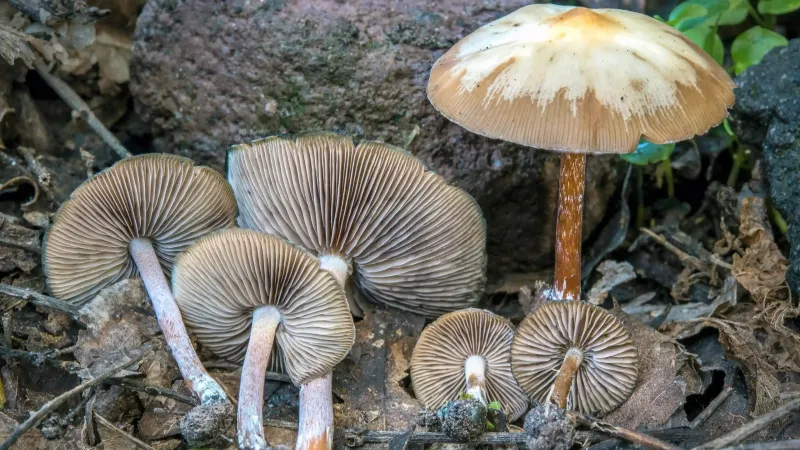
Psilocybe caerulescens fruiting bodies
Scientific Classification
Kingdom:Fungi
Division:Basidiomycota
Class:Agaricomycetes
Order:Agaricales
Family:Strophariaceae
Genus:Psilocybe
Frequently Asked Questions
- What is Derrumbes?
- Derrumbes (Psilocybe caerulescens) is a mushroom species, belonging to the Strophariaceae family. It is studied for its biological characteristics and is documented in the ShroomSpy mycology database.
- Is Derrumbes edible?
- Psychoactive, not for culinary use. Psilocybe caerulescens contains psilocybin and psilocin, tryptamine compounds that produce hallucinations and profound alterations of consciousness. It is one of the sacred Mazatec ceremonial species used by the curandera Maria Sabina, and was the first Psilocybe scientifically recognized as psychoactive by R. Gordon Wasson in 1955. Possession and use are illegal in many jurisdictions; verify local law before any handling.
- Is Derrumbes psychoactive?
- Derrumbes is documented as a psychoactive species. It contains psychoactive compounds that may produce mind-altering effects. Laws governing possession and use vary by jurisdiction.
- What effects does Derrumbes produce?
- Derrumbes is associated with the following effects: Focus. Individual experiences vary based on dose, set, and setting.
- What is the scientific classification of Derrumbes?
- Derrumbes belongs to the kingdom Fungi, division Basidiomycota, class Agaricomycetes, order Agaricales, family Strophariaceae, genus Psilocybe. Its scientific name is Psilocybe caerulescens.
About
Psilocybe caerulescens, known as Derrumbes or the Landslide Mushroom, is a psilocybin-producing species native to southern Mexico and subtropical South America. It fruits gregariously to cespitosely on disturbed, muddy, or humus-rich soils, often along ravines, landslides, and near corn or coffee plantations. Handling bruises the flesh and stem a distinctive blue, reflecting the psilocybin and psilocin it contains.
History
Psilocybe caerulescens is among the most historically significant of the sacred Mesoamerican mushrooms. Collected by Richard Schultes and Blas Pablo Reko near Huautla de Jiménez in 1938, it was the species ingested by R. Gordon Wasson during his 1955 velada with the Mazatec curandera María Sabina — the event that introduced "magic mushrooms" to the wider world through Wasson's 1957 Life magazine essay. It was the first Psilocybe recognized as psychoactive in the modern record. Together with P. aztecorum, it is a likely candidate for the teonanácatl referenced by Sahagún among the Aztecs.
Overview
The cap is 2 to 9 cm broad, deep olive black when young and strongly hygrophanous, fading to dark reddish or chestnut brown. The stem reaches 120 mm, often extends into a long pseudorhiza, and bruises bluish to azure when handled. Gills are grayish to soot brown with whitish edges. The species is a saprotroph of disturbed and muddy ground. It is psychoactive and used ceremonially; it is not a culinary mushroom, and its possession or use is restricted by law in many regions.
Physical Characteristics
Caps:
2 to 9 cm broad, obtusely campanulate to convex, smooth and slightly viscid when moist. Deep olive black when young, strongly hygrophanous, fading with age to dark reddish brown or chestnut brown near the disc. Margin often bluish and translucent-striate.
Gills:
Sinuate to adnate, close, broad, grayish to soot brown with whitish edges, darkening with spore maturity.
Cognitive Effects
Focus
Derrumbe (P. caerulescens) has traditional use in Mazatec healing ceremonies focused on divination and clear-minded problem solving at moderate dose.
Psychoactive Effects
Hallucinogenic
P. caerulescens produces pronounced psilocybin-mediated hallucinations; the species has been used ceremonially by Mazatec healers including María Sabina.
Spiritual
One of the primary velada ceremony mushrooms in Mazatec tradition, P. caerulescens is revered for facilitating contact with healing spirits.
Insightful
Strong introspective and revelatory effects are culturally documented and align with its traditional use in diagnosing illness and spiritual afflictions.
Euphoric
Substantial euphoric elevation is reported alongside the visionary experience.
Chemical Constituents
Medicinal Chemistry
Mushroom Ratings
0.0
Based on 0 Reviews
5
★4
★3
★2
★1
★Share your thoughts
If you've consumed this mushroom, share your thoughts with our community