Last updated:
Psilocybe stuntzii
"Stuntz's Blue Legs, Blue Ringer Mushroom, Stuntz's Psilocybe, Blue Ringers"
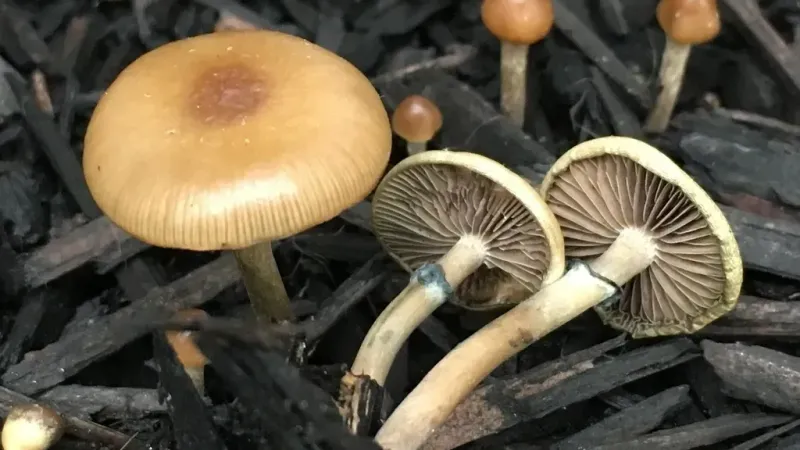
Psilocybe stuntzii fruiting bodies
Scientific Classification
Kingdom:Fungi
Division:Basidiomycota
Class:Agaricomycetes
Order:Agaricales
Family:Strophariaceae
Genus:Psilocybe
Frequently Asked Questions
- What is Stuntz's Blue Legs?
- Stuntz's Blue Legs (Psilocybe stuntzii) is a mushroom species, belonging to the Strophariaceae family. It is studied for its biological characteristics and is documented in the ShroomSpy mycology database.
- Is Stuntz's Blue Legs edible?
- Psychoactive, NOT a food mushroom. Psilocybe stuntzii contains psilocybin and psilocin and is hallucinogenic; potency is low (roughly half that of Psilocybe semilanceata). CRITICAL DANGER: it is a small brown ringed mushroom that grows in the same lawns, wood chips and pastures as the deadly amatoxin-containing Galerina autumnalis (and Pholiotina filaris) — the two have been found growing entwined, side by side. Amatoxin poisoning causes delayed (6-24 hour) onset of severe vomiting and diarrhea followed by fatal liver and kidney failure; one teenager died after mistaking Galerina for a Psilocybe. The only reliable separation is spore-print color (Psilocybe = dark purple-brown; Galerina = rusty brown). Never consume wild Psilocybe stuntzii; a single misidentification can be lethal.
- Is Stuntz's Blue Legs psychoactive?
- Stuntz's Blue Legs is documented as a psychoactive species. It contains psychoactive compounds that may produce mind-altering effects. Laws governing possession and use vary by jurisdiction.
- What is the scientific classification of Stuntz's Blue Legs?
- Stuntz's Blue Legs belongs to the kingdom Fungi, division Basidiomycota, class Agaricomycetes, order Agaricales, family Strophariaceae, genus Psilocybe. Its scientific name is Psilocybe stuntzii.
About
Psilocybe stuntzii is a small, fragile, blue-bruising mushroom of the Pacific Northwest. Its hygrophanous cap is conic to convex (1.5-5 cm), dark chestnut to olive-brown, fading to tan or pale yellow as it dries, and is covered by a thin separable gelatinous pellicle. A distinguishing feature is the persistent membranous annulus (ring) on its slender stem, which often bruises bluish. The spore print is dark purple-brown. It contains the psychoactive compounds psilocybin and psilocin, though at low potency relative to other bluing Psilocybe species.
History
Psilocybe stuntzii is a recently described species, not an ancient ceremonial mushroom. In the fall of 1972, large numbers of a strongly blue-bruising, ringed mushroom appeared on bark mulch spread across the University of Washington campus in Seattle. It was formally named Psilocybe stuntzii by mycologists Gastón Guzmán and Jonathan Ott in 1976, honoring Dr. Daniel Stuntz, who made the type collections. Within a few years it became one of the most commonly used wild psilocybin mushrooms in the Pacific Northwest, spreading readily through landscaping wood chips and newly laid lawns.
Overview
Psilocybe stuntzii fruits gregariously to cespitose from late summer into early winter on conifer wood chips, bark mulch, soils rich in woody debris, and new lawns, alongside Psilocybe semilanceata in pastures. It is abundant in Oregon, Washington and British Columbia. Its great danger lies in its strong resemblance to the deadly Galerina autumnalis, an amatoxin-containing mushroom that shares the same habitat and has been found growing intertwined with it; fatal poisonings have resulted from confusing the two. The key, life-saving distinction is the spore print: purple-brown in P. stuntzii versus rusty brown in Galerina. Reported chemical analyses (Beug & Bigwood; Repke et al.) found up to roughly 0.36% psilocybin, 0.12% psilocin and 0.02% baeocystin on a dry-weight basis.
Physical Characteristics
Caps:
The cap is conical to bell-shaped, measuring 1.5 to 5 cm in diameter, with a smooth, moist surface that is initially light brown and becomes darker with age, often developing a bluish tint when bruised.
Gills:
The gills are attached to the stem, closely spaced, and initially light gray to pale brown, becoming darker with maturity.
Psychoactive Effects
Hallucinogenic
Psilocybe stuntzii contains psilocybin and psilocin, which can produce visual and sensory hallucinations; potency is low relative to other bluing Psilocybe species.
Euphoric
Like other psilocybin mushrooms, sessions may involve elevated mood and euphoria, though effects vary widely with dose and individual.
Chemical Constituents
Medicinal Chemistry
Mushroom Ratings
0.0
Based on 0 Reviews
5
★4
★3
★2
★1
★Share your thoughts
If you've consumed this mushroom, share your thoughts with our community