Last updated:
Psilocybe subaeruginascens
"Subaeruginascens"
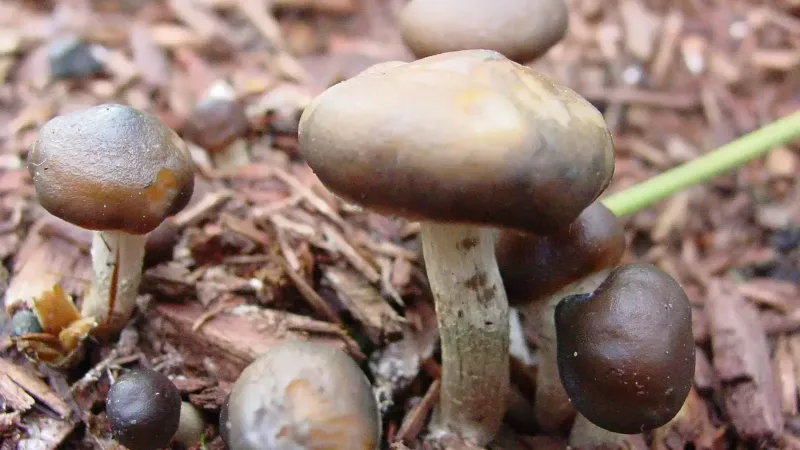
Psilocybe subaeruginascens fruiting bodies
Scientific Classification
Kingdom:Fungi
Division:Basidiomycota
Class:Agaricomycetes
Order:Agaricales
Family:Strophariaceae
Genus:Psilocybe
Frequently Asked Questions
- What is Subaeruginascens?
- Subaeruginascens (Psilocybe subaeruginascens) is a mushroom species, belonging to the Strophariaceae family. It is studied for its biological characteristics and is documented in the ShroomSpy mycology database.
- Is Subaeruginascens edible?
- Psychoactive, not a culinary mushroom. Contains psilocybin and psilocin and produces strong bruising-blue staining; ingestion causes hallucinations and altered states of consciousness. Possession and use are illegal in most jurisdictions. Easily confused with the deadly Galerina marginata, so wild collection carries serious risk.
- Is Subaeruginascens psychoactive?
- Subaeruginascens is documented as a psychoactive species. It contains psychoactive compounds that may produce mind-altering effects. Laws governing possession and use vary by jurisdiction.
- What effects does Subaeruginascens produce?
- Subaeruginascens is associated with the following effects: Memory. Individual experiences vary based on dose, set, and setting.
- What is the scientific classification of Subaeruginascens?
- Subaeruginascens belongs to the kingdom Fungi, division Basidiomycota, class Agaricomycetes, order Agaricales, family Strophariaceae, genus Psilocybe. Its scientific name is Psilocybe subaeruginascens.
About
Psilocybe subaeruginascens is a small, wood-loving psychoactive mushroom in the family Strophariaceae, containing the indole alkaloids psilocybin and psilocin. It has an orange-brown to olive- or greenish-brown conic to convex cap 1 to roughly 6 cm across that is viscid when moist and hygrophanous, fading to dull yellow-orange as it dries. The gills are broadly attached and grayish to dark brown at maturity, and the slender whitish stem carries a persistent membranous ring (annulus); all parts bruise bluish where injured. It is regarded as weakly to moderately active.
History
Psilocybe subaeruginascens was originally described by the mycologist Franz von Höhnel and is treated as the same species as Psilocybe aerugineomaculans. It is a distinctly Asian species, documented from temperate southern Japan and subtropical Indonesia, and is thought to be distributed between those regions. Chemical studies, including work by Koike and colleagues in the early 1980s, confirmed the presence of psilocybin and psilocin, placing it among the bluing, psilocybin-producing Psilocybe.
Overview
Ecologically the mushroom is a decomposer that grows gregariously to clustered on soils enriched with woody debris, in wood chips, and in wood chips mixed with horse dung, often along trails and roadsides bordering deciduous forest. It can fruit in large colonies. The most reliable field traits are the membranous ring on the stem and the prompt bluing of bruised tissue. A critical safety note: it closely resembles the deadly Galerina marginata, which contains lethal amatoxins; the rusty-brown spore deposit and lack of blue bruising distinguish Galerina, but misidentification can be fatal.
Physical Characteristics
Caps:
The cap is conical to bell-shaped, measuring 1.5 to 5 cm in diameter, with a smooth, moist surface that can appear slightly sticky. It is typically brown to yellow-brown, fading to a lighter color with age.
Gills:
The gills are attached to the stem, closely spaced, and initially light brown, becoming darker as the spores mature.
Cognitive Effects
Memory
Psilocybin from P. subaeruginascens promotes hippocampal neuroplasticity in animal studies, a mechanism relevant to associative memory formation.
Psychoactive Effects
Hallucinogenic
P. subaeruginascens produces characteristic psilocybin-mediated hallucinations; aeruginascin content may modulate receptor binding and softens dysphoric edge.
Euphoric
Strong mood elevation and euphoria are hallmarks of P. subaeruginascens experiences, attributed to psilocin serotonergic activity.
Insightful
Introspective insight and increased cognitive flexibility are central subjective features of P. subaeruginascens sessions at moderate to high doses.
Visuals
Pronounced visual phenomena including complex geometric patterns and color enhancement at doses above 1.5g dried weight.
Chemical Constituents
Medicinal Chemistry
Mushroom Ratings
0.0
Based on 0 Reviews
5
★4
★3
★2
★1
★Share your thoughts
If you've consumed this mushroom, share your thoughts with our community