Last updated:
Sarcodon Cyrneus
"Cyrene Amethyst Deceiver"
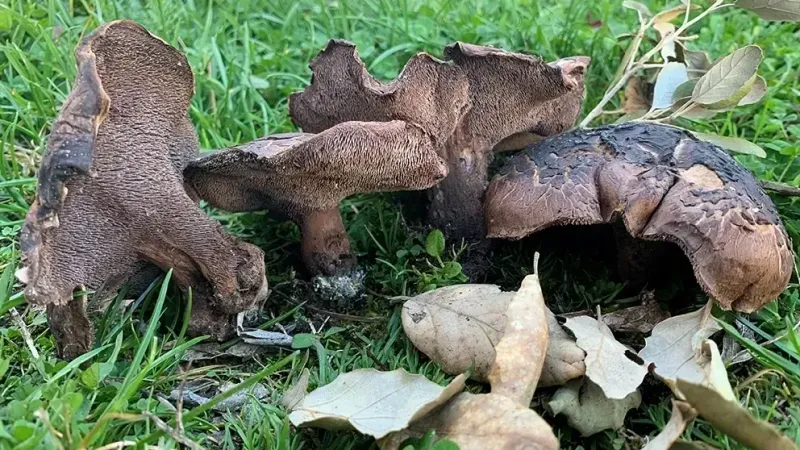
Sarcodon cyrneus fruiting bodies
Scientific Classification
Kingdom:Fungi
Division:Basidiomycota
Class:Agaricomycetes
Order:Thelephorales
Family:Bankeraceae
Genus:Sarcodon
Frequently Asked Questions
- What is Cyrene Amethyst Deceiver?
- Cyrene Amethyst Deceiver (Sarcodon Cyrneus) is a mushroom species, belonging to the Bankeraceae family. It is studied for its biological characteristics and is documented in the ShroomSpy mycology database.
- Is Cyrene Amethyst Deceiver edible?
- edible
- What is the scientific classification of Cyrene Amethyst Deceiver?
- Cyrene Amethyst Deceiver belongs to the kingdom Fungi, division Basidiomycota, class Agaricomycetes, order Thelephorales, family Bankeraceae, genus Sarcodon. Its scientific name is Sarcodon Cyrneus.
About
Sarcodon cyrneus, commonly referred to as the Cyrene Amethyst Deceiver, is a rare and visually striking tooth fungus known for its violet to purplish hues and spiny undersurface. Belonging to the Sarcodon genus, it is typically found in Mediterranean and subalpine forests, forming mycorrhizal relationships with coniferous trees. Although not widely consumed, its vivid coloration and rarity have attracted the attention of mycologists and mushroom enthusiasts.
History
Named after the island of Corsica (anciently known as Cyrne), S. cyrneus was first described in the 20th century and remains one of the lesser-known members of the Sarcodon genus. Its nickname as a “deceiver” is inspired by its color resemblance to Laccaria amethystina (Amethyst Deceiver), though the two are unrelated and structurally quite different.
While Sarcodon species are more common in temperate forests, S. cyrneus has a more restricted Mediterranean range. It is not traditionally used in medicine or cuisine but is valuable ecologically and taxonomically.
Overview
The cap is typically 5–12 cm wide, convex to depressed in shape, and displays shades of amethyst, violet, or grayish-lilac. The underside features soft, purplish spines instead of gills—typical of hydnoid fungi. It grows on soil, often under pine or fir trees, and fruits in late summer to autumn.
Although considered non-toxic, it is not commonly consumed due to its tough texture and bitter flavor. Its main significance lies in its role in forest ecosystems as a mycorrhizal partner, aiding in nutrient exchange between soil and trees.
Flavors
Bitter
Intense bitter taste
Astringent
Drying, puckering flavor
Textures
Firm
Dense, fleshy texture
Fragrances
Pungent
Strong acidic, sharp odor
Physical Characteristics
Caps:
Convex to flat, 5-15 cm wide. Scaly grayish brown.
Gills:
Tooth-like spines instead of gills, grayish.
Pharmacology
Helps With
Inflammation
Contains anti-inflammatory diterpenes
Cyrene Amethyst Deceiver Products
Explore Cyrene Amethyst Deceiver products from independent vendors
Similar Species
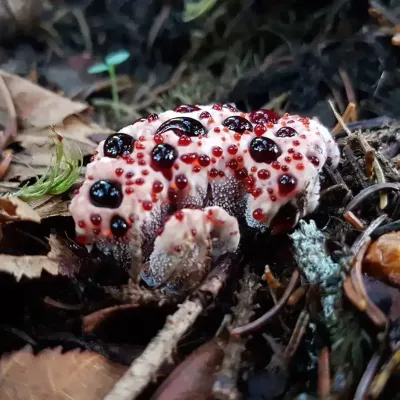
Species: Hydnellum Peckii
(bleeding tooth fungus)
Edibility: Non-edible. Hydnellum peckii is not toxic, but it is inedible due to its extremely tough, woody flesh and intensely bitter taste. It is not used as a food mushroom.
Key Differences: Red fluid oozes from the cap, lacks scaly texture
Species: Hydnellum Peckii
(bleeding tooth fungus)
Edibility: Non-edible. Hydnellum peckii is not toxic, but it is inedible due to its extremely tough, woody flesh and intensely bitter taste. It is not used as a food mushroom.
Key Differences: Red fluid oozes from the cap, lacks scaly texture
Mushroom Ratings
4.5
(2)
Based on 2 Reviews
5
★4
★3
★2
★1
★Share your thoughts
If you've consumed this mushroom, share your thoughts with our community
01/29/2025
Zack Mooney
ArousedCalmContentCreativityFocusEnergyDizzyHeadache
Foraged some Amethyst Deceiver mushrooms - they look cool with those purple colors. Dried them out and tried some.
Energy picked up and creative ideas started flowing which was nice for art stuff. Felt calm but focused, not overwhelmed like usual. Good combo for getting things done.
Did get dizzy and a mild headache so start small and see how it hits you. Seems to help with anxiety and stress too which honestly most of us need. Just forage responsibly and know what you're picking. If you're into wild mushrooms and want something that helps mental clarity, worth trying
01/29/2025
Thomas Folbrecht
CalmCreativityEuphoricFocusPerceptualRelaxedDizzyHeadache
Tried Cyrene Amethyst Deceiver and the purple/brown colors are really cool looking. Earthy robust flavor that made my dishes richer. Good for cooking.
After eating felt this calm wash over me plus a creativity boost - got a lot of writing done. Moments felt more vivid, almost euphoric. Perception heightened a bit.
But got dizzy and a mild headache when I ate too much, so start small and see how you handle it. Seems to help with anxiety, inflammation, and digestion based on how I've been feeling. Worth trying if you want something flavorful with potential benefits
2 people found this helpful