Last updated:
Scleroderma citrinum
"Common Earthball, Pigskin Poison Puffball, Yellow Earthball"
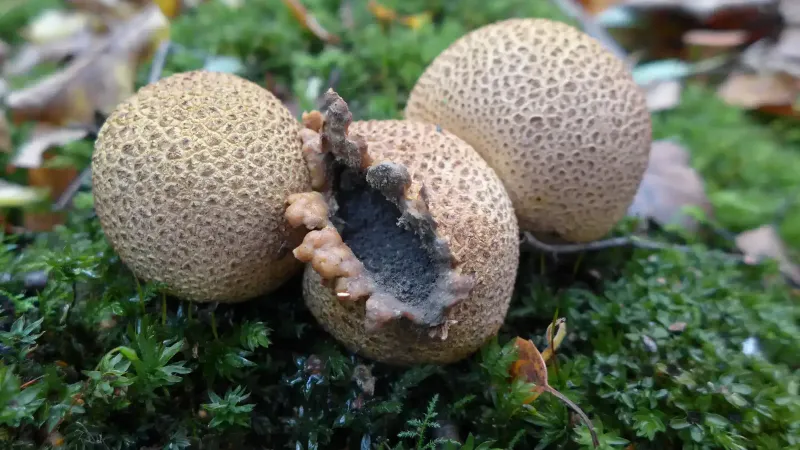
Scleroderma citrinum fruiting bodies
Scientific Classification
Kingdom:Fungi
Division:Basidiomycota
Class:Agaricomycetes
Order:Agaricales
Family:Sclerodermataceae
Genus:Scleroderma
Frequently Asked Questions
- What is Common Earthball?
- Common Earthball (Scleroderma citrinum) is a mushroom species, belonging to the Sclerodermataceae family. It is studied for its biological characteristics and is documented in the ShroomSpy mycology database.
- Is Common Earthball edible?
- Poisonous - do NOT eat. Scleroderma citrinum (the pigskin poison puffball) is toxic and is not edible. Ingestion causes gastrointestinal poisoning - nausea, vomiting, abdominal cramps, and diarrhoea typically begin within about 1-4 hours. Reactions can be serious: a documented case records a pot-bellied pig dying several hours after eating a single specimen, and Scleroderma species have caused liver damage and death in dogs. The tough, thick-skinned fruiting body is easily mistaken for an edible puffball, but its interior turns purplish-black at maturity (edible puffballs stay pure white inside) and it can also resemble the deadly destroying angel (Amanita virosa) in its button stage. Always cut any suspected puffball in half before considering it - if it is not uniformly white inside, discard it.
- What is the scientific classification of Common Earthball?
- Common Earthball belongs to the kingdom Fungi, division Basidiomycota, class Agaricomycetes, order Agaricales, family Sclerodermataceae, genus Scleroderma. Its scientific name is Scleroderma citrinum.
About
Scleroderma citrinum, the common earthball or pigskin poison puffball, is a poisonous, puffball-like fungus recognised by its tough, scaly, yellow-brown rind and firm flesh that turns purplish-black as its spores ripen. The ball-shaped fruiting body, usually 2.5-7.5 cm across, sits directly on the ground without a stem and is ectomycorrhizal, forming root partnerships with oaks, beeches, birches and conifers. It is common in woods and on heaths across the north temperate zone. Despite its superficial resemblance to edible puffballs, S. citrinum is toxic and must not be eaten.
History
The common earthball was described by the mycologist Christian Hendrik Persoon in 1801, in his Synopsis Methodica Fungorum. The genus name Scleroderma comes from the Greek skleros ("hard") and derma ("skin"), describing the tough outer rind, while the epithet citrinum means "lemon-yellow". For much of the twentieth century it was widely catalogued under the synonym S. aurantium. It has never been a food or medicinal staple because of its toxicity, though it has occasionally been used in central Europe - improperly - to adulterate truffle products, a practice strongly discouraged given its poisonous nature.
Overview
Ecologically, Scleroderma citrinum is an important mycorrhizal partner, exchanging soil nutrients with its host trees, and it is itself frequently parasitised by the bolete Pseudoboletus (Boletus) parasiticus, which fruits directly on its surface. It is not cultivated and has no culinary value. The most important practical fact about this species is its toxicity: it is regularly confused with edible puffballs and, in its young button form, can be mistaken for deadly Amanita species. Key separating features are the thick warty rind, the firm flesh that matures to a marbled purplish-black, and the absence of a true stem. Cutting any puffball in half to check for a uniformly white interior is the single most reliable safeguard against poisoning.
Physical Characteristics
Caps:
There is no true cap. The fruiting body is a rounded, often flattened or slightly lobed ball 2.5-7.5 cm (occasionally to 10 cm) across, dull yellow to ochre or clay-brown, with a thick, firm, scaly to warty rind. Cut when immature the flesh is white to pinkish; as the spores mature it becomes marbled purplish-black before splitting irregularly to release the spore mass.
Gills:
None. As a puffball-like (gasteroid) fungus it produces no gills; spores develop internally in a purplish-black spore mass.
Mushroom Ratings
0.0
Based on 0 Reviews
5
★4
★3
★2
★1
★Share your thoughts
If you've consumed this mushroom, share your thoughts with our community