Last updated:
Suillus granulatus
"granulated bolete, slippery jack"
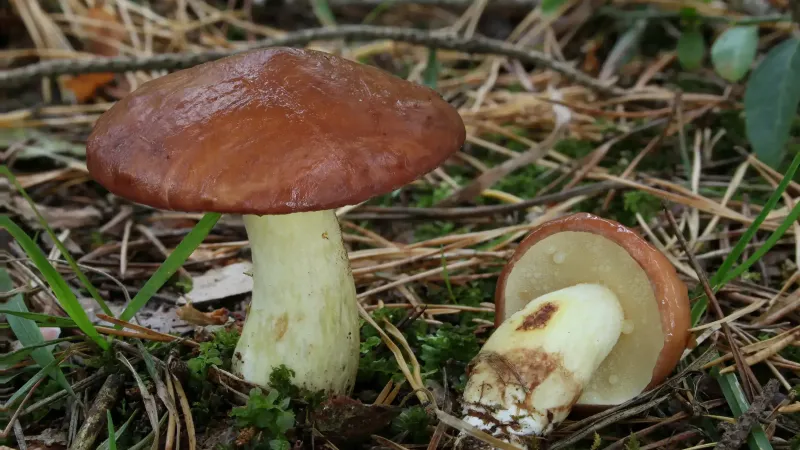
Suillus granulatus fruiting bodies
Scientific Classification
Kingdom:Fungi
Division:Basidiomycota
Class:Agaricomycetes
Order:Boletales
Family:Suillaceae
Genus:Suillus
Frequently Asked Questions
- What is granulated bolete?
- granulated bolete (Suillus granulatus) is a mushroom species, belonging to the Suillaceae family. It is studied for its biological characteristics and is documented in the ShroomSpy mycology database.
- Is granulated bolete edible?
- Edible when cooked. The glutinous cap cuticle and the slimy tube layer are best removed before cooking, as they can cause gastrointestinal upset (nausea, malaise) in some people, especially when eaten raw or in quantity. Of modest culinary value compared with porcini.
- What effects does granulated bolete produce?
- granulated bolete is associated with the following effects: Energy. Individual experiences vary based on dose, set, and setting.
- What is the scientific classification of granulated bolete?
- granulated bolete belongs to the kingdom Fungi, division Basidiomycota, class Agaricomycetes, order Boletales, family Suillaceae, genus Suillus. Its scientific name is Suillus granulatus.
About
Suillus granulatus is a slippery-capped bolete of pine forests, easily recognised by its smooth, glutinous ochre-brown cap, pale yellow pores that weep milky droplets when young, and a ringless stem speckled near the apex with fine granular dots. It is edible after the slimy cap skin and tube layer are removed, though it is of modest culinary standing. As an ectomycorrhizal partner of pines it plays an important role in forest nutrient cycling.
History
The species was described in the late 18th century and its epithet granulatus, Latin for "granulated," refers to the glandular dots on the upper stem rather than the cap. Long gathered across Europe and parts of Asia, it features in central European and Russian foraging traditions, where the slimy cuticle is peeled before cooking. It is one of the better-known members of the genus Suillus, the so-called slippery jacks named for their viscid caps.
Overview
Suillus granulatus is a wild-harvested mycorrhizal fungus rather than a cultivated crop, forming symbiotic associations with pine roots that aid nutrient and water uptake for the host tree. Its commercial significance is limited next to prized boletes such as porcini, but it is collected locally where pine forests are common. Key identification features are the smooth slimy cap (it is not warty), the milky-weeping young pores, and the granular dots on the stem; the lack of a ring and the pine association help separate it from the related ringed Suillus luteus.
Physical Characteristics
Caps:
Convex becoming flat, 4-12 cm across, ochre to cinnamon-brown, with a smooth, glutinous (slimy) surface when moist - not warty. Slime dries to a shiny gloss.
Gills:
None - the underside bears pores, not gills. Tubes and pores are pale yellow, often exuding milky-white droplets when young (hence 'weeping bolete'); they age to dull yellow.
Cognitive Effects
Energy
S. granulatus provides a well-rounded nutritional profile with B vitamins supporting energy metabolism.
Nutrition Facts
Serving Size100
Amount Per Serving
Calories270
% Daily Value*
Total Fat 3 g4%
Saturated Fat 0 g0%
Trans Fat 0 g
Cholesterol 0 mg0%
Sodium 15 mg1%
Total Carbohydrate 48 g17%
Dietary Fiber 16 g57%
Total Sugars 0 g
Protein 19 g38%
Vitamin A 0 µg 0%•Thiamin B1 0 mg 0%
Riboflavin B2 0 mg 0%•Niacin B3 0 mg 0%
Vitamin B6 0 mg 0%•Folate B9 0 µg 0%
Vitamin B12 0 mg 0%•Vitamin C 0 mg 0%
Vitamin D 7 µg 35%•Vitamin E 0 mg 0%
Vitamin K 0 µg 0%•Calcium 0 mg 0%
Copper 0 mg 0%•Iron 0 mg 0%
Magnesium 0 mg 0%•Manganese 0 mg 0%
Phosphorus 330 mg 26%•Potassium 1750 mg 37%
Selenium 14 µg 25%•Zinc 0 mg 0%
Vit A 0 µg 0%•B1 0 mg 0%
B2 0 mg 0%•B3 0 mg 0%
B6 0 mg 0%•B9 0 µg 0%
B12 0 mg 0%•Vit C 0 mg 0%
Vit D 7 µg 35%•Vit E 0 mg 0%
Vit K 0 µg 0%•Calcium 0 mg 0%
Copper 0 mg 0%•Iron 0 mg 0%
Mg 0 mg 0%•Mn 0 mg 0%
Phosph. 330 mg 26%•Pot. 1750 mg 37%
Selenium 14 µg 25%•Zinc 0 mg 0%
* Percent Daily Values are based on a 2,000 calorie diet.
Mushroom Ratings
0.0
Based on 0 Reviews
5
★4
★3
★2
★1
★Share your thoughts
If you've consumed this mushroom, share your thoughts with our community