Last updated:
Termitomyces robustus
"Termite Mushroom, Robust Termitomyces"
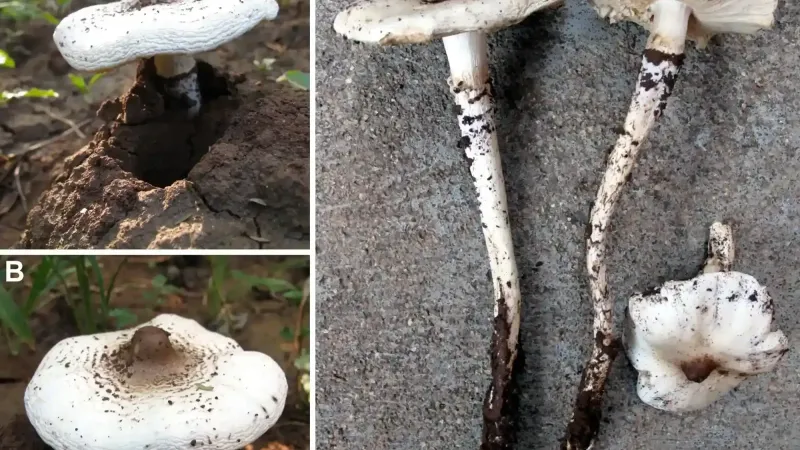
Termitomyces robustus fruiting bodies
Scientific Classification
Kingdom:Fungi
Division:Basidiomycota
Class:Agaricomycetes
Order:Agaricales
Family:Termitomycetaceae
Genus:Termitomyces
Frequently Asked Questions
- What is Termite Mushroom?
- Termite Mushroom (Termitomyces robustus) is a mushroom species, belonging to the Termitomycetaceae family. It is studied for its biological characteristics and is documented in the ShroomSpy mycology database.
- Is Termite Mushroom edible?
- edible - considered a delicacy in some cultures, but should be properly identified before consumption.
- What effects does Termite Mushroom produce?
- Termite Mushroom is associated with the following effects: Energy. Individual experiences vary based on dose, set, and setting.
- What is the scientific classification of Termite Mushroom?
- Termite Mushroom belongs to the kingdom Fungi, division Basidiomycota, class Agaricomycetes, order Agaricales, family Termitomycetaceae, genus Termitomyces. Its scientific name is Termitomyces robustus.
About
Termitomyces robustus is a large, choice edible mushroom that grows in an obligate association with fungus-farming termites of the subfamily Macrotermitinae. Its fruiting bodies arise from termite nests, especially aged or abandoned mounds, pushing up from deep underground via a long root-like "pseudorhiza" before opening into a smooth, pale-to-brown cap above a sturdy white stem. It occurs across tropical and subtropical regions, including central and West Africa and parts of Southeast Asia (such as Myanmar and southwestern China), and is prized in local cuisines for its dense, meaty flesh and rich savory flavor.
History
Termitomyces robustus has long been gathered from the wild as a seasonal delicacy, appearing during the rains when its mushrooms emerge from termite mounds. In central Africa it is highly favored as a delicious edible, and in southwestern China (Yunnan) and Burma (Myanmar) giant termite mushrooms are sold at roadside markets alongside other choice wild edibles. The way termites cultivate these fungi underground, and how the mushroom forms a long taproot reaching upward to the surface, has fascinated mycologists for generations.
Overview
The defining feature of T. robustus is its symbiosis with termites: the fungus is cultivated within the nest's fungus combs, and the visible mushroom is the reproductive stage that breaks the surface, often only after the colony is abandoned. This intimate dependence makes the species essentially impossible to cultivate commercially in the way button mushrooms are, so supply remains tied to wild collection from termite-mound habitats. Beyond its culinary value, preliminary laboratory research has noted a hypoglycemic (blood-sugar lowering) effect in extracts, though such findings are early and not a basis for medicinal use.
Physical Characteristics
Caps:
The cap is convex to broadly bell-shaped, measuring 5 to 15 cm in diameter, with a smooth, pale to dark brown surface that may become slightly sticky when moist.
Gills:
Gills are free, closely spaced, and white to cream in color, turning yellowish with age.
Cognitive Effects
Energy
T. robustus is among the highest-protein edible mushrooms per dry weight, providing essential amino acids that support physical energy and muscle recovery.
Pharmacology
Helps With
Immune System
Polysaccharide fractions from Termitomyces spp. show beta-glucan structures that may activate macrophage and complement immune pathways.
Digestion
T. robustus is a dietary staple in sub-Saharan Africa and West Africa; its fiber content supports gut motility and digestive health.
Nutrition Facts
Serving Size100
Amount Per Serving
Calories310
% Daily Value*
Total Fat 4 g5%
Saturated Fat 0.6 g3%
Trans Fat 0 g
Cholesterol 0 mg0%
Sodium 20 mg1%
Total Carbohydrate 46 g17%
Dietary Fiber 18 g64%
Total Sugars 0 g
Protein 28 g56%
Vitamin A 0 µg 0%•Thiamin B1 0 mg 0%
Riboflavin B2 0 mg 0%•Niacin B3 14 mg 88%
Vitamin B6 0 mg 0%•Folate B9 0 µg 0%
Vitamin B12 0 mg 0%•Vitamin C 0 mg 0%
Vitamin D 5 µg 25%•Vitamin E 0 mg 0%
Vitamin K 0 µg 0%•Calcium 0 mg 0%
Copper 1.4 mg 156%•Iron 4.5 mg 25%
Magnesium 0 mg 0%•Manganese 0 mg 0%
Phosphorus 420 mg 34%•Potassium 2000 mg 43%
Selenium 22 µg 40%•Zinc 6 mg 55%
Vit A 0 µg 0%•B1 0 mg 0%
B2 0 mg 0%•B3 14 mg 88%
B6 0 mg 0%•B9 0 µg 0%
B12 0 mg 0%•Vit C 0 mg 0%
Vit D 5 µg 25%•Vit E 0 mg 0%
Vit K 0 µg 0%•Calcium 0 mg 0%
Copper 1.4 mg 156%•Iron 4.5 mg 25%
Mg 0 mg 0%•Mn 0 mg 0%
Phosph. 420 mg 34%•Pot. 2000 mg 43%
Selenium 22 µg 40%•Zinc 6 mg 55%
* Percent Daily Values are based on a 2,000 calorie diet.
Mushroom Ratings
0.0
Based on 0 Reviews
5
★4
★3
★2
★1
★Share your thoughts
If you've consumed this mushroom, share your thoughts with our community