Last updated:
Tricholoma Pardinum
"Tiger Tricholoma, Tigertop, Spotted Tricholoma, Dirty Tricholoma"
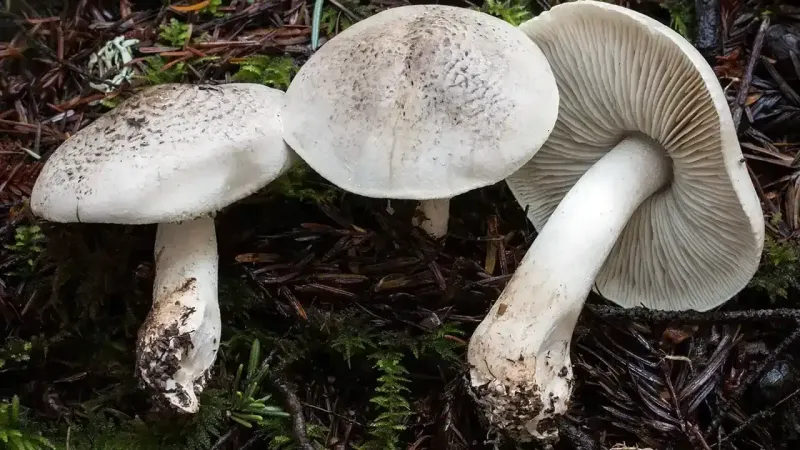
Tricholoma pardinum fruiting bodies
Scientific Classification
Kingdom:Fungi
Division:Basidiomycota
Class:Agaricomycetes
Order:Agaricales
Family:Tricholomataceae
Genus:Tricholoma
Frequently Asked Questions
- What is Tiger Tricholoma?
- Tiger Tricholoma (Tricholoma Pardinum) is a mushroom species, belonging to the Tricholomataceae family. It is studied for its biological characteristics and is documented in the ShroomSpy mycology database.
- Is Tiger Tricholoma edible?
- Poisonous - do NOT eat. Tricholoma pardinum is one of the most common causes of serious mushroom poisoning in Europe. Ingestion produces violent gastrointestinal poisoning - severe nausea, repeated vomiting, profuse diarrhea, abdominal cramps, sweating, and dizziness - typically beginning within 1 to 4 hours. Symptoms can be intense and prolonged, occasionally requiring hospitalization for dehydration, though recovery with supportive care usually occurs within 24 to 48 hours. It is dangerous partly because it superficially resembles several edible Tricholoma species. Never consume this mushroom.
- What is the scientific classification of Tiger Tricholoma?
- Tiger Tricholoma belongs to the kingdom Fungi, division Basidiomycota, class Agaricomycetes, order Agaricales, family Tricholomataceae, genus Tricholoma. Its scientific name is Tricholoma Pardinum.
About
Tricholoma pardinum, widely known as the Tiger Tricholoma or Tigertop, is a robust gray-capped woodland mushroom notorious as a poisonous species. It is one of the most frequently implicated causes of serious gastrointestinal mushroom poisoning in Europe. The cap is grayish, dry, and broken into darker fibrous scales over a paler ground, giving the spotted or "tiger-striped" look that names it; the flesh is white and firm and the gills are whitish to cream. It grows on the ground in coniferous and mixed forests, often on calcareous soil, as a mycorrhizal partner of trees. Its danger lies largely in its resemblance to several edible Tricholoma species, which leads foragers to mistake it for a meal.
History
Tricholoma pardinum has long been recorded in European mycological literature as a hazardous mushroom. The species epithet pardinum derives from the Latin for "leopard" or "panther," referring to the spotted, scaly cap rather than any culinary or pardoning quality. Across the foraging regions of Europe it has been responsible for repeated and well-documented poisoning episodes, and field guides consistently list it among the species that account for a substantial share of serious mushroom-poisoning cases. Modern chemical research has isolated lanostane triterpenoids (the pardinols) from its fruiting bodies, studied only for laboratory bioactivity and not for any safe or medicinal human use.
Overview
Tricholoma pardinum is a wild, non-edible, poisonous mushroom of no culinary or commercial food value. Eating it causes a severe gastrointestinal toxic syndrome - intense vomiting, diarrhea, abdominal pain, sweating, and dizziness - usually within one to four hours of ingestion. The illness can be debilitating and may require medical care for fluid loss, although it is generally not fatal in humans and most people recover within a couple of days with supportive treatment. Because it can be confused with edible look-alikes, accurate identification is critical, and the safe rule is simple: do not eat it.
Physical Characteristics
Caps:
Convex to flat, 5-15 cm in diameter, with a smooth, slightly sticky surface; color ranges from pale gray to brown with darker scales.
Gills:
Free, closely spaced, white to cream in color, with a slightly serrated edge.
Mushroom Ratings
0.0
Based on 0 Reviews
5
★4
★3
★2
★1
★Share your thoughts
If you've consumed this mushroom, share your thoughts with our community