Last updated:
Tuber borchii
"Bianchetto truffle, Whitish truffle"
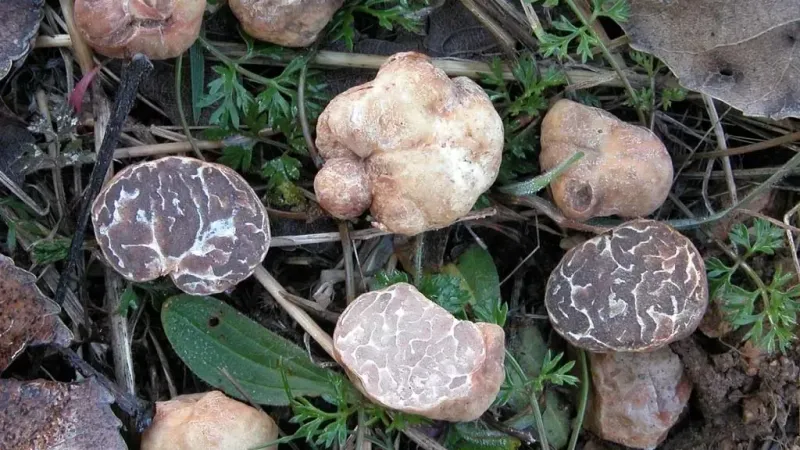
Tuber borchii fruiting bodies
Scientific Classification
Kingdom:Fungi
Division:Ascomycota
Class:Pezizomycetes
Order:Pezizales
Family:Tuberaceae
Genus:Tuber
Frequently Asked Questions
- What is Bianchetto truffle?
- Bianchetto truffle (Tuber borchii) is a mushroom species, belonging to the Tuberaceae family. It is studied for its biological characteristics and is documented in the ShroomSpy mycology database.
- Is Bianchetto truffle edible?
- Edible. A prized culinary truffle, though less valuable than the Italian white truffle (Tuber magnatum) or the Perigord black truffle (Tuber melanosporum). Like other truffles it is used in small amounts to flavour dishes for its garlicky, aromatic scent. Eat in moderation; allergic reactions are possible in sensitive individuals.
- What is the scientific classification of Bianchetto truffle?
- Bianchetto truffle belongs to the kingdom Fungi, division Ascomycota, class Pezizomycetes, order Pezizales, family Tuberaceae, genus Tuber. Its scientific name is Tuber borchii.
About
Tuber borchii, commonly known as the bianchetto or whitish truffle, is an edible ascomycete fungus prized in Italian cuisine. It should not be confused with the true Italian white truffle (Tuber magnatum), which is more valuable. T. borchii forms an irregular, pale cream to ochre underground fruiting body and grows in symbiotic (ectomycorrhizal) association with the roots of host trees such as oaks, hazels, pines and poplars, primarily in temperate regions of Europe, especially Italy.
History
Tuber borchii has long been gathered and used as a flavouring truffle in Italy, where it is locally cultivated. The genus name Tuber derives from the Latin for "swelling" or "tuber," reflecting the underground, knobby fruiting body. Although less famous than the Alba white truffle (Tuber magnatum) or the Perigord black truffle (Tuber melanosporum), it has attracted growing scientific interest, and it was among the first truffle species for which fruiting was achieved from seedlings inoculated with pure mycelial cultures.
Overview
As an ectomycorrhizal fungus, Tuber borchii forms a mutually beneficial relationship with its host trees, aiding their nutrient and water uptake while drawing carbon from the plant. It is one of the truffle species that can be cultivated, typically by raising host seedlings inoculated with truffle spores or mycelium. Its aroma is notably pungent and sulfurous, dominated by volatile sulfur compounds, and it is consumed in small quantities as a culinary seasoning rather than as a bulk food.
Flavors
Garlic
T. borchii has a characteristically garlicky, pungent flavor that distinguishes it from the more prized T. magnatum.
Earthy
Intense forest-floor earthiness with mushroom umami undertones that develop strongly with gentle heat.
Textures
Firm
Dense, firm flesh shaved thin; dissolves rapidly in fat during cooking, releasing aromatic volatiles.
Fragrances
Pungent
Powerful aroma dominated by dimethyl sulfide and bis(methylthio)methane — considerably more sulfurous than white truffle.
Physical Characteristics
Caps:
The fruiting body is irregularly shaped, typically 2-5 cm in diameter, with a smooth, pale white to yellowish exterior that may become slightly wrinkled as it matures.
Gills:
None
Nutrition Facts
Serving Size100
Amount Per Serving
Calories92
% Daily Value*
Total Fat 0.5 g1%
Saturated Fat 0 g0%
Trans Fat 0 g
Cholesterol 0 mg0%
Sodium 17 mg1%
Total Carbohydrate 17 g6%
Dietary Fiber 2 g7%
Total Sugars 0 g
Protein 9 g18%
Vitamin A 0 µg 0%•Thiamin B1 0 mg 0%
Riboflavin B2 0 mg 0%•Niacin B3 0 mg 0%
Vitamin B6 0 mg 0%•Folate B9 0 µg 0%
Vitamin B12 0 mg 0%•Vitamin C 6 mg 7%
Vitamin D 0 µg 0%•Vitamin E 0 mg 0%
Vitamin K 0 µg 0%•Calcium 0 mg 0%
Copper 0 mg 0%•Iron 1.8 mg 10%
Magnesium 0 mg 0%•Manganese 0 mg 0%
Phosphorus 0 mg 0%•Potassium 540 mg 11%
Selenium 0 µg 0%•Zinc 0 mg 0%
Vit A 0 µg 0%•B1 0 mg 0%
B2 0 mg 0%•B3 0 mg 0%
B6 0 mg 0%•B9 0 µg 0%
B12 0 mg 0%•Vit C 6 mg 7%
Vit D 0 µg 0%•Vit E 0 mg 0%
Vit K 0 µg 0%•Calcium 0 mg 0%
Copper 0 mg 0%•Iron 1.8 mg 10%
Mg 0 mg 0%•Mn 0 mg 0%
Phosph. 0 mg 0%•Pot. 540 mg 11%
Selenium 0 µg 0%•Zinc 0 mg 0%
* Percent Daily Values are based on a 2,000 calorie diet.
Mushroom Ratings
0.0
Based on 0 Reviews
5
★4
★3
★2
★1
★Share your thoughts
If you've consumed this mushroom, share your thoughts with our community