Last updated:
Verpa bohemica
"Early Morel, Wrinkled Thimble-cap, Bohemian Verpa, False Morel"
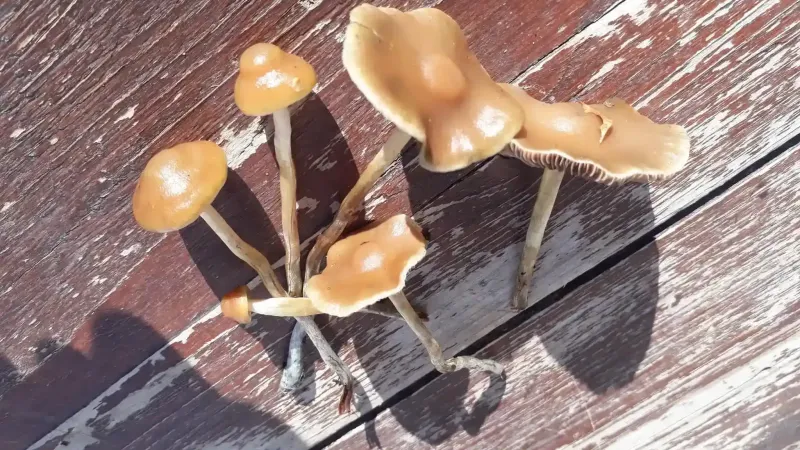
Verpa bohemica fruiting bodies
Scientific Classification
Kingdom:Fungi
Division:Ascomycota
Class:Pezizomycetes
Order:Morchellales
Family:Morchellaceae
Genus:Verpa
Frequently Asked Questions
- What is Early Morel?
- Early Morel (Verpa bohemica) is a mushroom species, belonging to the Morchellaceae family. It is studied for its biological characteristics and is documented in the ShroomSpy mycology database.
- Is Early Morel edible?
- Not recommended for consumption. Although Verpa bohemica is not considered lethally toxic like the true false morels (Gyromitra spp.), it is not a good edible and has caused poisonings: documented cases report gastrointestinal distress (cramps, nausea, vomiting), plus dizziness, disorientation, hypotension, and loss of coordination, especially when eaten in quantity, raw, or on consecutive days. It can be confused with the deadly Gyromitra esculenta. Best avoided.
- What is the scientific classification of Early Morel?
- Early Morel belongs to the kingdom Fungi, division Ascomycota, class Pezizomycetes, order Morchellales, family Morchellaceae, genus Verpa. Its scientific name is Verpa bohemica.
About
Verpa bohemica, commonly called the early morel or wrinkled thimble-cap, is a spring-fruiting ascomycete that superficially resembles a true morel but is set apart by a thimble-like cap attached to the stalk only at its apex, with a stem 'stuffed' with cottony mycelium rather than fully hollow. It fruits in spring, often in May, in damp ground near dead or decaying deciduous trees. Despite the morel resemblance, it is not considered good to eat and has been linked to gastrointestinal and neurological poisonings; it is best left in the field, particularly because it can be confused with the deadly Gyromitra esculenta.
History
Verpa bohemica has long been noted alongside the true morels (Morchella spp.) that fruit in the same season, and historical mycological works listed it under synonyms such as Morchella bispora and Morchella semilibera. In parts of Europe it acquired an uneasy reputation: in southern Poland the "early morel" is associated with folklore about the devil, reflecting longstanding awareness that it "can make you sick." Field guides have repeatedly cautioned that, although some foragers collect it, it is not a beginner's mushroom and is easily confused with toxic look-alikes.
Overview
Verpa bohemica is distinguished from true morels by bisecting the fruit body: in a true morel the cap and stalk are firmly united and the interior is completely hollow, whereas in Verpa the cap hangs free, attached only at the apex, and the stalk is filled with cottony tissue. The far more dangerous Gyromitra esculenta has a convoluted, brain-like cap and a chambered (not hollow) interior, and contains gyromitrin, a precursor of the deadly monomethylhydrazine. Because of the documented illnesses associated with V. bohemica and the risk of misidentification, this species is treated here as not recommended for eating.
Flavors
Earthy
Rich morel-adjacent earthy flavor when cooked; must be fully cooked to safely enjoy.
Textures
Tender
Hollow stem and pleated, crinkled cap with tender flesh when young; collapses on cooking.
Fragrances
Earthy
Fresh-soil fragrance reminiscent of morels; appealing when properly prepared.
Physical Characteristics
Caps:
The cap is conical to bell-shaped, measuring 3-10 cm in height, with a light brown to tan color and a smooth, slightly sticky texture.
Gills:
None; the cap is attached directly to the stem without gills.
Nutrition Facts
Serving Size100
Amount Per Serving
Calories255
% Daily Value*
Total Fat 2 g3%
Saturated Fat 0 g0%
Trans Fat 0 g
Cholesterol 0 mg0%
Sodium 12 mg1%
Total Carbohydrate 46 g17%
Dietary Fiber 18 g64%
Total Sugars 0 g
Protein 17 g34%
Vitamin A 0 µg 0%•Thiamin B1 0 mg 0%
Riboflavin B2 0 mg 0%•Niacin B3 0 mg 0%
Vitamin B6 0 mg 0%•Folate B9 0 µg 0%
Vitamin B12 0 mg 0%•Vitamin C 0 mg 0%
Vitamin D 0 µg 0%•Vitamin E 0 mg 0%
Vitamin K 0 µg 0%•Calcium 0 mg 0%
Copper 0 mg 0%•Iron 0 mg 0%
Magnesium 0 mg 0%•Manganese 0 mg 0%
Phosphorus 280 mg 22%•Potassium 1500 mg 32%
Selenium 0 µg 0%•Zinc 0 mg 0%
Vit A 0 µg 0%•B1 0 mg 0%
B2 0 mg 0%•B3 0 mg 0%
B6 0 mg 0%•B9 0 µg 0%
B12 0 mg 0%•Vit C 0 mg 0%
Vit D 0 µg 0%•Vit E 0 mg 0%
Vit K 0 µg 0%•Calcium 0 mg 0%
Copper 0 mg 0%•Iron 0 mg 0%
Mg 0 mg 0%•Mn 0 mg 0%
Phosph. 280 mg 22%•Pot. 1500 mg 32%
Selenium 0 µg 0%•Zinc 0 mg 0%
* Percent Daily Values are based on a 2,000 calorie diet.
Mushroom Ratings
0.0
Based on 0 Reviews
5
★4
★3
★2
★1
★Share your thoughts
If you've consumed this mushroom, share your thoughts with our community