Última atualização:
Albatrellus confluens
"common earthfan, confluent earthfan"
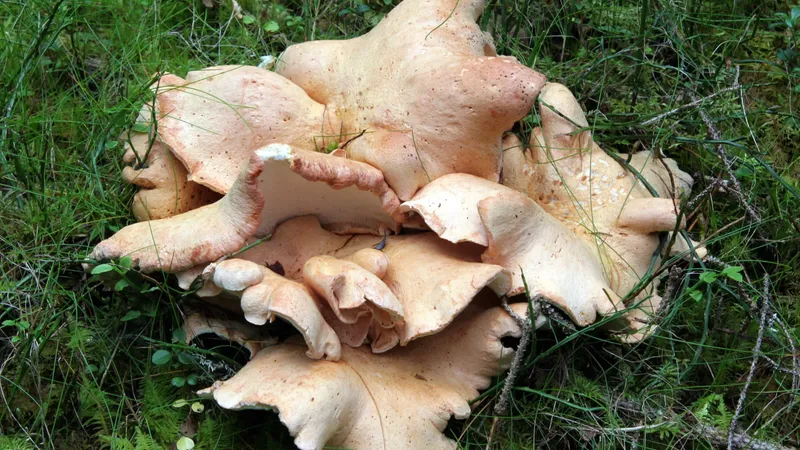
Albatrellus confluens fruiting bodies
Classificação Científica
Reino:Fungi
Divisão:Basidiomycota
Classe:Agaricomycetes
Ordem:Russulales
Família:Albatrellaceae
Gênero:Albatrellus
Perguntas Frequentes
- O que é a espécie common earthfan?
- A espécie common earthfan (Albatrellus confluens) pertence à família Albatrellaceae. É estudada por suas características biológicas e está documentada no banco de dados micológico da ShroomSpy.
- A espécie common earthfan é comestível?
- Comestibilidade incerta - geralmente considerado não comestível/não recomendado. Os relatos sobre seu uso alimentar são escassos e não verificados, e não há consenso confiável de que seja seguro consumi-lo. Não consumir.
- Que efeitos a espécie common earthfan produz?
- A espécie common earthfan está associada aos seguintes efeitos: Foco, Energia. As experiências individuais variam conforme a dose, o estado de espírito e o ambiente.
- Qual é a classificação científica de common earthfan?
- A espécie common earthfan pertence ao reino Fungi, divisão Basidiomycota, classe Agaricomycetes, ordem Russulales, família Albatrellaceae, gênero Albatrellus. Seu nome científico é Albatrellus confluens.
Sobre
Albatrellus confluens é um poliporo terrestre da família Albatrellaceae (ordem Russulales), conhecido comumente como leque-da-terra comum. Em vez de lâminas, apresenta uma superfície de poros branca a creme sob um chapéu carnoso de cor creme a pardo-ocre. Os chapéus de corpos frutíferos vizinhos costumam se fundir, hábito refletido no epíteto confluens. Frutifica no solo de florestas de coníferas do hemisfério norte, onde se associa às coníferas como simbionte ectomicorrízico. Sua comestibilidade é mal documentada e ele é geralmente tratado como não comestível, mas atraiu atenção científica como fonte de metabólitos secundários bioativos.
História
A espécie foi descrita por Albertini e Schweinitz e posteriormente transferida para o gênero Albatrellus por Kotlaba e Pouzar, dando o nome aceito Albatrellus confluens (Alb. & Schwein.) Kotl. & Pouzar. O nome do gênero deriva do latim albus ("branco"), em referência à superfície de poros e à carne pálidas típicas desses poliporos, enquanto confluens alude ao modo como os chapéus contíguos crescem unidos. O interesse pela espécie aumentou consideravelmente no início dos anos 2000, quando pesquisadores da China e do Japão isolaram e caracterizaram seus compostos bioativos.
Visão geral
Ao contrário dos fungos de prateleira que decompõem a madeira, A. confluens é um poliporo micorrízico que cresce no solo das florestas de coníferas e não é cultivado comercialmente. Seu principal interesse é químico: o meroterpenoide fenólico grifolina isolado de seus corpos frutíferos demonstrou em estudos de laboratório inibir o crescimento de várias linhagens de células de câncer humano e induzir apoptose (Ye et al., 2005; 2007), em parte por meio da supressão da via de sinalização ERK1/2. Outro composto relacionado, o albaconol, também foi estudado por sua atividade biológica. Esses achados referem-se a compostos isolados em ambiente de laboratório e não constituem prova de valor culinário nem de qualquer uso médico comprovado; não se recomenda comer este cogumelo.
Características Físicas
Chapéus:
The cap is fan-shaped to irregular, measuring 5-15 cm across, with a smooth to slightly velvety texture. It is typically brown to reddish-brown, often with a lighter edge.
Lamelas:
None - the underside features a pore surface instead of gills, with small pores that are white to cream-colored.
Efeitos Cognitivos
Foco
Albatrellus confluens contém grifolina, um composto fenólico estudado por sua capacidade de inibir a sinalização do NF-κB — uma via ligada à inflamação cognitiva que pode prejudicar a concentração.
Energia
Frações de polissacarídeos nos corpos frutíferos de A. confluens podem apoiar a função mitocondrial, contribuindo para a redução da fadiga física em estudos preliminares com animais.
Farmacologia
Ajuda Com
Sistema Imunológico
O composto grifolina em A. confluens pode modular as respostas imunológicas inatas ao downregular citocinas pró-inflamatórias em linhagens celulares de macrófagos.
Câncer
A grifolina isolada de A. confluens mostrou atividade citotóxica in vitro contra várias linhagens de células cancerígenas humanas, incluindo carcinoma de cólon e pulmão, embora a validação in vivo seja limitada.
Inflamação
Terpenoides scutigeral e confluentin em A. confluens podem inibir a 5-lipoxigenase, uma enzima central na cascata inflamatória do ácido araquidônico.
Possíveis Efeitos Colaterais
Náusea
Algumas pessoas relatam leve desconforto gastrointestinal após consumir A. confluens, possivelmente devido ao seu conteúdo de sesquiterpenos quando consumido cru ou mal cozido.
Constituintes Químicos
Química Medicinal
Informação Nutricional
Tamanho da Porção100
Quantidade por Porção
Calorias280
% Valor Diário*
Gordura Total 3.2 g4%
Gordura Saturada 0.4 g2%
Gordura Trans 0 g
Colesterol 0 mg0%
Sódio 18 mg1%
Carboidratos Totais 52 g19%
Fibra Alimentar 22 g79%
Açúcares Totais 0 g
Proteína 18 g36%
Vitamina A 0 µg 0%•Tiamina B1 0 mg 0%
Riboflavina B2 0 mg 0%•Niacina B3 0 mg 0%
Vitamina B6 0 mg 0%•Folato B9 0 µg 0%
Vitamina B12 0 mg 0%•Vitamina C 0 mg 0%
Vitamina D 12 µg 60%•Vitamina E 0 mg 0%
Vitamina K 0 µg 0%•Cálcio 0 mg 0%
Cobre 4.2 mg 467%•Ferro 0 mg 0%
Magnésio 0 mg 0%•Manganês 0 mg 0%
Fósforo 380 mg 30%•Potássio 2100 mg 45%
Selênio 18 µg 33%•Zinco 4.1 mg 37%
Vit A 0 µg 0%•B1 0 mg 0%
B2 0 mg 0%•B3 0 mg 0%
B6 0 mg 0%•B9 0 µg 0%
B12 0 mg 0%•Vit C 0 mg 0%
Vit D 12 µg 60%•Vit E 0 mg 0%
Vit K 0 µg 0%•Cálcio 0 mg 0%
Cobre 4.2 mg 467%•Ferro 0 mg 0%
Mg 0 mg 0%•Mn 0 mg 0%
Fósf. 380 mg 30%•Pot. 2100 mg 45%
Selênio 18 µg 33%•Zinco 4.1 mg 37%
* Os percentuais de valores diários são baseados em uma dieta de 2.000 calorias.
Avaliações de Cogumelos
0.0
Baseado em 0 Avaliação
5
★4
★3
★2
★1
★Compartilhe seus pensamentos
Se você consumiu este cogumelo, compartilhe seus pensamentos com nossa comunidade