Última atualização:
Clavariadelphus pistillaris
"tapered club, giant club"
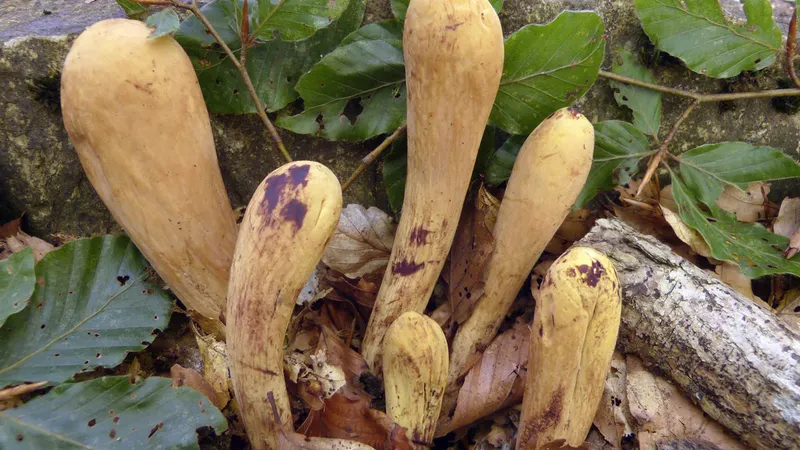
Clavariadelphus pistillaris fruiting bodies
Classificação Científica
Reino:Fungi
Divisão:Basidiomycota
Classe:Agaricomycetes
Ordem:Cantharellales
Família:Clavariaceae
Gênero:Clavariadelphus
Perguntas Frequentes
- O que é a espécie tapered club?
- A espécie tapered club (Clavariadelphus pistillaris) pertence à família Clavariaceae. É estudada por suas características biológicas e está documentada no banco de dados micológico da ShroomSpy.
- A espécie tapered club é comestível?
- Comestível, mas geralmente considerado de baixa qualidade devido ao seu amargor acentuado. A carne é macia e contém compostos amargos; é necessário demolhar ou ferver repetidamente para a tornar aceitável, e a maioria dos apanhadores considera-a inferior. C. pistillaris também é pouco comum e está listada como espécie rara ou ameaçada em parte da sua área de distribuição, pelo que se desaconselha a sua colheita. Como acontece com qualquer cogumelo silvestre, é essencial uma identificação segura antes de qualquer consumo.
- Qual é a classificação científica de tapered club?
- A espécie tapered club pertence ao reino Fungi, divisão Basidiomycota, classe Agaricomycetes, ordem Cantharellales, família Clavariaceae, gênero Clavariadelphus. Seu nome científico é Clavariadelphus pistillaris.
Sobre
Clavariadelphus pistillaris é o maior dos cogumelos em clava simples e não ramificados, com um corpo frutífero em forma de maça ou pilão que pode atingir cerca de 20 cm de altura e 5 cm de largura no seu ápice arredondado. A superfície enrugada varia de ocre pálido a rosado ou rosa, escurecendo para castanho ou púrpura ao ser manuseada. Surge sobre o solo em florestas caducifólias, sobretudo sob faias, entre a folhada e detritos lenhosos. Embora comestível, a sua carne macia é nitidamente amarga e é geralmente considerada um cogumelo culinário pobre.
História
A espécie foi descrita por micologistas antigos e colocada por Donk no género Clavariadelphus, cujo nome combina o latim clava ("maça") com uma referência aos seus parentes, os cogumelos em clava. Elias Fries, no início do século XIX, agrupou os cogumelos em clava simples e coraloides com base na forma do corpo frutífero; estudos microscópicos posteriores separaram-nos em géneros distintos. C. pistillaris nunca foi uma espécie alimentar ou medicinal importante e hoje é mais notada pelo seu estatuto de conservação, figurando entre os fungos raros ou ameaçados de várias regiões.
Visão geral
Clavariadelphus pistillaris distingue-se pela sua única clava grande e enrugada e pela sua coloração ocre a rosa que escurece ao toque. O ápice achatado dos exemplares maduros não possui tecido produtor de esporos, característica que sugere uma possível ligação evolutiva aos cantarelos. É facilmente confundido com a espécie afim Clavariadelphus truncatus, de ápice mais truncado e plano e sabor mais doce, e com cogumelos coraloides ramificados como Ramaria e Clavulina, que diferem na forma. Por ser pouco comum e estar protegido em parte da sua área, deve ser apreciado no campo em vez de colhido.
Sabores
Bitter
The flesh has a pronounced bitterness that limits its culinary value; soaking or prolonged boiling reduces it somewhat.
Texturas
Soft
Soft, spongy flesh that often becomes hollow and tougher with age.
Fragrâncias
Earthy
Faint, unremarkable woodland odor.
Características Físicas
Chapéus:
The cap is elongated and club-shaped, typically measuring 5-15 cm in height and 1-3 cm in diameter. It is usually pale yellow to cream in color, with a smooth texture.
Lamelas:
None
Informação Nutricional
Tamanho da Porção100
Quantidade por Porção
Calorias320
% Valor Diário*
Gordura Total 0.6 g1%
Gordura Saturada 0 g0%
Gordura Trans 0 g
Colesterol 0 mg0%
Sódio 14 mg1%
Carboidratos Totais 62.4 g23%
Fibra Alimentar 20 g71%
Açúcares Totais 0 g
Proteína 16.3 g33%
Vitamina A 0 µg 0%•Tiamina B1 0 mg 0%
Riboflavina B2 0 mg 0%•Niacina B3 0 mg 0%
Vitamina B6 0 mg 0%•Folato B9 0 µg 0%
Vitamina B12 0 mg 0%•Vitamina C 0 mg 0%
Vitamina D 0 µg 0%•Vitamina E 0 mg 0%
Vitamina K 0 µg 0%•Cálcio 0 mg 0%
Cobre 0 mg 0%•Ferro 0 mg 0%
Magnésio 0 mg 0%•Manganês 0 mg 0%
Fósforo 340 mg 27%•Potássio 1900 mg 40%
Selênio 0 µg 0%•Zinco 0 mg 0%
Vit A 0 µg 0%•B1 0 mg 0%
B2 0 mg 0%•B3 0 mg 0%
B6 0 mg 0%•B9 0 µg 0%
B12 0 mg 0%•Vit C 0 mg 0%
Vit D 0 µg 0%•Vit E 0 mg 0%
Vit K 0 µg 0%•Cálcio 0 mg 0%
Cobre 0 mg 0%•Ferro 0 mg 0%
Mg 0 mg 0%•Mn 0 mg 0%
Fósf. 340 mg 27%•Pot. 1900 mg 40%
Selênio 0 µg 0%•Zinco 0 mg 0%
* Os percentuais de valores diários são baseados em uma dieta de 2.000 calorias.
Avaliações de Cogumelos
0.0
Baseado em 0 Avaliação
5
★4
★3
★2
★1
★Compartilhe seus pensamentos
Se você consumiu este cogumelo, compartilhe seus pensamentos com nossa comunidade