Última atualização:
Hericium coralloides
"Coral Tooth, Bear's Head, Comb Tooth"
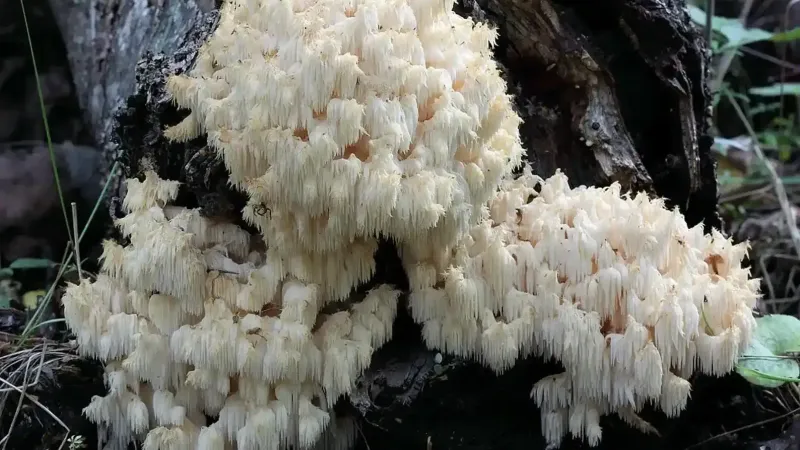
Hericium coralloides fruiting bodies
Classificação Científica
Reino:Fungi
Divisão:Basidiomycota
Classe:Agaricomycetes
Ordem:Russulales
Família:Hericiaceae
Gênero:Hericium
Perguntas Frequentes
- O que é a espécie Coral Tooth?
- A espécie Coral Tooth (Hericium coralloides) pertence à família Hericiaceae. É estudada por suas características biológicas e está documentada no banco de dados micológico da ShroomSpy.
- A espécie Coral Tooth é comestível?
- Comestível e excelente. A carne é delicada, com textura semelhante à do caranguejo ou da lagosta quando cozida, e desenvolve um leve doçor sem amargor. É melhor colhido jovem e branco; os exemplares velhos e amarelados ficam azedos. Como com todos os cogumelos silvestres, cozinhe bem e confirme a identificação antes de consumir.
- Que efeitos a espécie Coral Tooth produz?
- A espécie Coral Tooth está associada aos seguintes efeitos: Memória, Foco, Energia. As experiências individuais variam conforme a dose, o estado de espírito e o ambiente.
- Qual é a classificação científica de Coral Tooth?
- A espécie Coral Tooth pertence ao reino Fungi, divisão Basidiomycota, classe Agaricomycetes, ordem Russulales, família Hericiaceae, gênero Hericium. Seu nome científico é Hericium coralloides.
Sobre
Hericium coralloides, conhecido popularmente como dente de coral ou cogumelo cabeça de urso, é um vistoso fungo de podridão branca que cresce como um aglomerado ramificado, semelhante a coral ou delicadamente a uma galhada, de até cerca de 30 cm de largura. Espinhos curtos pendem para baixo em fileiras ao longo da parte superior de seus ramos. Frutifica em árvores de folha larga mortas ou moribundas — carvalho, faia, bordo, nogueira, sicómoro e outras madeiras duras — mais frequentemente sobre troncos e cepos em florestas temperadas da América do Norte, Europa, China e Japão. Como saprofita, ajuda a decompor a madeira morta e a reciclar os nutrientes da floresta. É comestível e excelente, com textura semelhante à do caranguejo ou da lagosta quando cozido, e é estudado por seus compostos neurotróficos.
História
Hericium coralloides pertence à família de fungos dentados Hericiaceae, da ordem Russulales. O nome do gênero Hericium deriva do latim para ouriço, em referência aos dentes espinhosos e pendentes comuns ao gênero, enquanto o epíteto coralloides significa "semelhante a coral". É parente próximo da mais conhecida juba de leão (H. erinaceus) e de H. abietis, e distingue-se de H. erinaceus por seu hábito ramificado: em H. coralloides os espinhos se bifurcam e surgem de um corpo muito ramificado, enquanto em H. erinaceus os espinhos pendem individualmente de uma massa única sem ramificações. A espécie é suficientemente rara em partes da Europa para constar de listas vermelhas nacionais, onde seus corpos frutíferos silvestres são protegidos.
Visão geral
Hericium coralloides é valorizado tanto como comestível gourmet quanto como objeto de pesquisa de cogumelos medicinais. Quimicamente, caracteriza-se melhor pelas coralocinas — as coralocinas A–C, isoladas por Wittstein e colaboradores em 2016, são metabólitos indutores do fator de crescimento nervoso (NGF) e do fator neurotrófico derivado do cérebro (BDNF) isolados especificamente desta espécie, e as coralocinas D–E foram depois descritas a partir de seus corpos frutíferos. Como outros membros do gênero, também contém polissacarídeos bioativos estudados por sua atividade antitumoral e imunomoduladora. Grande parte da literatura popular sobre os compostos neurotróficos da "juba de leão" (hericenonas e erinacinas) refere-se principalmente a H. erinaceus; H. coralloides compartilha a mesma classe de compostos neurotróficos por meio de suas próprias coralocinas, sem ser idêntico a ela. Como espécie saprofita, é comparativamente fácil de cultivar em serragem de madeira dura esterilizada ou pelo método tradicional de toras.
Características Físicas
Chapéus:
The fruiting body resembles a cluster of coral, with a branching structure. It can grow up to 30 cm in height and 20 cm in width, featuring a white to cream color and a soft, spongy texture.
Lamelas:
None - the species lacks gills and instead has spines or teeth that hang down from the fruiting body.
Efeitos Cognitivos
MemóRia
Hericium coralloides contém hericenonas e erinacinas que podem promover a síntese do fator de crescimento nervoso (NGF), apoiando a neurogênese hipocampal e a função da memória.
Foco
Os compostos que promovem o NGF em H. coralloides podem aumentar a mielinização e a plasticidade sináptica no córtex pré-frontal, apoiando um desempenho atencional sustentado.
Energia
O alto teor de proteínas e vitaminas do complexo B em H. coralloides apoia a produção de energia mitocondrial e reduz a fadiga cognitiva.
Farmacologia
Ajuda Com
Função Nervosa
Os compostos hericenona e erinacina em H. coralloides estimulam a expressão de NGF e BDNF, promovendo a regeneração de nervos periféricos e proteção contra condições desmielinizantes.
Demência
Ensaios clínicos com H. erinaceus (mesma classe de compostos) mostram melhora cognitiva em comprometimento cognitivo leve; H. coralloides contém erinacinas bioativas sobrepostas.
Alzheimer
A erinacina A de Hericium spp. demonstra inibição da agregação de beta-amiloide e hiperfosforilação de tau em modelos celulares da doença de Alzheimer.
Depressão
Extratos de H. erinaceus mostram efeitos semelhantes a antidepressivos em modelos animais através da neurogênese hipocampal e redução de citocinas inflamatórias; H. coralloides compartilha esse perfil de compostos.
Sistema Imunológico
Polissacarídeos de beta-glucano em H. coralloides ativam vias imunológicas de macrófagos e células NK através do engajamento do receptor dectin-1.
Possíveis Efeitos Colaterais
Alergias
Dermatite de contato rara e leve alergia respiratória ao manusear H. coralloides durante a colheita; alergia alimentar é incomum.
Constituintes Químicos
Química Medicinal
Informação Nutricional
Tamanho da Porção100
Quantidade por Porção
Calorias295
% Valor Diário*
Gordura Total 3.5 g4%
Gordura Saturada 0.4 g2%
Gordura Trans 0 g
Colesterol 0 mg0%
Sódio 8 mg0%
Carboidratos Totais 52 g19%
Fibra Alimentar 20 g71%
Açúcares Totais 0 g
Proteína 22 g44%
Vitamina A 0 µg 0%•Tiamina B1 0 mg 0%
Riboflavina B2 0 mg 0%•Niacina B3 9 mg 56%
Vitamina B6 0 mg 0%•Folato B9 0 µg 0%
Vitamina B12 0 mg 0%•Vitamina C 0 mg 0%
Vitamina D 10 µg 50%•Vitamina E 0 mg 0%
Vitamina K 0 µg 0%•Cálcio 0 mg 0%
Cobre 0.8 mg 89%•Ferro 0 mg 0%
Magnésio 0 mg 0%•Manganês 0 mg 0%
Fósforo 410 mg 33%•Potássio 2100 mg 45%
Selênio 20 µg 36%•Zinco 4.2 mg 38%
Vit A 0 µg 0%•B1 0 mg 0%
B2 0 mg 0%•B3 9 mg 56%
B6 0 mg 0%•B9 0 µg 0%
B12 0 mg 0%•Vit C 0 mg 0%
Vit D 10 µg 50%•Vit E 0 mg 0%
Vit K 0 µg 0%•Cálcio 0 mg 0%
Cobre 0.8 mg 89%•Ferro 0 mg 0%
Mg 0 mg 0%•Mn 0 mg 0%
Fósf. 410 mg 33%•Pot. 2100 mg 45%
Selênio 20 µg 36%•Zinco 4.2 mg 38%
* Os percentuais de valores diários são baseados em uma dieta de 2.000 calorias.
Avaliações de Cogumelos
0.0
Baseado em 0 Avaliação
5
★4
★3
★2
★1
★Compartilhe seus pensamentos
Se você consumiu este cogumelo, compartilhe seus pensamentos com nossa comunidade