Última atualização:
Hypsizygus ulmarius
"Elm Oyster Mushroom, White Elm Mushroom"
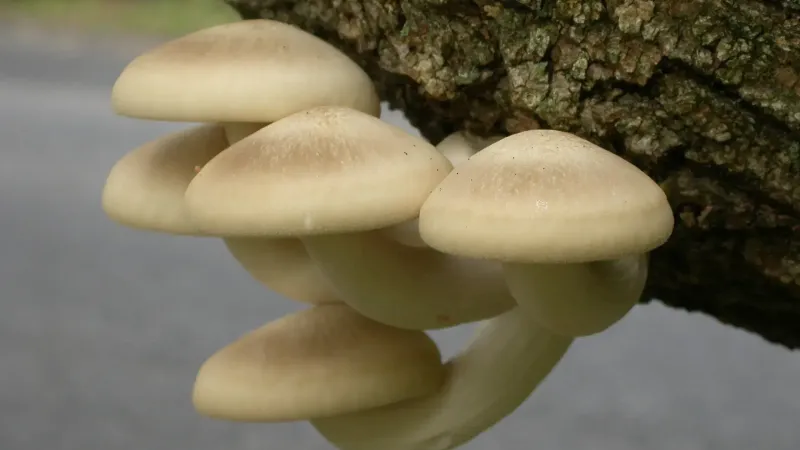
Hypsizygus ulmarius fruiting bodies
Classificação Científica
Reino:Fungi
Divisão:Basidiomycota
Classe:Agaricomycetes
Ordem:Agaricales
Família:Lyophyllaceae
Gênero:Hypsizygus
Perguntas Frequentes
- O que é a espécie Elm Oyster Mushroom?
- A espécie Elm Oyster Mushroom (Hypsizygus ulmarius) pertence à família Lyophyllaceae. É estudada por suas características biológicas e está documentada no banco de dados micológico da ShroomSpy.
- A espécie Elm Oyster Mushroom é comestível?
- Comestível - um cogumelo comestível de qualidade, considerado por muitos especialistas superior aos cogumelos ostra comuns em sabor e textura firme. Não tem parentesco com as verdadeiras ostras (Pleurotus), apesar da semelhança superficial.
- Que efeitos a espécie Elm Oyster Mushroom produz?
- A espécie Elm Oyster Mushroom está associada aos seguintes efeitos: Foco, Energia. As experiências individuais variam conforme a dose, o estado de espírito e o ambiente.
- Qual é a classificação científica de Elm Oyster Mushroom?
- A espécie Elm Oyster Mushroom pertence ao reino Fungi, divisão Basidiomycota, classe Agaricomycetes, ordem Agaricales, família Lyophyllaceae, gênero Hypsizygus. Seu nome científico é Hypsizygus ulmarius.
Sobre
Hypsizygus ulmarius, comumente chamado de cogumelo ostra de ulmeiro ou cogumelo branco de ulmeiro, é um fungo saprófito de podridão parda que frutifica em madeiras duras vivas e mortas, em especial ulmeiros, álamos, faias, bordos e salgueiros. Embora seu chapéu largo se assemelhe superficialmente a um verdadeiro cogumelo ostra, não tem parentesco próximo com Pleurotus; características microscópicas únicas e seu tipo de podridão parda o colocam no gênero Hypsizygus. É valorizado como comestível de qualidade e cultivado comercialmente, sobretudo no Japão.
História
A taxonomia desta espécie tem uma história longa e confusa. Foi descrita originalmente na Europa dentro da tradição Bulliard: Fries e, em vários momentos, foi tratada como Pleurotus ulmarius (Bull.: Fr.) Kummer e Lyophyllum ulmarium (Bull.: Fr.) Kühner, antes de Redhead transferi-la para Hypsizygus ulmarius em 1984. O nome do gênero vem do grego hypsi ("no alto") e zygos ("jugo"), enquanto o epíteto ulmarius deriva do latim ulmus, "ulmeiro", em alusão à sua frequente associação com ulmeiros. No Japão é conhecido como shirotamogitake ("cogumelo branco de ulmeiro") e tamo-motashi.
Visão geral
Ecologicamente, H. ulmarius é um decompositor de podridão parda de madeiras duras, em contraste com a podridão branca produzida por Pleurotus ostreatus, uma diferença fundamental entre os dois. O chapéu é hemisférico a plano (às vezes umbilicado), uniformemente castanho-claro, bege, pardo-acinzentado a cinza, com 4-15 cm de largura, com a margem enrolada a incurvada quando jovem; as lamelas são decorrentes e próximas, e o pé é grosso, de inserção excêntrica e curvado na base. Cultivado no Japão desde 1973 em serragem ou toras de madeira dura, é apreciado pela textura firme e pelo sabor suave e agradável. O interesse medicinal relatado (propriedades antitumorais ou imunomoduladoras) baseia-se em grande parte em relatos anedóticos e não publicados e em dados de parentes próximos, de modo que tais afirmações devem ser consideradas preliminares.
Características Físicas
Chapéus:
The cap is convex to flat, measuring 5-15 cm in diameter, with a smooth, pale to light brown surface that may become slightly sticky when moist.
Lamelas:
Gills are decurrent, closely spaced, and white to cream in color, becoming slightly darker with age.
Efeitos Cognitivos
Foco
Hypsizygus ulmarius contém ergotioneína, um poderoso aminoácido antioxidante que se acumula seletivamente no tecido neural e pode proteger a função cognitiva ao longo do tempo.
Energia
O alto teor de vitaminas do complexo B, incluindo riboflavina e niacina em H. ulmarius, apoia o metabolismo energético mitocondrial e pode reduzir a fadiga.
Farmacologia
Ajuda Com
Sistema Imunológico
As frações de polissacarídeos de H. ulmarius podem aumentar a citotoxicidade das células assassinas naturais e a fagocitose de macrófagos em ensaios de imunostimulação em camundongos.
Colesterol
O consumo do cogumelo ostra de ulmeiro pode contribuir para a redução do colesterol através do conteúdo de lovastatina e beta-glucanas, semelhante a outros Pleurotaceae.
Estresse Oxidativo
A ergotioneína em H. ulmarius se acumula em eritrócitos e mitocôndrias, proporcionando proteção direcionada contra o estresse oxidativo em tecidos metabolicamente ativos.
Microbioma intestinal
As frações de fibra dietética em H. ulmarius, incluindo quitina e beta-glucanas, podem atuar como prebióticos apoiando populações benéficas de bactérias intestinais.
Possíveis Efeitos Colaterais
Alergias
Asma ocupacional rara devido à exposição a esporos durante o cultivo; alergia alimentar é incomum.
Constituintes Químicos
Química Medicinal
Informação Nutricional
Tamanho da Porção100
Quantidade por Porção
Calorias295
% Valor Diário*
Gordura Total 3 g4%
Gordura Saturada 0.4 g2%
Gordura Trans 0 g
Colesterol 0 mg0%
Sódio 22 mg1%
Carboidratos Totais 50 g18%
Fibra Alimentar 16 g57%
Açúcares Totais 0 g
Proteína 24 g48%
Vitamina A 0 µg 0%•Tiamina B1 0 mg 0%
Riboflavina B2 3.2 mg 246%•Niacina B3 14.5 mg 91%
Vitamina B6 0 mg 0%•Folato B9 0 µg 0%
Vitamina B12 0 mg 0%•Vitamina C 0 mg 0%
Vitamina D 6 µg 30%•Vitamina E 0 mg 0%
Vitamina K 0 µg 0%•Cálcio 0 mg 0%
Cobre 1.2 mg 133%•Ferro 0 mg 0%
Magnésio 0 mg 0%•Manganês 0 mg 0%
Fósforo 370 mg 30%•Potássio 2000 mg 43%
Selênio 26 µg 47%•Zinco 5.2 mg 47%
Vit A 0 µg 0%•B1 0 mg 0%
B2 3.2 mg 246%•B3 14.5 mg 91%
B6 0 mg 0%•B9 0 µg 0%
B12 0 mg 0%•Vit C 0 mg 0%
Vit D 6 µg 30%•Vit E 0 mg 0%
Vit K 0 µg 0%•Cálcio 0 mg 0%
Cobre 1.2 mg 133%•Ferro 0 mg 0%
Mg 0 mg 0%•Mn 0 mg 0%
Fósf. 370 mg 30%•Pot. 2000 mg 43%
Selênio 26 µg 47%•Zinco 5.2 mg 47%
* Os percentuais de valores diários são baseados em uma dieta de 2.000 calorias.
Avaliações de Cogumelos
0.0
Baseado em 0 Avaliação
5
★4
★3
★2
★1
★Compartilhe seus pensamentos
Se você consumiu este cogumelo, compartilhe seus pensamentos com nossa comunidade