Última atualização:
Phlebia radiata
"radiate polypore"
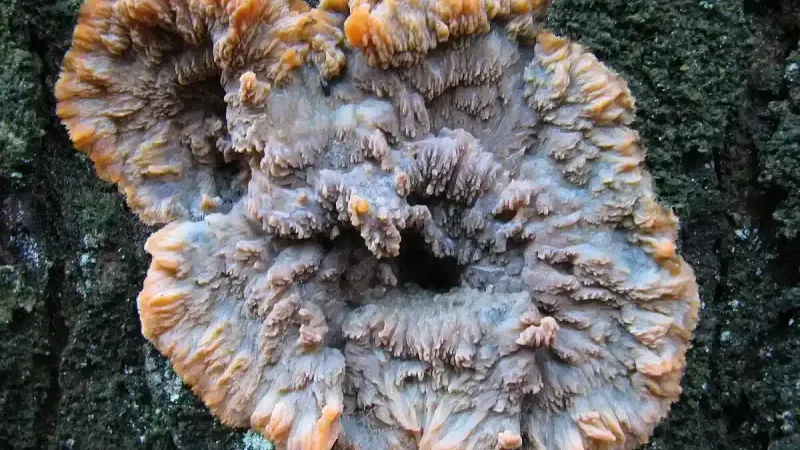
Phlebia radiata fruiting bodies
Classificação Científica
Reino:Fungi
Divisão:Basidiomycota
Classe:Agaricomycetes
Ordem:Polyporales
Família:Meruliaceae
Gênero:Phlebia
Perguntas Frequentes
- O que é a espécie radiate polypore?
- A espécie radiate polypore (Phlebia radiata) pertence à família Meruliaceae. É estudada por suas características biológicas e está documentada no banco de dados micológico da ShroomSpy.
- A espécie radiate polypore é comestível?
- Nao comestivel. Phlebia radiata e um fungo lignicola, fino e crostoso, sem valor culinario; nao e coletado nem consumido. Nao se sabe que seja venenoso, mas nao e uma especie comestivel.
- Qual é a classificação científica de radiate polypore?
- A espécie radiate polypore pertence ao reino Fungi, divisão Basidiomycota, classe Agaricomycetes, ordem Polyporales, família Meruliaceae, gênero Phlebia. Seu nome científico é Phlebia radiata.
Sobre
Phlebia radiata e um fungo de podridao branca resupinado e crostoso que cresce aderido a madeira morta em vez de formar um corpo de frutificacao com pe ou em forma de prateleira. Esta amplamente distribuido sobre madeira em decomposicao nas florestas temperadas da America do Norte e da Europa, onde desempenha um papel ecologico importante na decomposicao da madeira. P. radiata e conhecido cientificamente como um potente degradador da lignina, o polimero rigido que da resistencia a madeira.
Historia
Phlebia radiata foi descrito pelo micologo Elias Magnus Fries no inicio do seculo XIX. O nome do genero Phlebia deriva do grego para veia, em referencia a textura enrugada e venosa da superficie fertil. A especie nunca foi utilizada como alimento nem na medicina tradicional; sua importancia cientifica surgiu do estudo de como os fungos lignicolas decompoem a lignina e a celulose.
Na micologia e na biotecnologia modernas, P. radiata tornou-se um organismo modelo para o estudo das enzimas ligninoliticas. Os pesquisadores caracterizaram sua producao de lignina peroxidase (LiP), manganes peroxidase (MnP) e lacase, e ela foi estudada por sua capacidade de transformar poluentes ambientais persistentes como o TNT.
Visao geral
Phlebia radiata e um fungo corticioide (crostoso), nao um poliporo, e forma laminas finas, enrugadas e cerosas que aderem firmemente a superficie da madeira morta. Como fungo de podridao branca, degrada a lignina e a celulose, contribuindo para o ciclo de nutrientes e a reciclagem da madeira morta nos ecossistemas florestais.
Sua importancia ecologica e bioquimica reside em seu sistema enzimatico. Junto com Phanerochaete chrysosporium, P. radiata e classificado no grupo lignina-manganes peroxidase dos fungos de podridao branca, secretando peroxidases extracelulares e lacase que oxidam e decompoem a lignina. Essa mesma maquinaria enzimatica tornou a especie objeto de interesse para a microrremediacao e a biotecnologia industrial.
Características Físicas
Chapéus:
The cap is not distinctly formed as it is a resupinate fungus, typically smooth and crust-like, with a pale yellow to white coloration.
Lamelas:
None
Avaliações de Cogumelos
0.0
Baseado em 0 Avaliação
5
★4
★3
★2
★1
★Compartilhe seus pensamentos
Se você consumiu este cogumelo, compartilhe seus pensamentos com nossa comunidade