Última atualização:
Polyporus squamosus
"Dryad's saddle, Pheasant's back"
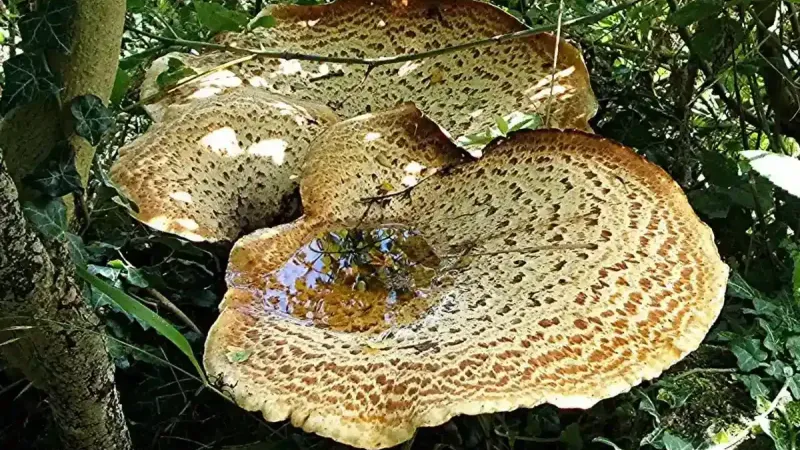
Polyporus squamosus fruiting bodies
Classificação Científica
Reino:Fungi
Divisão:Basidiomycota
Classe:Agaricomycetes
Ordem:Polyporales
Família:Polyporaceae
Gênero:Polyporus
Perguntas Frequentes
- O que é a espécie Dryad's saddle?
- A espécie Dryad's saddle (Polyporus squamosus) pertence à família Polyporaceae. É estudada por suas características biológicas e está documentada no banco de dados micológico da ShroomSpy.
- A espécie Dryad's saddle é comestível?
- Comestivel quando jovem e tenro, com uma fragancia caracteristica de melancia. Apenas as margens externas macias dos exemplares jovens sao consumidas; a carne endurece e torna-se incomestivel com a idade, de modo que os cogumelos velhos nao valem a pena ser colhidos. Nao e um comestivel por si so, mas funciona em fatias finas e salteado em sopas, frittatas e outros pratos.
- Qual é a classificação científica de Dryad's saddle?
- A espécie Dryad's saddle pertence ao reino Fungi, divisão Basidiomycota, classe Agaricomycetes, ordem Polyporales, família Polyporaceae, gênero Polyporus. Seu nome científico é Polyporus squamosus.
Sobre
Polyporus squamosus, conhecido comumente como sela-de-driade ou dorso-de-faisao, e um cogumelo de prateleira caracterizado por seus corpos frutiferos em forma de leque e semicirculares, com uma superficie de cor ocre-amarelada a palha marcada por zonas concentricas de escamas castanhas e achatadas. A parte inferior apresenta poros esbranquicados grandes e angulares em vez de laminas, e um exemplar fresco ao ser rasgado libera uma inconfundivel fragancia de melancia. Cresce sobre tocos e troncos de arvores de madeira dura como o platano e o olmo, atuando como saprobio e parasita, e distribui-se amplamente pela Europa, Asia e leste da America do Norte. O fungo e comestivel quando jovem e tenro e desempenha um importante papel ecologico como decompositor da madeira.
Historia
Polyporus squamosus foi nomeado pela primeira vez de forma valida por William Hudson e posteriormente sancionado por Elias Magnus Fries, o que da a citacao de autoridade (Huds.) Fr. O epiteto especifico deriva do latim squama, que significa "escama", em referencia as escamas castanhas marcantes distribuidas sobre o chapeu. Apreciado ha muito tempo pelos coletores como substituto primaveril quando as morchelas escasseiam, tambem figurou na Medicina Tradicional Chinesa como um remedio quente para aliviar tendoes e ligamentos doloridos. Sua abundancia e facil identificacao fizeram dele um elemento familiar das comunidades de coleta do hemisferio norte temperado.
Visao geral
Do ponto de vista ecologico, Polyporus squamosus e um importante decompositor de podridao branca que degrada a lignina e a celulose da madeira dura morta e viva, contribuindo para o ciclo de nutrientes da floresta. Frutifica principalmente na primavera e no verao, mas pode aparecer durante todo o ano, formando frequentemente grupos escalonados sobre o mesmo hospedeiro em temporadas sucessivas. A analise fitoquimica identificou a trealose como seu principal acucar livre e o acido p-hidroxibenzoico como seu principal composto fenolico, juntamente com niveis notaveis de beta-tocoferol e acidos graxos poli-insaturados; os extratos mostram atividade antioxidante, antifungica e antibacteriana. Seu chapeu escamoso e sua grande superficie porosa branca o distinguem facilmente dos poliporos mais duros em forma de casco.
Sabores
Mild
Young P. squamosus has a mild, mushroomy flavor that works best incorporated into cooked dishes; older specimens turn bitter and leathery.
Texturas
Firm
Young specimens have firm, tender flesh near the margins; the bracket toughens rapidly and becomes inedible as it ages and expands.
Fragrâncias
Floral
A torn fresh specimen releases a distinctive watermelon-like (cucumber-melon) fragrance that aids identification.
Características Físicas
Chapéus:
The cap is fan-shaped to saddle-shaped, measuring 5-30 cm across, with a wavy margin. It is typically brown to yellow-brown with a scaly texture.
Lamelas:
None; the underside features a series of small pores instead of gills, which are white to cream-colored.
Farmacologia
Ajuda Com
Supressão Bacteriana
Extracts of Polyporus squamosus show antibacterial activity against E. coli, Staphylococcus aureus, Bacillus subtilis, and Salmonella typhimurium in laboratory studies.
Inflamação
As a low-calorie, high-fiber food relatively rich in polyunsaturated fatty acids, P. squamosus has been studied as a potentially valuable food for combating inflammation and heart disease.
Possíveis Efeitos Colaterais
Náusea
Older P. squamosus brackets become tough, fibrous, and indigestible; only young, tender outer margins should be eaten to avoid gastrointestinal upset.
Constituintes Químicos
Química Medicinal
Informação Nutricional
Tamanho da Porção100
Quantidade por Porção
Calorias280
% Valor Diário*
Gordura Total 2.5 g3%
Gordura Saturada 0 g0%
Gordura Trans 0 g
Colesterol 0 mg0%
Sódio 18 mg1%
Carboidratos Totais 50 g18%
Fibra Alimentar 19 g68%
Açúcares Totais 0 g
Proteína 20 g40%
Vitamina A 0 µg 0%•Tiamina B1 0 mg 0%
Riboflavina B2 0 mg 0%•Niacina B3 11 mg 69%
Vitamina B6 0 mg 0%•Folato B9 0 µg 0%
Vitamina B12 0 mg 0%•Vitamina C 0 mg 0%
Vitamina D 0 µg 0%•Vitamina E 0 mg 0%
Vitamina K 0 µg 0%•Cálcio 0 mg 0%
Cobre 0 mg 0%•Ferro 0 mg 0%
Magnésio 0 mg 0%•Manganês 0 mg 0%
Fósforo 310 mg 25%•Potássio 1800 mg 38%
Selênio 16 µg 29%•Zinco 0 mg 0%
Vit A 0 µg 0%•B1 0 mg 0%
B2 0 mg 0%•B3 11 mg 69%
B6 0 mg 0%•B9 0 µg 0%
B12 0 mg 0%•Vit C 0 mg 0%
Vit D 0 µg 0%•Vit E 0 mg 0%
Vit K 0 µg 0%•Cálcio 0 mg 0%
Cobre 0 mg 0%•Ferro 0 mg 0%
Mg 0 mg 0%•Mn 0 mg 0%
Fósf. 310 mg 25%•Pot. 1800 mg 38%
Selênio 16 µg 29%•Zinco 0 mg 0%
* Os percentuais de valores diários são baseados em uma dieta de 2.000 calorias.
Avaliações de Cogumelos
0.0
Baseado em 0 Avaliação
5
★4
★3
★2
★1
★Compartilhe seus pensamentos
Se você consumiu este cogumelo, compartilhe seus pensamentos com nossa comunidade