Reishi: The 'Mushroom of Immortality,' Minus the Mythology
By Josh Shearer on 25/07/2026
Reishi is the flagship medicinal mushroom, wrapped in 2,000 years of myth. What lingzhi actually is, its triterpenes and beta-glucans, and how to read a label.
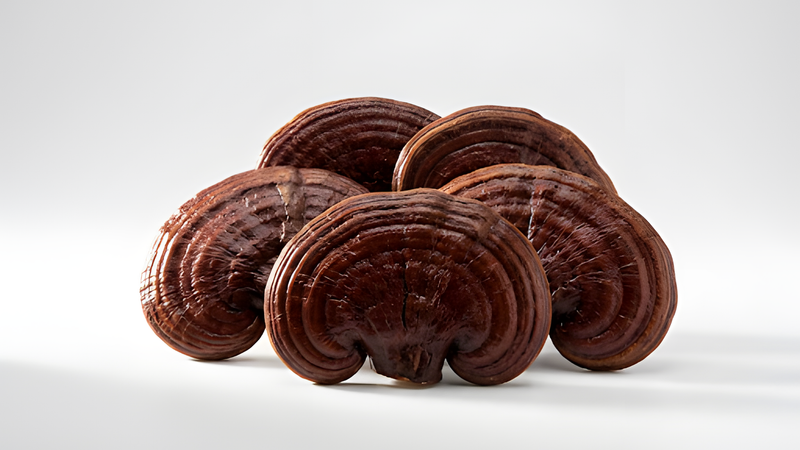
Reishi has been called the mushroom of immortality for two thousand years, ranked above ginseng in the classic Chinese herbals and carved into the thrones of emperors. It is also the best-selling medicinal mushroom on the supplement shelf today. That combination of ancient reverence and modern marketing means reishi comes wrapped in more mythology than almost any fungus. Here is what is actually underneath it.
What reishi is
Reishi is a lacquered polypore, a woody, kidney-shaped shelf mushroom with a glossy, varnished-looking cap in shades of red, orange, and black. The genus name Ganoderma means "shiny skin." Its Chinese name is lingzhi; the Japanese name reishi is the one that stuck in the West.
Two practical facts follow from that woody body. First, reishi is bitter and inedible as food. You do not sauté it. It is consumed as a tea or decoction, or as an extract or tincture, the same way you would use a medicinal bark. Second, that bitterness is not incidental: it comes from the triterpenes, one of the two compound families reishi is prized for.
What is in it
Reishi's chemistry splits into two headline groups. The triterpenes (ganoderic and ganoderenic acids, over 150 of them) are the bitter, resinous compounds. The beta-glucans and other polysaccharides, of which reishi makes more than 200, are the immune-active fraction shared across medicinal mushrooms, and a good reishi runs somewhere between 15 and 35 percent beta-glucan. Interestingly, the triterpene content rises as the mushroom matures from mycelium into a full fruiting body, one reason fruiting-body products and mycelium products are not interchangeable.
What the research actually supports
In traditional Chinese medicine reishi is the archetypal adaptogen, used to calm the mind, support sleep, and tonify the system over the long term. Modern research has grown fast, from under 200 papers a year in 2002 to over 800 by 2020, and the most active human-study areas are immune modulation, sleep, cardiovascular and cholesterol effects, liver protection, and cancer-support programs. Animal studies show reishi extracts can prolong sleep through a GABA-related mechanism and activate immune cells.
Now the honest part. When you see a benefits list for reishi that reads like a cure-all, covering heart, lungs, liver, blood sugar, mood, immunity, and cancer all at once, that breadth is a reason for skepticism, not excitement. Most of that evidence is preliminary: cell studies, animal models, and clinical trials that are mostly small, mostly from China, and short on independent replication. The fair way to describe reishi is that it is a traditional adaptogen whose beta-glucans support normal immune function, with a promising but still-maturing research base. It is not a treatment for any disease, and anything sold as one is selling the myth.
How to read a reishi label
Reishi is one of the few mushroom products where what is on the label may not be what is in the jar, so a little literacy helps.
The species name is the first tell. Most "red reishi" traded today is genetically Ganoderma lingzhi, even though countless products still print the older name Ganoderma lucidum, because the taxonomy was only cleaned up in 2012 and labels lag. That specific mismatch is common and not alarming. What matters more is whether the maker can tell you the species at all, ideally confirmed by DNA and chemical analysis, and whether the product is a fruiting-body extract (higher in triterpenes, more labor-intensive, usually grown in Asia) or a mycelium product (often grown on grain in the US, and lower in the bitter triterpenes unless separated from its substrate). Neither is wrong, but they are different things, and the price should reflect which one you are buying.
Bottom line
Reishi earns its long reputation as a calming, immune-supporting adaptogen with a genuinely rich chemistry of triterpenes and beta-glucans, and a research base that is real and growing. It does not earn the "cures everything" framing that trails it around. Buy it for what it is, check that the label knows what species it is selling, and let the emperors keep the immortality.
Preguntas frecuentes
Not as food. Reishi is woody and bitter, so it is used as a tea, decoction, or extract rather than cooked and eaten.
Referencias
- Mohammed, C., Aaroe, A., Buchold, G., Krummel, D., Stamets, P., Sharma, A., Alschuler, L., & Sengupta, S. (2026). Fungal-derived supplements in integrative oncology. The American Journal of Medicine, 139(4), 530-537. https://doi.org/10.1016/j.amjmed.2025.12.028
- (2026). Efectos hepatoprotectores del hongo Reishi (Ganoderma Lucidum) entre pacientes con enfermedad del hígado graso asociada a disfunción metabólica. .
- Hobbs, C. (2020). Los Hongos Medicinales de Christopher Hobbs: La Guía Esencial. North Adams, MA: Storey Publishing.
- Klupp, N. L., Chang, D., Hawke, F., Kiat, H., Cao, H., Grant, S. J., & Bensoussan, A. (2015). Hongo Ganoderma lucidum para el tratamiento de factores de riesgo cardiovascular.. .
- Rogers, R. (2011). La Farmacia Fúngica: La Guía Completa de Hongos Medicinales y Líquenes de América del Norte. Berkeley, CA: North Atlantic Books.
- Powell, M. (2010). Hongos Medicinales: Una Guía Clínica. Mycology Press.