Shiitake: The Everyday Mushroom That Happens to Be Medicinal
By Josh Shearer on 07/19/2026
Shiitake is the everyday mushroom with a deep research record. Its umami, a sunlight vitamin D trick, the cholesterol story, and what the science really says.
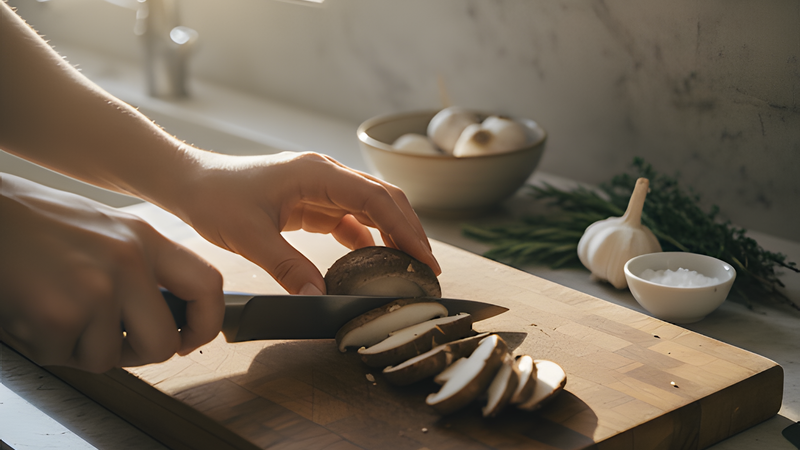
Shiitake is the mushroom hiding in plain sight. It is the second most cultivated mushroom on earth, behind only the button mushroom, so most people have eaten it in a stir-fry or a bowl of ramen without thinking twice. What fewer people know is that shiitake also has one of the deepest research records of any culinary mushroom. It is an everyday ingredient that happens to be a serious subject of study.
In the kitchen first
Start with the obvious reason to buy shiitake: it tastes great. It is rich, savory, and full of umami, with a meaty texture that holds up to searing, braising, and roasting. Dried shiitake are more intense than fresh, and rehydrating them gives you both the softened mushroom and a dark, flavorful soaking liquid that works as an instant stock. If you only ever treat shiitake as food, you are getting your money's worth.
The vitamin D trick worth knowing
Here is a genuinely useful, verifiable fact. Shiitake is high in ergosterol, a compound that converts to vitamin D when exposed to ultraviolet light, the same way your skin makes it in sunlight. The size of the effect is striking. Shiitake grown and dried indoors was measured at only about 110 international units of vitamin D per 100 grams, but the same strain sun-dried with the gills facing up jumped to roughly 46,000 IU per 100 grams. If you buy fresh shiitake, setting them gill-side-up in direct sun for a day before cooking or drying meaningfully raises their vitamin D. Few kitchen tricks are that cheap or that dramatic.
Fiber, and the cholesterol story
Shiitake is high in dietary fiber, roughly 25 to 35 percent by dry weight, including a large share of beta-glucans. That soluble and insoluble fiber can help maintain healthy cholesterol levels and acts as a prebiotic, feeding beneficial gut bacteria.
Shiitake also contains eritadenine, a compound found essentially nowhere else, which researchers have studied for lowering cholesterol through a mechanism different from statins. The evidence is real but modest in scale: in one small study, 30 healthy young women who ate about 9 grams of dried shiitake a day for a week saw total cholesterol drop by 7 to 12 percent. That is a small, short study, not a prescription, and the honest framing is that shiitake is a fiber-rich food with a promising compound, not a cholesterol drug.
Lentinan and the immune research, kept in perspective
The compound that made shiitake famous in research is lentinan, a highly purified beta-glucan first isolated in 1969. In Japan, lentinan is a licensed pharmaceutical, given by injection alongside chemotherapy for gastric cancer. That is worth stating clearly precisely because it is so easily misused in marketing: lentinan as a hospital drug is an isolated, purified, injected compound. Eating shiitake, or taking a shiitake supplement, is not the same thing and should not be sold as if it were. What eating shiitake does offer is a beta-glucan-rich food that supports normal immune function, which is a fair and modest claim.
A note for growers
Shiitake is a rewarding mushroom to grow, but it is a patient project, not a beginner sprint. It runs on hardwood, traditionally oak logs inoculated with plug or sawdust spawn and sealed with wax, or on supplemented sawdust blocks indoors. Logs can take the better part of a year to colonize before they fruit, then produce for several years. If you are new to cultivation, start with oysters and come back to shiitake once you have a harvest behind you.
Bottom line
Shiitake is the best kind of functional mushroom: one you would happily eat even if it did nothing special. It is delicious, genuinely nutritious, a natural source of vitamin D you can boost with sunlight, and the backbone of decades of immune research, as long as you keep the difference between a purified drug and a good dinner clearly in mind.
Frequently Asked Questions
Yes. Shiitake is rich in B vitamins, dietary fiber, and beta-glucans that support immune function, and it is a natural source of vitamin D. It is also one of the most researched culinary mushrooms.
References
- Araújo-Rodrigues, H., Sousa, A., Relvas, J., Tavaria, F., & Pintado, M. (2024). An Overview on Mushroom Polysaccharides: Health-promoting Properties, Prebiotic and Gut Microbiota Modulation Effects and Structure-function Correlation. Carbohydrate Polymers, 333, 121978. https://doi.org/10.1016/j.carbpol.2024.121978
- Hobbs, C. (2020). Christopher Hobbs's Medicinal Mushrooms: The Essential Guide. North Adams, MA: Storey Publishing.
- Dai, X., Stanilka, J. M., Rowe, C. A., Esteves, E. A., Nieves Jr, C., Spaiser, S. J., Christman, M. C., Langkamp-Henken, B., & Percival, S. S. (2015). Consuming Lentinula edodes (Shiitake) Mushrooms Daily Improves Human Immunity: A Randomized Dietary Intervention in Healthy Young Adults. .
- Rogers, R. (2011). The Fungal Pharmacy: The Complete Guide to Medicinal Mushrooms and Lichens of North America. Berkeley, CA: North Atlantic Books.