Last updated:
Psilocybe CubensisRusty Whyte
"Rusty Whyte"
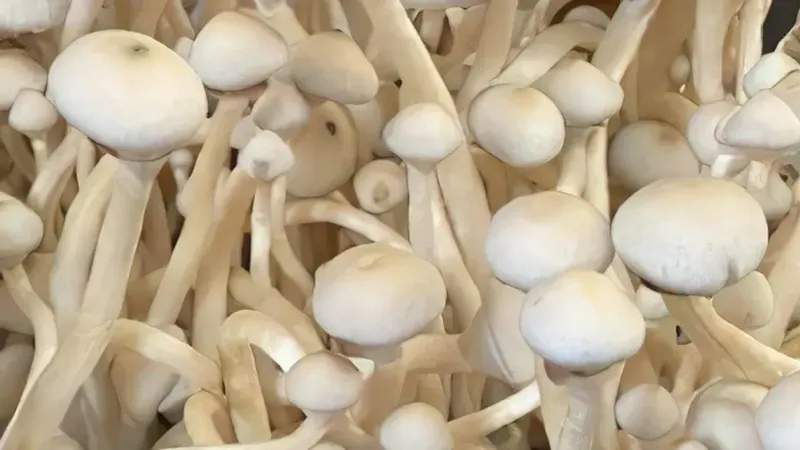
Psilocybe Cubensis fruiting bodies
Scientific Classification
Kingdom:Fungi
Division:Basidiomycota
Class:Agaricomycetes
Order:Agaricales
Family:Hymenogastraceae
Genus:Psilocybe
Frequently Asked Questions
- What is the Rusty Whyte strain?
- Rusty Whyte is a documented mushroom strain of Rusty Whyte (Psilocybe Cubensis). It is cataloged in the ShroomSpy mycology database with strain-specific characteristics, origin, and identification details.
- Is Rusty Whyte edible?
- Psychoactive
- Is Rusty Whyte psychoactive?
- Rusty Whyte is documented as a psychoactive species. It contains psychoactive compounds that may produce mind-altering effects. Laws governing possession and use vary by jurisdiction.
- What effects does Rusty Whyte produce?
- Rusty Whyte is associated with the following effects: Creativity. Individual experiences vary based on dose, set, and setting.
- What is the scientific classification of Rusty Whyte?
- Rusty Whyte belongs to the kingdom Fungi, division Basidiomycota, class Agaricomycetes, order Agaricales, family Hymenogastraceae, genus Psilocybe. Its scientific name is Psilocybe Cubensis.
Want to grow your own?
Tell us your experience level and we will point you at the right kit and supplies.
About
Rusty Whyte is a rare and visually striking leucistic variant of Psilocybe cubensis, combining ghostly white coloration with unique rusty-colored spores, hence the name. Unlike typical cubensis varieties, this strain features almost albino-looking fruiting bodies that stand out in any grow, and delivers a balanced, clear-headed psychedelic experience marked by emotional insight, visual clarity, and a smooth energetic flow.
History
Rusty Whyte was developed through intentional isolation of a leucistic phenotype crossed with a rust-sporing strain, likely involving Albino A+ or similar and a Redspore lineage. The result is a genetically fascinating hybrid that quickly became a collector’s favorite for its rare visual genetics and stable, user-friendly effects.
It’s especially popular among mycologists, aesthetic growers, and those seeking a consistent yet memorable journey.
Overview
Fruits are medium-sized, with pale white to ivory caps, sturdy white stems, and rust-colored spore prints—a rare combination. Colonization is moderate, flushes are uniform and photogenic, and it performs well in various substrates.
Effects are mentally clear, emotionally grounding, and gently visual, offering a reliable experience for therapeutic use, light exploration, or creative engagement. Ideal for both beginners and connoisseurs.
Physical Characteristics
Caps:
White to off-white, sometimes developing rusty spots with age, smooth texture.
Gills:
Adnate to adnexed, initially white then turning purple-brown with spore maturity.
Cognitive Effects
Creativity
May stimulate original thought and problem-solving abilities.
Psychoactive Effects
Perceptual
Users often experience a subjective alteration of time perception.
Pharmacology
Helps With
Depression
Shown to reduce symptoms in clinical settings.
Anxiety
Can decrease anxiety levels temporarily.
Possible Side Effects
Nausea
Common especially when taken in raw form.
Headache
Some users report headaches after the effects wear off.
Grow at Home
Start your cultivation journey with quality grow kits from independent vendors
Chemical Constituents
Medicinal Chemistry
Similar Species
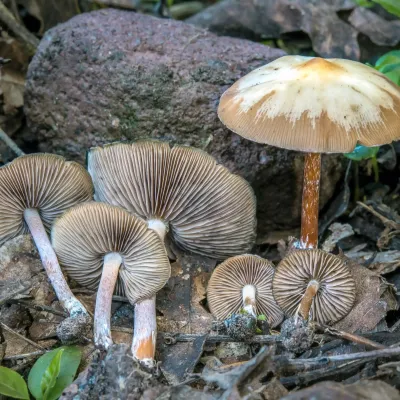
Species: Psilocybe caerulescens
(Derrumbes)
Edibility: Psychoactive, not for culinary use. Psilocybe caerulescens contains psilocybin and psilocin, tryptamine compounds that produce hallucinations and profound alterations of consciousness. It is one of the sacred Mazatec ceremonial species used by the curandera Maria Sabina, and was the first Psilocybe scientifically recognized as psychoactive by R. Gordon Wasson in 1955. Possession and use are illegal in many jurisdictions; verify local law before any handling.
Key Differences: Darker cap and does not develop rusty spots.
Species: Psilocybe caerulescens
(Derrumbes)
Edibility: Psychoactive, not for culinary use. Psilocybe caerulescens contains psilocybin and psilocin, tryptamine compounds that produce hallucinations and profound alterations of consciousness. It is one of the sacred Mazatec ceremonial species used by the curandera Maria Sabina, and was the first Psilocybe scientifically recognized as psychoactive by R. Gordon Wasson in 1955. Possession and use are illegal in many jurisdictions; verify local law before any handling.
Key Differences: Darker cap and does not develop rusty spots.
Mushroom Ratings
0.0
Based on 0 Reviews
5
★4
★3
★2
★1
★Share your thoughts
If you've consumed this mushroom, share your thoughts with our community