Maitake (Hen of the Woods): The Dancing Mushroom, Explained
By Josh Shearer on 11/07/2026
Hen of the woods is a choice edible and a serious research subject. What maitake is, how to identify it, its nutrition, and what its beta-glucans really do.
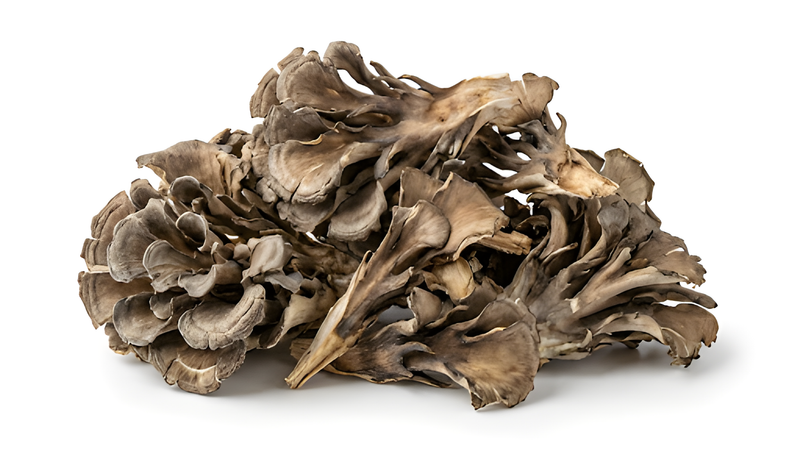
Maitake means "dancing mushroom" in Japanese, and the folklore says foragers danced when they found one. It is worth the dance. Grifola frondosa is that rare thing: a mushroom that is genuinely delicious on the plate and genuinely interesting to researchers, without either side being hype. Here is what it is, how to know it, and what the science does and does not say.
What maitake is and where it grows
Maitake is a polypore that fruits in a big layered cluster at the base of hardwood trees, especially oaks. A single cluster can be 20 to 40 inches across, made of many overlapping gray-brown caps with wavy margins that look like the ruffled feathers of a sitting hen, which is where the English name hen of the woods comes from. It returns to the same spot for years because it lives on the tree's roots and base, emerging each fall from an underground structure called a sclerotium, roughly the size of a potato. In eastern North America you find it from September into November.
Know your look-alikes
Maitake has a few cousins worth knowing so you do not confuse them. Black-staining polypore (Meripilus sumstinei) looks similar but bruises black when handled. Berkeley's polypore (Bondarzewia berkeleyi) is thicker-fleshed and cream colored. The cauliflower mushroom (Sparassis) shares the ruffled look but has ribbon-like folds. None of these is a dangerous poisoning risk the way a death cap is, but they are different eating, so learn the cluster-on-oak habit and the hen-feather caps before you harvest.
In the kitchen
This is a choice edible, and the reason many people seek it out has nothing to do with supplements. Maitake is meaty and savory, holds its texture, and shines in stews, soups, and anything slow-cooked. Cut it into strips and fry until the edges crisp, or simmer it into a hearty broth. Harvest young clusters, and plan to clean it well, because the many crevices trap grit and the occasional insect. It is also one of the most widely cultivated gourmet mushrooms, so you do not have to forage to cook with it.
What is actually in it
Maitake has a genuinely good nutrition profile. By dry weight it runs roughly 40 percent usable protein, around 15 percent fiber, and 9 percent minerals, with potassium standing out, plus B-complex vitamins and some vitamin D. The compounds that get researchers' attention are its beta-glucans, which make up about a quarter of the dry weight. These are the same broad family of immune-active polysaccharides found across medicinal mushrooms.
The functional angle, told honestly
Two beta-glucan fractions from maitake have been studied specifically: grifolan, and a concentrated preparation called D-fraction (and its more purified, orally available cousin, MD-fraction). In laboratory and animal studies, these fractions act on immune cells, activating macrophages, natural killer cells, and T cells. In the language that is both accurate and appropriate for a food, maitake beta-glucans support immune function.
Here is the honest boundary. Most of the eye-catching research, on tumor response, blood sugar, and hormonal conditions like PCOS, is preliminary, built on cell cultures, animal models, and a handful of small human trials. That is a legitimate reason to find maitake interesting. It is not a basis for treating it as a therapy for any disease, and the concentrated D-fraction used in that research is a different thing from the mushroom you sauté for dinner. Eat maitake because it is excellent food with a solid nutrient profile and a promising, still-maturing research story, not because it promises to fix anything.
Bottom line
Maitake earns its place twice over: it is one of the best-eating wild and cultivated mushrooms you can get, and its beta-glucans are a real and active area of immune research. Enjoy the first fact freely. Treat the second with interest and honesty, and you have the mushroom exactly right.
Perguntas frequentes
Maitake (Grifola frondosa), or hen of the woods, is a polypore mushroom that grows in large clustered fronds at the base of oaks. It is both a prized edible and a widely studied functional mushroom.
Referências
- Mohammed, C., Aaroe, A., Buchold, G., Krummel, D., Stamets, P., Sharma, A., Alschuler, L., & Sengupta, S. (2026). Fungal-derived supplements in integrative oncology. The American Journal of Medicine, 139(4), 530-537. https://doi.org/10.1016/j.amjmed.2025.12.028
- Amaranthus, M. (2025). Maitake, the Dancing Mushroom: For your Kitchen and Health. Journal of Food and Nutrition, 11(2). https://doi.org/10.17303/jfn.2025.11.203
- Hobbs, C. (2020). Medicinais Cogumelos de Christopher Hobbs: O Guia Essencial. North Adams, MA: Storey Publishing.
- Meuninck, J. (2014). Cogumelos Comestíveis e Medicinais Ilustrados Básicos. Guilford, CT: Falcon Guides.
- Rogers, R. (2011). A Farmácia Fúngica: O Guia Completo para Cogumelos Medicinais e Liquens da América do Norte. Berkeley, CA: North Atlantic Books.
- Preuss, H. G., Eschard, B., Bagchi, D., & Perricone, N. V. (2010). Extratos de Cogumelo Maitake Melhoram a Hipertensão Progressiva e Outras Perturbações Metabólicas Crônicas em Ratas Fêmeas Idosas. .
- Wesa, K. M. & Cassileth, B. R. (2009). Estudo Clínico de Fase I/II de um Extrato de Polissacarídeo de Grifola frondosa (Cogumelo Maitake) em Pacientes com Câncer de Mama. Revista de Pesquisa em Câncer e Oncologia Clínica, 135(9), 1215-1221.