The Ultimate Amanita Muscaria Guide: Identification, Chemistry, Effects, Dosage, and Legality (2026)
By Louis on 05/18/2026
The most complete Amanita muscaria guide online. Identification, muscimol chemistry, dosage, preparation, legal status, and safe sourcing.
The Ultimate Amanita Muscaria Guide: Identification, Effects, Dosage, Legality
Key Takeaways
- What it is: Amanita muscaria, also called fly agaric, is a psychoactive mushroom containing muscimol and ibotenic acid (not psilocybin).
- Effects: Sedative, dream-like, dissociative — closer to a benzodiazepine than a classical psychedelic.
- Legal status (2026): Federally unregulated in the US; banned in Louisiana only; FDA prohibits use in conventional food as of December 2024.
- Safe dose range (muscimol): 1–2 mg microdose, 6–15 mg threshold to full effect; varies dramatically by individual.
- Critical: Always buy from vendors with third-party Certificates of Analysis after the 2024 Diamond Shruumz outbreak.
Amanita muscaria is the mushroom your brain pictures when someone says "mushroom." Red cap, white spots, slightly cartoonish, slightly menacing. It's the Mario power-up. It's the Smurfs' house. It's the thing the fairy is sitting on in every Victorian book illustration ever drawn. It's also a federally unregulated psychoactive fungus with thousands of years of human use, a complicated chemistry, an industry that started exploding around 2022, and a December 2024 FDA action that reshuffled the entire commercial landscape. This guide covers everything: what it is, how to identify it, what it does to your brain, how to prepare it, what doses do what, what the law says in 2026, and how to source it without ending up in a CDC report.
For the broader picture of how Amanita fits among other legal mushrooms in the US, see our Guide to Legal Mushrooms in the USA..
What Amanita Muscaria Actually Is
Quick answer: Amanita muscaria, commonly called fly agaric, is a psychoactive mushroom in the Amanita genus. It contains muscimol and ibotenic acid (not psilocybin), grows in mycorrhizal partnership with birch and pine trees across the Northern Hemisphere, and has been used by humans for an estimated 6,000 years.
The species is a basidiomycete fungus, member of the Amanita genus, and one of the most globally recognized organisms on the planet. The common names are fly agaric, fly amanita, and in older texts the "bug agaric," all referencing its historical use as an insecticide in northern Europe, chunks of cap soaked in milk would attract and kill flies, hence the name. According to Wikipedia's etymological summary, an alternative theory is that "fly" refers not to the insect but to the medieval belief that flies could enter the head and cause madness.
It forms ectomycorrhizal relationships with the roots of birch, pine, spruce, fir, cedar, and oak, which means it doesn't decompose dead wood like an oyster mushroom. It partners with living trees in a symbiotic exchange where the fungus shares phosphorus and nitrogen with the tree in exchange for sugars. This is also why you can't grow it in a closet on a bag of grain.
It grows across the temperate and boreal forests of the Northern Hemisphere (North America, Europe, Asia) and has been introduced to parts of the Southern Hemisphere alongside imported pine plantations, where it now spreads invasively in places like New Zealand. If you're in a forest with the right tree partners between late summer and early winter, you can probably find it. The species often forms large fairy rings, the circular growth patterns that gave us centuries of European folklore about magic.
How to Identify Amanita Muscaria
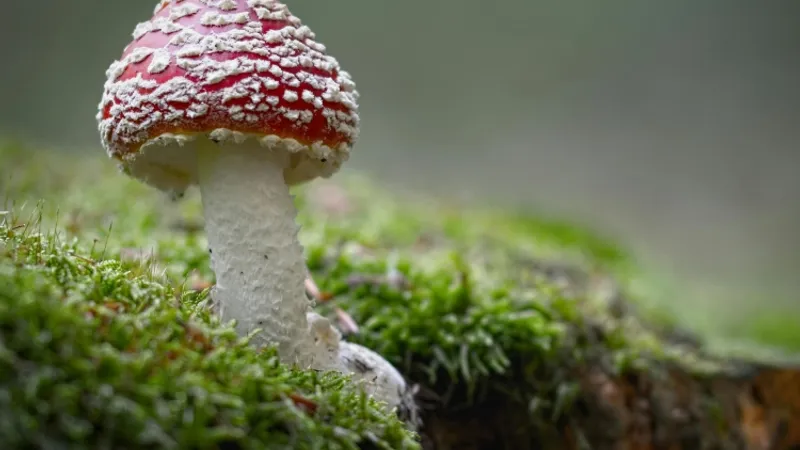
Quick answer: Amanita muscaria has a bright red cap (5–20 cm) covered in white or yellow warts, white free gills, a white stem with a skirt-like ring, and a bulbous base with concentric rings (not a sac-like volva). Its spore print is white. The combination of red cap, white warts, and ringed bulbous base is diagnostic.
The classic field marks are unmistakable when you know what to look for:
- Cap: 8–20 cm across, bright scarlet to deep red (sometimes orange or yellow depending on variety), covered in white or pale yellow warts that are remnants of the universal veil. Heavy rain can wash these off, leaving a bald red cap.
- Universal veil clue: When young, the entire mushroom looks like a small white "egg" emerging from the soil. Cutting one in half at this stage reveals a characteristic yellowish layer of skin under the veil, a key identification feature.
- Gills: White, free (not attached to the stem), crowded.
- Stem: 5–20 cm tall, white, with a distinct skirt-like ring (the partial veil remnant) near the top.
- Base: Bulbous, often with concentric rings of veil tissue rather than a true sac-like volva. This is a critical distinguishing feature from the deadly Amanita species.
- Spore print: White.
- Smell: Mild, slightly earthy, not distinctive.
The Five Main Varieties
Variety | Cap Color | Range |
|---|---|---|
var. muscaria | Bright red with white-to-yellow warts | Eurasia (the "classic" European fly agaric) |
var. flavivolvata | Red with yellow warts | Western North America, Mexico, Andean South America |
var. guessowii | Yellow to orange with white warts | Northeastern North America |
var. alba | White with white warts (rare) | Scattered, uncommon |
var. persicina | Peach to salmon-pink | Southeastern US |
Recent DNA work suggests these color varieties may not represent meaningful genetic differences and that the taxonomy will probably get revised in the next few years. For practical purposes, all of them contain the same active compounds in roughly comparable concentrations. more information about Amanita muscaria at ShroomSpy.com.
The Look-Alikes That Will Kill You
This part isn't optional reading. Amanita muscaria belongs to a genus that includes some of the deadliest mushrooms on Earth. The two you absolutely have to know:
- Amanita phalloides (death cap): Olive-green to yellowish cap, white gills, white spore print, and crucially, a sac-like volva at the base rather than concentric rings. Contains amatoxins that destroy the liver. There is no antidote. A single cap can kill an adult.
- Amanita virosa / Amanita bisporigera (destroying angels): Pure white throughout, with a sac-like volva. Same amatoxins, same outcome.
Amanita muscaria's closest psychoactive cousin is Amanita pantherina (panther cap), which contains the same muscimol and ibotenic acid in higher and more variable concentrations. It's brown-capped with white warts, and consuming it is significantly riskier because the dose-response curve is steeper. We cover the identification differences, the potency variability problem, and why most experienced practitioners stick with muscaria in Amanita Pantherina: The Riskiest Cousin.
If you cannot reliably distinguish a fly agaric from a death cap or a destroying angel in a side-by-side photo lineup, do not forage. Buy from a tested vendor instead.
The Chemistry: What's Actually In There
Quick answer: Amanita muscaria contains four notable compounds: muscimol (the main psychoactive, a GABA-A agonist), ibotenic acid (a neurotoxic precursor that converts to muscimol via decarboxylation), muscarine (present in trace amounts, pharmacologically irrelevant), and muscazone (a minor breakdown product). Muscimol is what makes the experience.
Muscimol (the main event)
Muscimol is a potent GABA-A receptor full agonist, structurally similar to the inhibitory neurotransmitter GABA itself. When it binds to GABA-A receptors, it slows central nervous system activity, producing the characteristic sedative, dream-like, dissociative effects. Pharmacologically it's in the same general family as benzodiazepines and z-drugs like zolpidem.
According to clinical studies summarized in Wikipedia's muscimol entry, the oral threshold dose in humans is approximately 6 mg, with the psychoactive range commonly cited as 8–15 mg. Peak effects occur 1–3 hours after oral ingestion and last 4–8 hours, with residual effects sometimes lingering up to 24 hours. As little as 1 gram of dried Amanita muscaria button can contain this amount of muscimol, though potency varies enormously between specimens.
The layer just below the skin of the cap contains the highest concentration of muscimol. Stems and base contain much less.
Ibotenic Acid (the prodrug, and the problem)
Ibotenic acid is the precursor that the mushroom actually produces in greater quantity. Structurally it resembles glutamate, the brain's main excitatory neurotransmitter, and it acts as an NMDA receptor agonist. Two important things about ibotenic acid:
- It's neurotoxic. In animal studies it's used specifically as a tool to lesion brain tissue. Consuming significant raw ibotenic acid produces nausea, vomiting, sweating, twitching, and a generally unpleasant experience.
- It converts to muscimol through decarboxylation, chemistry-speak for "loses a carboxyl group." Heat does this. Drying does this. Your stomach acid does some of it too. This is why traditional preparation methods all involve drying or boiling.
There's a persistent online myth that carbonated beverages can reverse decarboxylation and convert muscimol back to ibotenic acid. This is chemically incorrect. The myth comes from a 2005 self-published booklet by Donald Teeter and has been repeated in books and forums ever since. Carbonation doesn't undo decarboxylation. Don't worry about your seltzer.
Muscarine (the misnamed minor compound)
Despite giving the entire muscarinic acetylcholine receptor system its name (because it was first isolated from this mushroom in 1869), muscarine is present in Amanita muscaria in tiny concentrations — typically around 0.0003%. Per the toxicology literature summarized by Benjamin in Mushrooms: Poisons and Panaceas, the concentration in fly agaric is too low to play any meaningful role in poisoning symptoms. The famous "muscarinic" symptoms (sweating, salivation, lacrimation, abdominal cramps) require concentrations roughly 300 times higher.
Ironically, several other mushroom species. like Inocybe erubescens and small white Clitocybe species. contain muscarine in genuinely dangerous amounts. The compound is just named for the wrong mushroom.
Muscazone (the mystery)
Muscazone is a degradation product of ibotenic acid produced by ultraviolet radiation, with weak psychoactive effects. It's typically present in small amounts and isn't a major contributor to the overall experience.
How Amanita Effects Compare to Psilocybin
Quick answer: Amanita muscaria and psilocybin mushrooms produce fundamentally different experiences. Amanita's muscimol acts on GABA receptors and produces sedation, dream-like states, and dissociation. Psilocybin acts on serotonin receptors and produces classical psychedelic effects with visual geometry and ego dissolution. They are not interchangeable.
This deserves its own section because the comparison gets made constantly and is almost always wrong. Kevin Feeney, a lawyer and cultural anthropologist at Central Washington University who edited a major academic compendium on Amanita muscaria, told NPR in December 2024 that "there are people that are interested in having heavy psychedelic experiences, and this really isn't the mushroom to go to for that."
Trait | Amanita muscaria (muscimol) | Psilocybin mushrooms |
|---|---|---|
Receptor target | GABA-A (inhibitory) | 5-HT2A serotonin (excitatory) |
Effect category | Sedative / dissociative / deliriant | Classical psychedelic |
Visual effects | Subtle distortions, micropsia/macropsia, dream-like imagery (closed-eye) | Strong open-eye geometric patterns, color enhancement |
Cognitive effects | Dissociation, time loops, lucid dream state, occasional amnesia | Ego dissolution, insight experiences, emotional release |
Body load | Heavy sedation, sometimes nausea, muscle twitching | Moderate body activation, possible nausea early on |
Duration | 4–8 hours, residual up to 24 | 4–6 hours |
Federal legal status (US) | Unscheduled (FDA restricts food use) | Schedule I |
Risk profile | Drug interactions with CNS depressants; pet toxicity; raw-ibotenic-acid toxicity | Cardiovascular caution; psychological risk for those with predisposition |
If you're approaching Amanita expecting a psilocybin-style trip, you'll be disappointed, alarmed, or both.
What an Amanita Experience Actually Feels Like
Quick answer: Amanita muscaria typically produces a 4–8 hour experience that begins with mild relaxation and warmth, deepens into sedation with closed-eye dream-like imagery, often features unusually vivid music appreciation and time distortion, and ends in a sleepy phase often followed by exceptionally vivid dreams that night.
Effects vary dramatically by dose, individual, and preparation, but a general arc looks like this:
Onset (30 minutes to 3 hours): Subtle warming sensation, mild relaxation, sometimes mild nausea or stomach unease. Heavy eyelids. Music starts feeling more interesting.
Plateau (1–4 hours in): Deepening sedation. Many users describe a "heavy" body feeling, like sinking into the couch. Closed-eye visuals can appear, often described as dream-like or hypnagogic rather than the geometric patterns of classical psychedelics. Some people experience time distortion, looping thoughts, or brief moments of dissociation. A subset report synesthesia (hearing colors, seeing sounds). Auditory perception sharpens.
Comedown (4–8 hours in): Gradual return, often through a sleepy phase. Many users report unusually vivid and detailed dreams that night and the night after. Some report improved sleep quality for several days.
Higher doses push the experience toward genuine dissociation, delirium, occasional amnesia for parts of the experience, and physical symptoms including muscle twitching, sweating, and elevated heart rate. This is where the deliriant classification earns its name.
A 2023 study by Ordak et al. published in the journal Toxics surveyed reasons people use Amanita muscaria. The most commonly reported uses were improving sleep, reducing alcohol and benzodiazepine use and withdrawal symptoms, and alleviating anxiety. Other reported uses included pain relief, mental stimulation, and decreased depression. The study notes that despite these self-reported benefits, clinical evidence supporting therapeutic claims remains scarce.
Dosage: The Honest Conversation
Quick answer: A microdose of Amanita muscaria is 1–2 mg of muscimol or roughly 0.1–1 g of dried cap. The threshold for psychoactive effects is about 6 mg muscimol; the psychoactive range is 8–15 mg, equivalent to roughly 1–5 g of dried cap. Individual responses vary enormously, so always start lower than you think you need.
Disclaimer first: dosage information here is educational. Amanita muscaria is not approved by the FDA for human consumption, and individual responses vary enormously. What follows reflects the published clinical literature and harm-reduction consensus, not personal medical advice. Start low. Go slow.
Dose Ranges (Dried Mushroom and Pure Muscimol)
Dose Level | Dried Cap | Equivalent Muscimol | Typical Effects |
|---|---|---|---|
Microdose | 0.1–1 g | 1–2 mg | Sub-perceptual; reported subtle mood, sleep, and pain effects |
Threshold | 1–3 g | 3–6 mg | Mild relaxation, slight perceptual changes |
Low (psycholytic) | 3–5 g | 6–10 mg | Clear sedation, mild dream-state, music enhancement |
Medium | 5–10 g | 10–15 mg | Full effects, dissociation, vivid closed-eye visuals |
High | 10–30 g | 15+ mg | Strong delirium, possible amnesia, physical symptoms; not recommended |
These ranges assume properly dried, decarboxylated material. Raw fresh mushrooms behave very differently because of the unconverted ibotenic acid load. Commercial extracts and gummies should list muscimol content per serving directly, that's the number that matters, not the total Amanita extract weight.
Microdosing Specifically
The microdosing-with-Amanita conversation has grown fast since Baba Masha's 2022 book Microdosing with Amanita Muscaria documented experience reports from over 3,000 volunteers. A 2023 retrospective case study published in the Journal of Psychedelic Studies followed a woman who used a gradually declining microdose regimen over 3.5 months for depression, anxiety, and trauma-related sleep disorders. Her self-reported symptoms improved meaningfully, blood work showed no abnormalities, and liver function actually improved slightly.
That's a single case study, not a clinical trial, and it should be read as suggestive rather than conclusive. Common microdose protocols use 1–2 mg of muscimol (or roughly 0.1–0.5 g dried cap) once daily or every other day, with a cycling pattern that includes rest days to reduce tolerance buildup. For a full breakdown of protocols, scheduling, stacking considerations, and contraindications, see our Complete Guide to Amanita Muscaria Microdosing Protocol.
Preparation: Decarboxylation Done Right
Quick answer: Raw Amanita muscaria contains neurotoxic ibotenic acid, which converts to the desired muscimol through decarboxylation (heat or extended drying). The three reliable methods are slow drying at low temperature, simmering in acidified water for 20–30 minutes, or buying a tested commercial extract.
Method 1: Long Drying (Traditional)
Cut caps into thin slices. Dry at low heat (around 175°F / 80°C) in a dehydrator or oven for several hours until fully cracker-dry. This converts a substantial portion of ibotenic acid to muscimol. It's the gentlest method and preserves the most of the experience profile traditional users describe.
Method 2: Acidic Boil (Most Effective)
Slice the dried (or fresh) caps. Simmer in water acidified with lemon juice or a teaspoon of citric acid (target pH around 3) for 20–30 minutes. The acidic conditions accelerate decarboxylation. Strain. Drink the tea, optionally consume the mushroom material as well.
This is the method most traditional Siberian and Scandinavian preparations are based on. A common mistake: discarding the water. The water contains most of the muscimol. Drink it.
Method 3: Buy a Tested Extract (Recommended for Most People in 2026)
Reputable extract manufacturers control the decarboxylation process in lab conditions, test the finished product for muscimol content, and publish a Certificate of Analysis showing exact dosage per serving. You skip the guesswork and the risk of getting it wrong with a wild specimen of unknown chemistry.
For the chemistry behind why each method works, the temperature and pH thresholds that actually matter, and how home methods compare to commercial extraction, our decarboxylation explainer for mushroom users goes into the molecular detail.
A Brief, Honest History of Human Use
Quick answer: Amanita muscaria has been used by humans for an estimated 6,000 years across Siberia, Scandinavia, and parts of indigenous North America. Documented use includes Siberian shamanic ceremonies and urine recycling. Popular theories about Viking berserkers, Vedic Soma, and Santa Claus origins range from plausible to entertaining storytelling.
Some popular claims about Amanita's history are sturdy. Others are speculation that has hardened into "fact" through repetition, and a credible guide should be honest about which is which.
Probably true: Siberian shamanic use for divination and ritual. Use of urine recycling, muscimol is excreted partially unmetabolized, and Siberian shamans drank the urine of mushroom users to extend the experience. This is well documented in 18th-century European accounts and was even mentioned by Anglo-Irish writer Oliver Goldsmith in his 1762 novel Citizen of the World. Use as an insecticide in pre-modern Europe is also well attested, the Flemish botanist Carolus Clusius traced the milk-and-mushroom fly trap to Frankfurt, Germany, and Linnaeus reported it from southern Sweden where he grew up.
Plausible but contested: The Viking berserker theory, which holds that Norse warriors consumed Amanita before battle. The original sagas don't mention mushrooms. Black henbane, ergot, and grief-rage psychology are now considered equally or more likely explanations by serious historians.
Probably overstated: The "Soma" theory, popularized by R. Gordon Wasson in his 1968 book Soma: Divine Mushroom of Immortality, proposes that the sacred drink referenced in the Hindu Rigveda was Amanita muscaria. Vedic scholar John Brough rejected the theory in 1971 as being based on language too vague to support the claim. Indian scholars Dash and Padhy noted that the Manusmriti specifically prohibits both eating mushrooms and drinking urine, both central to the proposed Soma practice. Other researchers including Feeney and Austin have published evidence supporting the theory. The honest answer is the case is unsettled.
Almost certainly fun storytelling rather than history: The Santa Claus origin theory connects the red-and-white shaman costume, entry through smoke holes, reindeer (which do eat Amanita and excrete muscimol-rich urine), and gift-giving to a unified Siberian shamanic Christmas origin. There are real points of connection between Siberian shamanism and certain Christmas traditions, but the "Santa is a fly agaric shaman" narrative was largely pieced together in the late 20th century and lacks the medieval textual support that would make it serious history. Tell it at a holiday party. Don't tell it in a thesis.
The mushroom has also left a deep mark in literature. Naturalist Mordecai Cubitt Cooke documented the size-distortion effects in his 1860s books The Seven Sisters of Sleep and A Plain and Easy Account of British Fungi, observations widely thought to have inspired Lewis Carroll's Alice's Adventures in Wonderland (1865). Charles Kingsley's 1866 novel Hereward the Wake features a hallucinogenic "scarlet toadstool from Lappland" as a plot element. Thomas Pynchon's Gravity's Rainbow (1973) describes preparation of an Amanita-containing baked good in detail.
Risks, Contraindications, and Drug Interactions
Quick answer: Amanita muscaria is significantly safer than its reputation when properly prepared and dosed, but combining it with alcohol, benzodiazepines, opioids, or other CNS depressants is dangerous. It is highly toxic to dogs and cats. Pre-existing seizure disorders, severe liver/kidney disease, pregnancy, and breastfeeding are contraindications.
Real Risks
- Raw or under-decarboxylated material: High ibotenic acid content causes nausea, vomiting, sweating, muscle twitching, and unpleasant cognitive effects.
- CNS depressant interactions: Muscimol's GABA-A activity stacks dangerously with alcohol, benzodiazepines, opioids, barbiturates, and other sedatives. Combinations can produce dangerous sedation, respiratory depression, and amnesia. Avoid mixing.
- High doses: Genuine delirium, amnesia for parts of the experience, occasional seizures, and prolonged duration that can be psychologically distressing. A 2021 case report published in PMC documented a 44-year-old patient who consumed approximately half a kilogram of foraged Amanita muscaria and fell into a coma; he was discharged on the fourth day after supportive treatment.
- Pre-existing conditions: Seizure disorders, severe liver or kidney disease, or active prescription psychiatric medications are reasons to avoid use without consulting a knowledgeable medical provider.
- Pregnancy and breastfeeding: No safety data exists. Avoid.
- Driving and machinery: Don't. Hell nah.
What Doctors Should Know
The PMC case report notes that for Amanita muscaria poisoning, there is no antidote. Atropine and physostigmine are contraindicated because the symptoms include both cholinergic and anticholinergic features. Benzodiazepines are generally effective for managing agitation, with caution about respiratory depression. ECG and electrolyte monitoring are recommended. This is useful to know if you ever need to communicate with an ER physician on someone else's behalf, many don't see Amanita cases often.
Death Risk
Direct fatalities from Amanita muscaria consumption in adults are extremely rare and almost always involve massive overdoses or mistaken identification of more toxic species. The most famous historical case is Count Achilles de Vecchi, an Italian official in Washington DC who died in 1897 after consuming approximately two dozen mushrooms he had collected and identified as Amanita caesarea, but actually were Amanita muscaria. Modern fatalities are much rarer, in part because of better awareness and supportive medical care.
This isn't a license for casual recklessness. It does mean the mushroom's deadly reputation is overstated relative to compounds like alcohol or opioids.
Pet Safety (Non-Negotiable!)
Amanita muscaria is significantly toxic to dogs and cats. Symptoms include vomiting, tremors, seizures, coma, and death. Dogs are particularly attracted to gummy and chocolate Amanita products because of the sweet packaging. Store these the way you'd store prescription medications. If a pet ingests any amount, contact the ASPCA Animal Poison Control Center (888-426-4435) immediately.
The FDA's December 2024 Action: What It Actually Means
Quick answer: On December 18, 2024, the FDA issued a letter to industry stating that Amanita muscaria, its extracts, and its constituents (muscimol, ibotenic acid, muscarine) are unapproved food additives that do not meet Generally Recognized As Safe (GRAS) standards. This means food products like gummies and chocolates containing Amanita are now considered "adulterated" and subject to enforcement. The mushroom itself remains legal to possess; only its use in conventional food is restricted.
This is the most important regulatory development in the Amanita space in decades, and it's been widely misreported. Several websites now claim the FDA "banned" Amanita muscaria. This is wrong. Here's what actually happened.
The FDA's letter, issued in the wake of the Diamond Shruumz outbreak and a mounting wave of adverse event reports, stated three specific things:
- Amanita muscaria and its constituents are not GRAS-approved as food additives. The FDA reviewed over 600 scientific publications and concluded the available evidence does not establish safety for use in conventional food.
- Food products containing these substances are "adulterated" under the Federal Food, Drug, and Cosmetic Act. Manufacturers face potential enforcement action.
- Dietary supplement use is being separately evaluated. The FDA encouraged manufacturers exploring supplement formulations to engage with the Office of Dietary Supplement Programs.
What the action did NOT do:
- It did not schedule the mushroom or its compounds. Amanita remains federally unscheduled.
- It did not make personal possession illegal.
- It did not affect dried whole mushrooms sold for purposes other than food (e.g., spiritual, decorative, microscopy).
- It did not preempt state law, which remains the same in 49 states.
What it changes in practice: the gummy, chocolate bar, and beverage market is now operating under direct enforcement risk. Some brands have already pivoted to dietary supplement framing. Others are reformulating. The wholesale legal landscape for psychoactive Amanita food products is now substantially more complicated than it was before December 2024.
Eric Leas, an epidemiologist at UC San Diego who has documented public health concerns around the mushroom and was quoted in NPR's coverage of the FDA action, said "I feel it's the right call. It could potentially have very large implications for this market." Christian Rasmussen, who runs the online retailer MN Nice Botanicals, told NPR the action stems largely from "the actual adulterated products that have hit the market in recent years, containing various synthetic drugs and being marketed as Amanita."
FDA letter to the industry about Amanita Muscaria
The Diamond Shruumz Cautionary Tale
Quick answer: In 2024, Diamond Shruumz mushroom edibles were linked to 180 illnesses, 73 hospitalizations, and three potentially associated deaths across 34 states. FDA testing found the products contained the Schedule I substance psilocin, a synthetic psilocybin analog, the prescription drug pregabalin, kavalactones, and inconsistent levels of muscimol. The brand was recalled in June 2024 and the case directly prompted the FDA's December 2024 action.
The lesson is uncomfortable but worth stating plainly: "legal mushroom" on a label does not mean the product contains what the label says it does. The only protection consumers have is third-party testing with publicly accessible certificates of analysis from ISO-certified labs. If a product doesn't have one, it's a guessing game with your nervous system.
The FDA investigation concluded that muscimol alone "couldn't explain all the symptoms reported by ill people who consumed the Diamond Shruumz-brand products." That admission is what made the case so significant, the symptoms came from a chemistry-set the labels didn't disclose. summary of the CDC investigation on Diamond Shruumz.
Legal Status in 2026
Quick answer: As of February 2026, Amanita muscaria, muscimol, and ibotenic acid are not regulated or banned in any US state or the District of Columbia, with the single exception of Louisiana. The FDA prohibits use as a food additive but does not control personal possession. Texas considered a ban in 2025; all bills failed. The mushroom is federally legal in most countries internationally, with notable bans in Australia, the Netherlands, Romania, Thailand, and Russia.
According to the Legislative Analysis Center's March 2026 fact sheet:
Status | Where | Details |
|---|---|---|
Banned | Louisiana | State Act 159 (2005) classifies Amanita muscaria as a "hallucinogenic plant." Cultivation permitted only for ornamental purposes. |
Legal, no scheduling | All other 49 states + DC | Not scheduled at the state level. |
Failed bans | Texas | Multiple 2025 bills attempted to add muscimol and ibotenic acid to penalty group 2. All failed. |
Labeling rules only | Minnesota | Not banned. The MN Department of Agriculture requires Amanita products to be sold as dietary supplements with full ingredient transparency. |
Federal food restriction | Nationwide | FDA letter of December 18, 2024 prohibits use as food additive. |
For the complete state-by-state breakdown across the entire legal mushroom landscape (including psilocybin programs in Oregon, Colorado, New Mexico, New Jersey, South Dakota, and Connecticut), see our Guide to Legal Mushrooms in the USA..
Can You Grow Amanita Muscaria?
Quick answer: Mostly no. Because Amanita muscaria forms an obligate ectomycorrhizal relationship with specific tree species, it cannot be cultivated on grain, sawdust, or other substrates the way oyster mushrooms or lion's mane can. There's no functional Amanita grow kit. Wild foraging or commercial harvest from forests is the only practical source.
A small number of mycologists have reported success inoculating young birch and pine seedlings in controlled outdoor settings, but these are decade-long projects with low success rates. For practical purposes, Amanita muscaria comes from wild foraging or commercial harvest from forests in places like Lithuania, Estonia, and the Pacific Northwest.
This is also why prices for high-quality dried Amanita are higher than for cultivated functional mushrooms. The labor and time involved in foraging, identifying, drying, and testing wild mushrooms is substantial.
How to Spot a Fake or Adulterated Product
Quick answer: Red flags include missing or unreachable Certificates of Analysis, vague ingredient lists ("proprietary blend"), no quantified muscimol content per serving, suspiciously low prices, medical claims about treating diseases, and brands shipping psychoactive products to all 50 states with no state restrictions at checkout.
After Diamond Shruumz, this section is mandatory reading for anyone shopping in this category. Before buying, run through this checklist:
- No Certificate of Analysis available? Walk away. ISO-certified third-party COAs are the bare minimum.
- Label says "mushroom blend" or "proprietary blend" without species and quantities? Walk away.
- No muscimol content listed in milligrams per serving? You don't know what you're taking. Walk away.
- No ibotenic acid content listed? You don't know how much decarboxylation occurred. Caution.
- Product makes claims about treating, curing, or diagnosing any disease? That's an illegal claim under FDA rules and a sign of an unreliable manufacturer.
- Suspiciously low price? Quality extraction, third-party testing, and compliant manufacturing cost money. A bag of gummies for $9.99 has not paid for any of that.
- Brand ships psychoactive products to all 50 states without any state restriction at checkout? They're either ignoring Louisiana law or the product isn't what they say it is.
- No clear company information, no lawyer-reviewed Terms of Service, no listed phone number? Anonymous brands are a red flag.
How to Source Amanita Safely
Quick answer: Buy from vendors with publicly accessible third-party Certificates of Analysis from ISO-certified labs. The COA should show muscimol content per serving, ibotenic acid content, heavy metal screen, microbial testing, and the Latin species name (Amanita muscaria). Skip anything sold as "mushroom blend."
Three things to check before buying any Amanita product:
First, third-party Certificate of Analysis. The COA should show muscimol content per serving (the number that determines what you're actually taking), ibotenic acid content (lower is generally safer), absence of contaminants like heavy metals and pesticides, and microbial testing.
Second, transparent species and sourcing. The label should list Amanita muscaria specifically (not just "Amanita extract" or "mushroom blend"), state where the mushrooms were harvested, and ideally describe the decarboxylation process used.
Third, dosage clarity per serving. Look for milligrams of muscimol per gummy, capsule, or dropperful, not just total Amanita extract weight. A 500 mg "Amanita extract" gummy with 5 mg of muscimol is a microdose product. A 500 mg gummy with 15 mg of muscimol is a full-dose product.
ShroomSpy's marketplace model lets you compare vendors side by side, with every listing showing whether the seller provides third-party testing documentation.
Glossary
Basidiomycete: A division of fungi that includes most mushrooms with gills, including Amanita muscaria.
Decarboxylation: A chemical reaction that removes a carboxyl group from a molecule. In Amanita, decarboxylation converts ibotenic acid to muscimol via heat or extended drying.
Ectomycorrhizal: A symbiotic relationship between fungi and plant roots in which the fungal hyphae form a sheath around the outside of the root.
Fly agaric: Common name for Amanita muscaria, derived from its historical use as an insecticide.
GABA-A receptor: An inhibitory neurotransmitter receptor in the central nervous system. Muscimol acts as a full agonist here, producing sedative and dissociative effects.
GRAS: Generally Recognized As Safe — an FDA designation for food additives that have been demonstrated safe through scientific consensus or long history of use.
Ibotenic acid: A neurotoxic amino acid in raw Amanita muscaria that converts to muscimol via decarboxylation.
Muscimol: The principal psychoactive compound in Amanita muscaria, a GABA-A receptor full agonist.
Universal veil: The membrane that encloses a young mushroom of the Amanita genus. Remnants form the warts on the cap and the volva at the base.
Volva: The cup-like or ringed structure at the base of an Amanita stem, formed from universal veil remnants. The shape (sac vs. concentric rings) is a critical identification feature.
Frequently Asked Questions
Is Amanita muscaria a psychedelic?
Not in the classical sense. Psychedelics like psilocybin act on serotonin receptors and produce visual geometry, color enhancement, and ego dissolution. Amanita muscaria's main compound, muscimol, acts on GABA receptors and produces sedation, dream-like states, dissociation, and sometimes delirium at higher doses. It's classified pharmacologically closer to a sedative-deliriant.
How long do Amanita muscaria effects last?
Peak effects occur 1–3 hours after oral consumption and last 4–8 hours. Residual effects, including unusually vivid dreams, can persist up to 24 hours after the acute experience ends.
Did the FDA ban Amanita muscaria in 2024?
No. The FDA's December 18, 2024 action prohibits the use of Amanita muscaria and its constituents as food additives in conventional food, but does not schedule the mushroom, criminalize possession, or affect non-food uses. Personal possession remains legal in 49 US states.
Can you eat Amanita muscaria raw?
Technically yes, practically no. Raw Amanita contains high concentrations of ibotenic acid, which is neurotoxic and produces nausea, vomiting, sweating, and muscle twitching. Drying or boiling converts most of the ibotenic acid to muscimol and dramatically improves the experience.
Will Amanita muscaria show up on a drug test?
Standard 5-panel and 10-panel employment drug tests do not screen for muscimol or ibotenic acid. They look for THC, opiates, amphetamines, cocaine, and PCP. Specialized expanded panels can detect Amanita compounds but are uncommon outside specific clinical or legal contexts.
Is Amanita muscaria addictive?
There's no evidence of physical dependence. Tolerance to muscimol does build with repeated frequent use, which is why most microdosing protocols include rest days. Psychological dependence is theoretically possible with any habit-forming substance.
Can you mix Amanita muscaria with alcohol or cannabis?
You can. You shouldn't. Muscimol's GABA-A agonist activity stacks dangerously with alcohol and other CNS depressants, producing severe sedation, respiratory depression, and amnesia. Cannabis interactions are less dangerous but can amplify the dissociative effects unpredictably. Avoid combining.
What's the difference between Amanita muscaria and Amanita pantherina?
Amanita pantherina (panther cap) contains the same active compounds in higher and more variable concentrations. The dose-response curve is steeper, meaning the margin between a desired dose and an overwhelming one is narrower. Cap color is brown rather than red. Pantherina is significantly riskier and is not recommended for casual use.
How is Amanita muscaria legal when psilocybin mushrooms aren't?
Federal drug law schedules specific compounds, not specific mushroom species. Psilocybin and psilocin are Schedule I controlled substances. Muscimol and ibotenic acid are not scheduled. Because Amanita muscaria contains the latter and not the former, it falls outside the Controlled Substances Act. Louisiana is the one US state that bans the mushroom directly.
Can Amanita muscaria help with sleep?
Anecdotal reports and emerging research suggest muscimol can improve sleep quality, particularly NREM deep sleep. The pharmacological mechanism is plausible — muscimol's GABA-A activity is similar to the mechanism of benzodiazepines and z-drugs commonly prescribed for insomnia. Clinical research is still in early stages.
What's the safest way to try Amanita muscaria for the first time?
Buy a tested commercial product with documented muscimol content from a vendor that publishes a Certificate of Analysis from an ISO-certified lab. Start at a microdose (1–2 mg muscimol). Have a sober trip sitter present. Be in a familiar, comfortable environment. Don't combine with other substances. Don't drive. Wait at least three hours before considering an additional dose.
Is foraging Amanita muscaria legal?
Foraging laws vary by state and by land. Generally, foraging on private land with permission is fine. Foraging in national forests for personal use is generally permitted in small quantities. Foraging for commercial sale typically requires a state-certified wild mushroom harvester course. Louisiana prohibits Amanita muscaria entirely.
Conclusion
Amanita muscaria is one of the most fascinating organisms on Earth, a fungus with thousands of years of human use, a chemistry that puts it in a pharmacological category of its own, and a current regulatory landscape complicated by both its iconic legality and the FDA's December 2024 restriction on food use. Knowing the difference between a meaningful experience and a hospital trip comes down to three things: pick a tested vendor, start lower than you think you need to, and treat the mushroom with the respect a 6,000-year human relationship has earned. None of this constitutes medical or legal advice; consult a qualified professional before consuming any psychoactive substance.
Shop Amanita muscaria products from vetted vendors
Frequently Asked Questions
They are not interchangeable. Amanita muscaria's main compound, muscimol, acts on GABA-A receptors and produces sedation, dream-like states, and dissociation, placing it closer to a benzodiazepine than a classical psychedelic. Psilocybin acts on serotonin (5-HT2A) receptors and produces classical psychedelic effects like visual geometry and ego dissolution. Approaching Amanita expecting a psilocybin-style trip leads to disappointment or alarm.
References
- (2026). Fly agaric: Ibotenic acid decarboxylation to muscimol.
- (2026). Amanita Muscaria (Fly Agaric) Fact Sheet.
- Roosevelt, M. W. (2024). Letter to Industry on the Use of Amanita Muscaria or its Constituents in Food.
- Stone, W. (2024). The FDA restricts a psychoactive mushroom used in some edibles.
- Leas, E. C. (2024). Need for a Public Health Response to the Unregulated Sales of Amanita muscaria Mushrooms. .
- Feeney, K. (2023). On microdosing with the Mario mushroom. .
- Ordak, M., Galzaka, A., Nasierowski, T., Muszynska, E., & Bujalska-Zadrozny, M. (2023). Reasons, Form of Ingestion and Side Effects Associated with Consumption of Amanita muscaria. .
- Rampolli, F. I., Kamler, P., Carlino, C. C., & Bedussi, F. (2021). The Deceptive Mushroom: Accidental Amanita muscaria Poisoning. .
- Leonavičius, J., Marksa, M., Kazlauskiene, D., Nenortienė, P., & Bezruk, I. (2019). Determination of muscimol in Amanita muscaria L. by high–performance thin–layer chromatography (HPTLC) method after decarboxylation. .
- Turkia, M. Psycholytic dosing or 'microdosing' of Amanita muscaria (red fly agaric) mushrooms—A retrospective case study. .