Turkey Tail: The Most-Researched Medicinal Mushroom (and the Most Oversold)
By Josh Shearer on 23/07/2026
Turkey tail is the most-studied medicinal mushroom, and the most oversold. What PSK and PSP really are, what the research shows, and the line marketers cross.
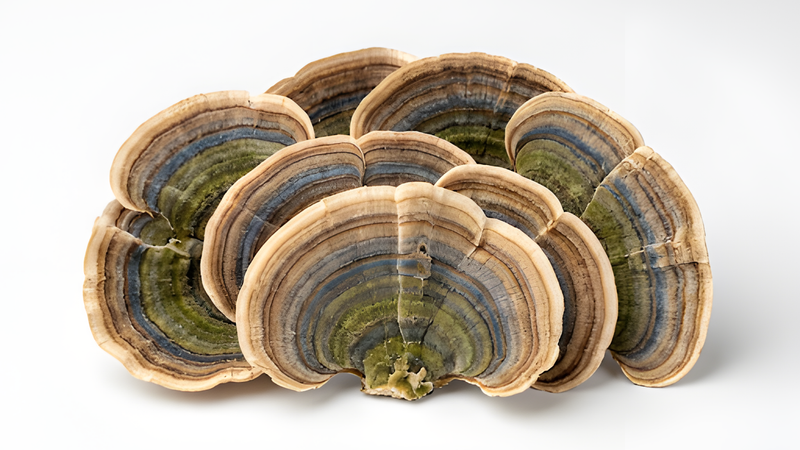
Turkey tail is the mushroom that launched a thousand supplement labels, and it half-deserves it. Trametes versicolor is the single most-researched medicinal mushroom in the world, with a genuine pharmaceutical track record behind it. It is also the mushroom whose marketing most often outruns the evidence. Both things are true, and telling them apart is the whole point.
What it is, and where you have already seen it
Turkey tail is a thin, leathery polypore that grows in overlapping tiled clusters on stumps and dead wood, all over the world, all year round. The top of each fan shows concentric bands of color, brown, rust, gray, sometimes blue or greenish, with zones of fine fuzzy hair, which is exactly what a wild turkey's tail looks like. It is one of the easiest mushrooms to find and identify, and you have almost certainly walked past a log covered in it.
One thing to get straight up front: turkey tail is not a food mushroom. It is too thin and leathery to eat like a shiitake. People consume it as a tea, a decoction, or an extract, not as dinner.
Why researchers care: PSK and PSP
Turkey tail has one of the highest beta-glucan contents of any mushroom, over 50 percent by some measures, and beta-glucans are the compounds behind most of the immune research on medicinal fungi. Two concentrated extracts have been studied more than almost any other mushroom compound: PSK (polysaccharide-K, brand name Krestin), developed in Japan, and PSP (polysaccharide peptide), its Chinese counterpart.
These are not casual supplements. PSK was approved as a prescription cancer drug in Japan in 1977, and by 1987 it accounted for a quarter of that country's entire spending on anticancer agents. It is given to patients orally at several grams a day, alongside standard chemotherapy, and clinical trials have linked it to improved quality of life and, in some studies of stomach and colorectal cancer, longer survival when added to conventional treatment. In lab and animal work, PSK and PSP activate immune cells across the board: T-cells, macrophages, natural killer cells, interferon, and interleukins.
The line marketers cross
Here is where honesty matters. Everything impressive above is about PSK and PSP, purified pharmaceutical extracts produced from specific strains grown in liquid culture, used as adjuncts to chemotherapy under medical supervision. That is not the same as a capsule of ground-up mushroom, and it is definitely not the same as tea.
The American Cancer Society puts it plainly: "Available scientific evidence does not support claims that the raw mushroom itself is an effective anti-cancer agent in humans." A retail turkey tail product is not a cancer treatment, and any label that implies otherwise is selling the drug's reputation without the drug. It is also worth knowing that the commercial extracts sold in the US are frequently not manufactured the way the clinical-trial products were, so even the "PSK" or "PSP" on a label may not be what was studied.
What is fair to say
Stripped of the hype, turkey tail is still genuinely interesting. It is a beta-glucan-rich extract that supports normal immune function, it has a deeper research record than any other medicinal mushroom, and its fiber may act as a prebiotic that feeds beneficial gut bacteria. Those are honest, modest, structure-and-function claims, and they are reason enough to find turkey tail worth using.
Bottom line
Turkey tail is the best-studied mushroom in the medicine cabinet and the easiest to oversell. Respect the research by describing it accurately: a purified extract of it is a real adjunct cancer drug in Japan, and the tea or capsule you buy is a beta-glucan-rich immune supporter, not a treatment. Hold both facts at once and you understand turkey tail better than most of the labels selling it.
Perguntas frequentes
Not as food. It is too thin and leathery to chew. Turkey tail is consumed as a tea, decoction, or extract rather than cooked like an edible mushroom.
Referências
- Mohammed, C., Aaroe, A., Buchold, G., Krummel, D., Stamets, P., Sharma, A., Alschuler, L., & Sengupta, S. (2026). Fungal-derived supplements in integrative oncology. The American Journal of Medicine, 139(4), 530-537. https://doi.org/10.1016/j.amjmed.2025.12.028
- Araújo-Rodrigues, H., Sousa, A., Relvas, J., Tavaria, F., & Pintado, M. (2024). An Overview on Mushroom Polysaccharides: Health-promoting Properties, Prebiotic and Gut Microbiota Modulation Effects and Structure-function Correlation. Carbohydrate Polymers, 333, 121978. https://doi.org/10.1016/j.carbpol.2024.121978
- Hobbs, C. (2020). Medicinais Cogumelos de Christopher Hobbs: O Guia Essencial. North Adams, MA: Storey Publishing.
- Pallav, K., Dowd, S. E., Villafuerte, J., Yang, X., Kabbani, T., Hansen, J., Dennis, M., Feffler, D. A., Newburg, D. S., & Kelly, C. P. (2014). Efeitos do polissacaropeptídeo de Trametes versicolor e amoxicilina no microbioma intestinal de voluntários saudáveis: um ensaio clínico randomizado. .
- Rogers, R. (2011). A Farmácia Fúngica: O Guia Completo para Cogumelos Medicinais e Liquens da América do Norte. Berkeley, CA: North Atlantic Books.
- Powell, M. (2010). Cogumelos Medicinais: Um Guia Clínico. Mycology Press.
- Oba, K., Teramukai, M., Kobayashi, M., Matsui, T., Kodera, Y., & Sakamoto, J. (2007). PSK e sobrevivência de pacientes com câncer gástrico: meta-análise abrangente de ensaios clínicos randomizados. Nutrição e Câncer, 57(2), 158-164. https://doi.org/10.1080/01635580701274597