The Easiest Mushrooms to Grow at Home (and Where to Start)
By Josh Shearer on 07/11/2026
Oyster mushrooms are the best first grow, and here is why. A beginner's guide to the easiest mushrooms to grow at home, from kits to straw to garden beds.
The beginner question is usually "which mushroom tastes best?" That is the wrong question. The right one is "which mushroom forgives my mistakes?" Growing mushrooms is a race between the species you want and the molds and bacteria you don't, and a first-timer's setup is never as clean as a lab. So the best starter mushroom is not the fanciest one. It is the one that colonizes so fast and so aggressively that contaminants never get a foothold. By that standard there is a clear winner.
Start with oyster mushrooms. It is not close.
Oyster mushrooms (Pleurotus ostreatus) and their close relatives are the best mushrooms for a first-time grower, full stop. Paul Stamets calls the species "exceedingly easy to cultivate," and cultivation guides consistently name it the top pick for beginners for one reason: its mycelium grows fast enough to outpace competing molds and bacteria. That speed is what makes it forgiving. You can work with less-than-sterile technique, fruit it in an imperfect environment, and still get mushrooms.
Oysters are also the least fussy species about what they eat. They will fruit from wheat straw, hardwood sawdust, spent coffee grounds, cardboard, corn cobs, peanut shells, and a long list of other agricultural leftovers. That flexibility means your first substrate can be cheap and easy to find. The main relatives worth knowing are the pearl oyster (the standard gray one), the phoenix oyster (P. pulmonarius), and the vivid pink oyster (P. djamor), which is fast and heat-loving but does not keep well after harvest.
Grow a kit before you grow from scratch
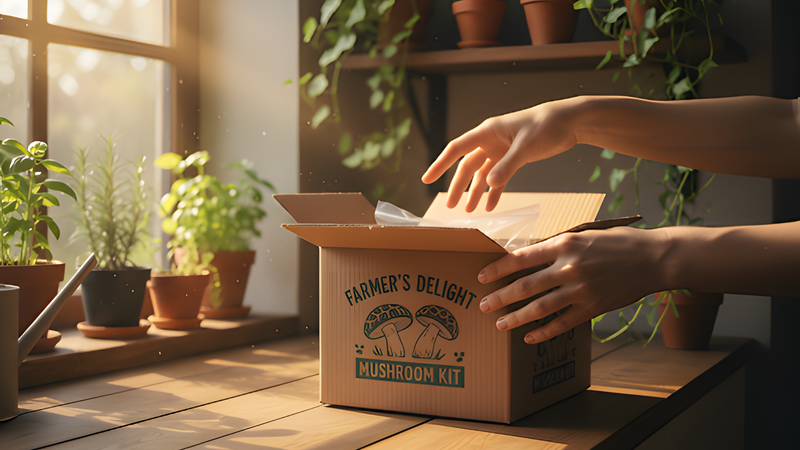
If you have never done this, buy a grow kit first. A kit is a bag of substrate already fully colonized by mushroom mycelium, so the hard and contamination-prone part is done for you. You cut a slit in the bag, put it somewhere with fresh air and indirect light, and mist it. Mushrooms usually start pinning within one to three weeks and are ready to harvest three to ten days after that.
One thing kit instructions rarely tell you: most kits will fruit again. Growers typically toss a block after the first flush, but a second and sometimes third flush will come weeks later if you rehydrate it and stay patient. Some people even collect "spent" blocks from local mushroom farms and fruit them at home for almost nothing. A kit teaches you what healthy fruiting looks like before you risk your own substrate.
Your first from-scratch grow: oysters on straw
When you are ready to start from spawn, oysters on pasteurized straw is the classic entry method, and it needs no pressure cooker or still-air box.
The shape of it is simple. You pasteurize chopped straw by soaking it in hot water for about an hour, which knocks back competing organisms without fully sterilizing (straw does not need it). You drain and cool it, then mix in grain spawn, which is just mushroom mycelium grown on rye, sorghum, or millet, bought from a reputable supplier. That mix goes into a bucket or bag to colonize for a couple of weeks, and once it is solid white with mycelium you move it into a humid, fresh-air fruiting space.
Match the strain to your climate. Oyster mycelium runs across a wide range, roughly 41 to 86 F, but fruiting temperature is strain-specific. Standard pearl and summer strains like it warm, around 77 F, while blue oyster strains fruit in a cool 41 to 59 F window. Buying a strain suited to your room temperature does more for your success than any gadget.
A quick word on substrate choice. Straw colonizes in weeks and fruits within months, which is why beginners use it. Hardwood logs and sawdust hold far more nutrients and can produce for years, but they take one to two years to colonize. That patience is a virtue later, not on your first grow.
Even lower-tech: grow them outdoors in a bed
If you would rather skip bags and misting entirely, the lowest-effort path is an outdoor mushroom bed, and two species are made for it.
Wine cap (Stropharia rugoso-annulata), also called king stropharia or garden giant, is the standout. You inoculate a bed of straw and hardwood chips with spawn, cap it with a thin layer of soil, and let the weather do the rest. It colonizes around 70 to 81 F and fruits in the 64 to 75 F range, producing large meaty mushrooms from late spring through summer. It grows happily in polyculture, tucked among garden vegetables where its shade and moisture are a feature, not a problem.
Shaggy mane (Coprinus comatus) also grows well in a straw-compost garden bed. The one catch is timing: a mature shaggy mane dissolves itself into black ink within a day or two, so you harvest young and eat it the same day. That is a handling quirk, not a difficulty, and the flavor rewards it.
Species to grow second, not first
A couple of popular mushrooms are worth naming mostly so you know to wait on them.
Shiitake (Lentinula edodes) is a rewarding grow but a slower, more demanding one. It runs on supplemented hardwood sawdust blocks or on logs that take the better part of a year to colonize, and the blocks need more careful sterile work than oysters do. It is a great second project once you have a flush or two behind you.
Lion's mane (Hericium erinaceus) is very kit-friendly and beginner-accessible in that form, but from scratch it is pickier about fruiting conditions than an oyster, preferring warm temperatures near 79 F and high humidity, and it can be temperamental about forming those tidy round fruit bodies. Buy it as a kit first; graduate to sawdust blocks later.
The one rule that actually matters
Everything above reduces to a single principle: pick a species that outruns contamination, and keep your work reasonably clean. Beginners lose grows to green mold and bacterial funk far more often than to anything exotic, and the fix is not expensive equipment. It is choosing a forgiving mushroom, using fresh clean substrate, washing your hands and surfaces, and not opening things more than you need to.
Start with an oyster kit. Move to oysters on straw. Put a wine cap bed in the garden. By the time you are itching to try shiitake logs or a lion's mane block, you will have the one thing no guide can give you, which is a feel for what a healthy grow looks and smells like.
Frequently Asked Questions
Oyster mushrooms. Their mycelium colonizes fast enough to outcompete mold, they tolerate imperfect conditions, and they fruit on a wide range of cheap substrates like straw, sawdust, and coffee grounds.
References
- McCoy, P. (2016). Radical Mycology: A Treatise on Seeing and Working with Fungi. Chthaeus Press.
- Stamets, P. (2000). Growing Gourmet and Medicinal Mushrooms. Berkeley, CA: Ten Speed Press.
- Stamets, P. & Chilton, J. S. (1983). The Mushroom Cultivator: A Practical Guide to Growing Mushrooms at Home. Agarikon Press.